Performance Review Template: The Form, the Scale, and What Not to Write

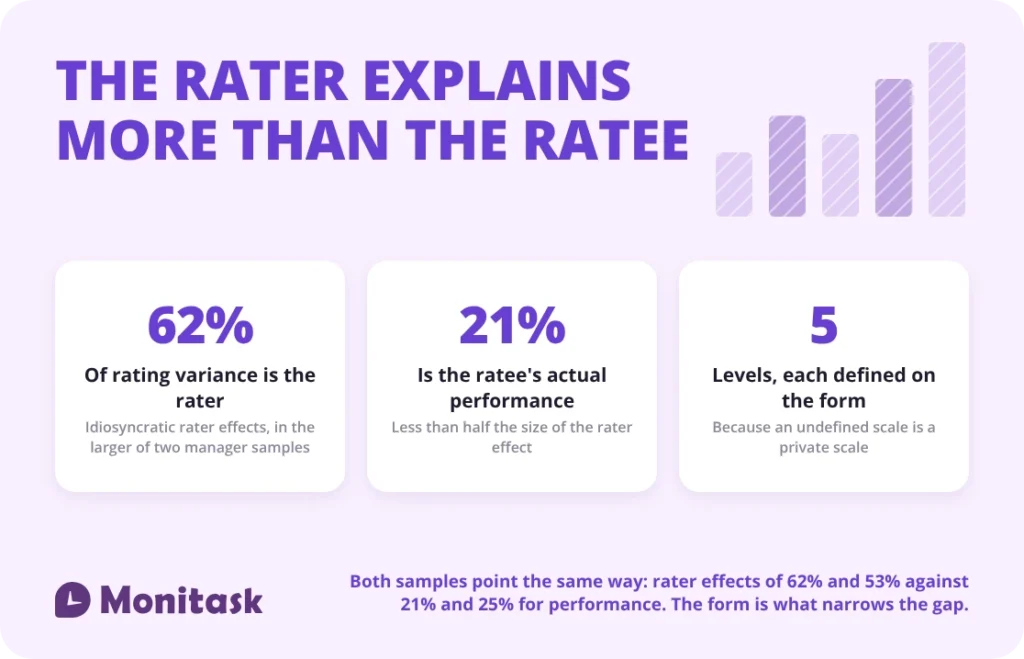
The form is on this page: header, period, a rating scale with every level defined, competencies, goals, development, employee comments, signatures. Most templates list those components without supplying them, and almost all leave the scale undefined — which is how “meets expectations” comes to mean whatever each manager thinks it means. That matters more than it sounds: in two large studies of manager ratings, who did the rating explained more than twice as much of the result as how the person actually performed.
What goes in a performance review form?
9 blocks. The order is deliberate: the period and the scale come before any rating, so the reviewer agrees to the rules before applying them.
| # | Block | Purpose |
|---|---|---|
| 1 | Header | Employee, role, manager, review date |
| 2 | Review period | Exact dates, so “the period” is not arguable |
| 3 | Scale definition | Each level stated in behavioral terms, on the form |
| 4 | Competencies | Rated separately, each with a required example |
| 5 | Goals from the last period | What was set, what happened, rated against the original wording |
| 6 | Goals for the next period | Each with a measure of done, an owner and a date |
| 7 | Development | What support is agreed, and by when |
| 8 | Employee comments | Written by the employee, not summarized by the manager |
| 9 | Signatures | Acknowledging the discussion, not agreeing with it |
The scale is block 3 for a reason. A reviewer who reads the definitions after forming a view will fit the definitions to the view. Our glossary entry on the performance review covers the ritual around the form; this page is about the document itself, and performance evaluation criteria covers how competencies get chosen.
The template: the form itself
Copy it, replace the bracketed fields, and keep the scale definitions on the form rather than in a manager handbook nobody opens. Every rating needs an example beside it, including the middle one.
PERFORMANCE REVIEW

Employee: [name]                 Role: [title]
Manager:  [name]                 Department: [department]
Review period: [start date] to [end date]
Review date:   [date]

-------------------------------------------------------------------
RATING SCALE - apply these definitions, not your own

5 - Consistently exceeded. Delivered the role in full and took on work beyond it. Others changed how they work because of their example. At least two specific instances can be named.
4 - Exceeded in part. Delivered the role in full, and exceeded it in a defined area. One or more specific instances can be named.
3 - Met the role. Delivered what the role requires, at the expected standard, through the period. This is the expected rating for someone performing the job as defined.
2 - Partially met. Delivered some requirements; one or more fell short of the standard, with a specific example and a date.
1 - Did not meet. Core requirements were not delivered, with specific examples and dates, and this has been raised before this review.

A rating of 3 is not a criticism. If most of your team is
rated 4 or 5, the scale is not being applied.

-------------------------------------------------------------------
COMPETENCIES - rate each separately. An example is required for every
rating, including 3: what happened, and when.

  Quality of work - accuracy, completeness, standard of output       [ ]
  Reliability - meets commitments and deadlines                      [ ]
  Problem solving - handles obstacles without escalating everything  [ ]
  Collaboration - how they work with colleagues and other teams      [ ]
  Communication - clarity, timeliness, keeping people informed       [ ]
  Role-specific - one competency defined for this role               [ ]

  Example for each rating above:
  [what happened, with a date]

-------------------------------------------------------------------
GOALS FROM THE LAST PERIOD - quote the goal as it was written, not as
remembered.

  Goal as set:  [text]
  Due:          [date]
  Outcome:      [what happened]
  Rating:       [ ]

-------------------------------------------------------------------
GOALS FOR THE NEXT PERIOD

  Goal:            [text]
  Measure of done: [how we will know]
  Owner:           [name]
  Due:             [date]

-------------------------------------------------------------------
DEVELOPMENT - what support is agreed, and by when
[training, coaching, exposure or resource, with a date and an owner]

-------------------------------------------------------------------
OVERALL RATING: [ ]
Must be consistent with the competency ratings above. If it differs,
explain why here: [________]

MANAGER SUMMARY (facts and examples)
[________]

EMPLOYEE COMMENTS (written by the employee)
[________]

-------------------------------------------------------------------
Manager signature:  [____]   Date: [____]
Employee signature: [____]   Date: [____]

The employee's signature acknowledges the discussion took place. It does
not indicate agreement with the ratings.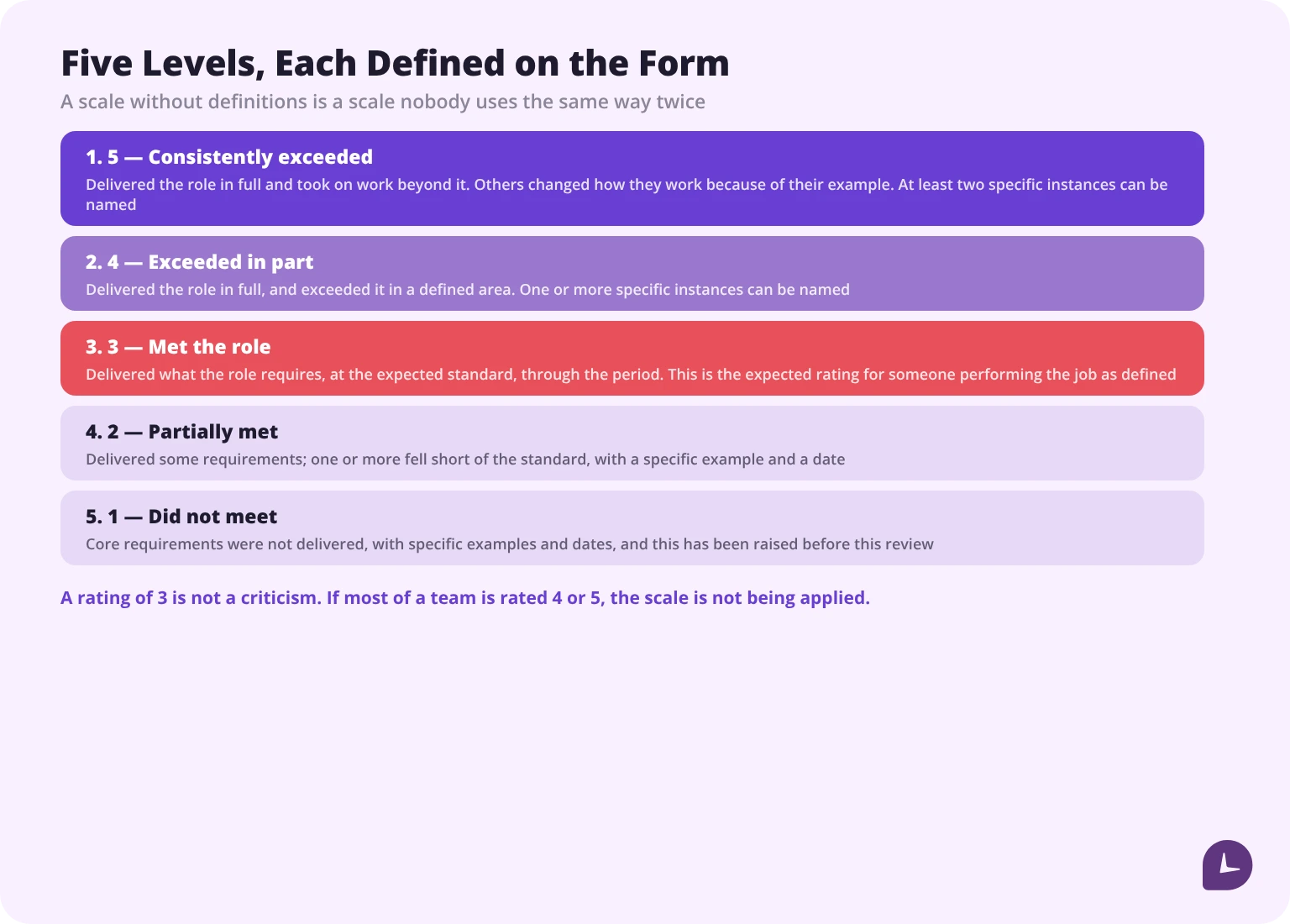
Quarterly short form. Keep the header, period, scale, three competencies, goals from and for the period, and both signature lines. Drop development and the manager summary; those belong in the annual.
Hourly or shift roles. Replace the goals blocks with attendance and punctuality against the policy, adherence to the schedule, and completion of assigned tasks per shift – each still requiring an example and a date. Keep the same scale.
The employee comments block is not decoration. It is also the one part of the form where the evidence says something specific. Across two meta-analyses twenty years apart, self-ratings and supervisor ratings correlate at about 0.34 and 0.35 – and Leniency in self-ratings is indicated by higher mean levels of self-ratings compared with supervisory ratings
– while peer and supervisor ratings agree with each other at about 0.62. Two meta-analyses twenty years apart put self-supervisor agreement at almost exactly the same place, and peer and supervisor ratings agree far more closely with each other than either does with the employee’s own. The self-rating is the outlier source, not one view among equals. Treat an employee self-evaluation as a source of examples you did not have, not as a second opinion of equal weight.
What rating scale should you use?
5 levels, each defined on the form, with the middle level stated as the expected outcome.
The number of levels matters less than three design choices:
| Choice | Do this | Because |
|---|---|---|
| Define each level | Behavioral description, on the form | Otherwise every manager applies a private scale |
| Normalize the middle | Say that 3 is the expected rating | Otherwise 3 reads as failure and everyone gets 4 |
| Require an example at every level | Including the middle | An unexplained rating cannot be defended or compared |
On the number itself, the research is less helpful than you would hope. The best-known study of response categories found that The most reliable scores were those from scales with between 7 and 10 response categories
, which is more than most appraisal forms use — but it tested service-quality ratings with mostly student respondents, and other work recommends four or five categories for exactly this kind of scale. There is no settled answer for performance appraisal specifically.
A four-level scale removes the middle and forces a direction, which some organizations prefer. It is worth knowing what that actually buys. Removing the midpoint does not remove the neutral responses; it redistributes them, and studies disagree about which way. One found omission shifted answers positive, another found it shifted them negative. All of this evidence is from survey research rather than performance appraisal, where no comparable test could be found. So removing the midpoint stops raters parking on it; it does not make the resulting ratings more accurate, and you should not expect it to cure central tendency.
Five with a defined middle is the version that survives contact with managers who do not enjoy difficult conversations.
What to avoid: percentage scores, which imply precision the exercise does not have. And forced distribution, which deserves more than a one-line dismissal, because the evidence does not support one.
Does forcing a distribution work?
It depends which outcome you are asking about, and the two best studies point in opposite directions.
A controlled experiment published in Management Science found that productivity is significantly higher under a forced distribution by about 6% to 12%
. That is a real effect and it is not the whole finding: the same paper reports that the productivity effects are less clear cut when participants have prior experience
with the system, and that a forced distribution becomes detrimental when workers have access to a simple option to sabotage each other
.
Field data from a multinational firm, published in the same journal, looked at what happens to the people the curve pushes down. Employees nominated for a top rating and then downgraded to fit the distribution were a different kind of casualty: downgraded employees are at least 34% more likely to voluntarily exit
. The paper’s conclusion is that the mechanisms producing demotivation are more powerful than the management strategies meant to combat them
— larger bonuses and reassurance did not hold them.
Lab gains, field costs. The productivity result is from a controlled experiment and weakens with repeat exposure; the exit result is observational field data from a real firm, where larger bonuses and reassurance did not offset it.
The practical reading for a form like this one: a forced distribution produces ratings that describe the quota rather than the person, and it costs you specific people you did not intend to lose. If what you actually want is for managers to stop rating everyone 4, the defined middle and the required example do that work without the quota.
Which rater effects does the form have to fight?
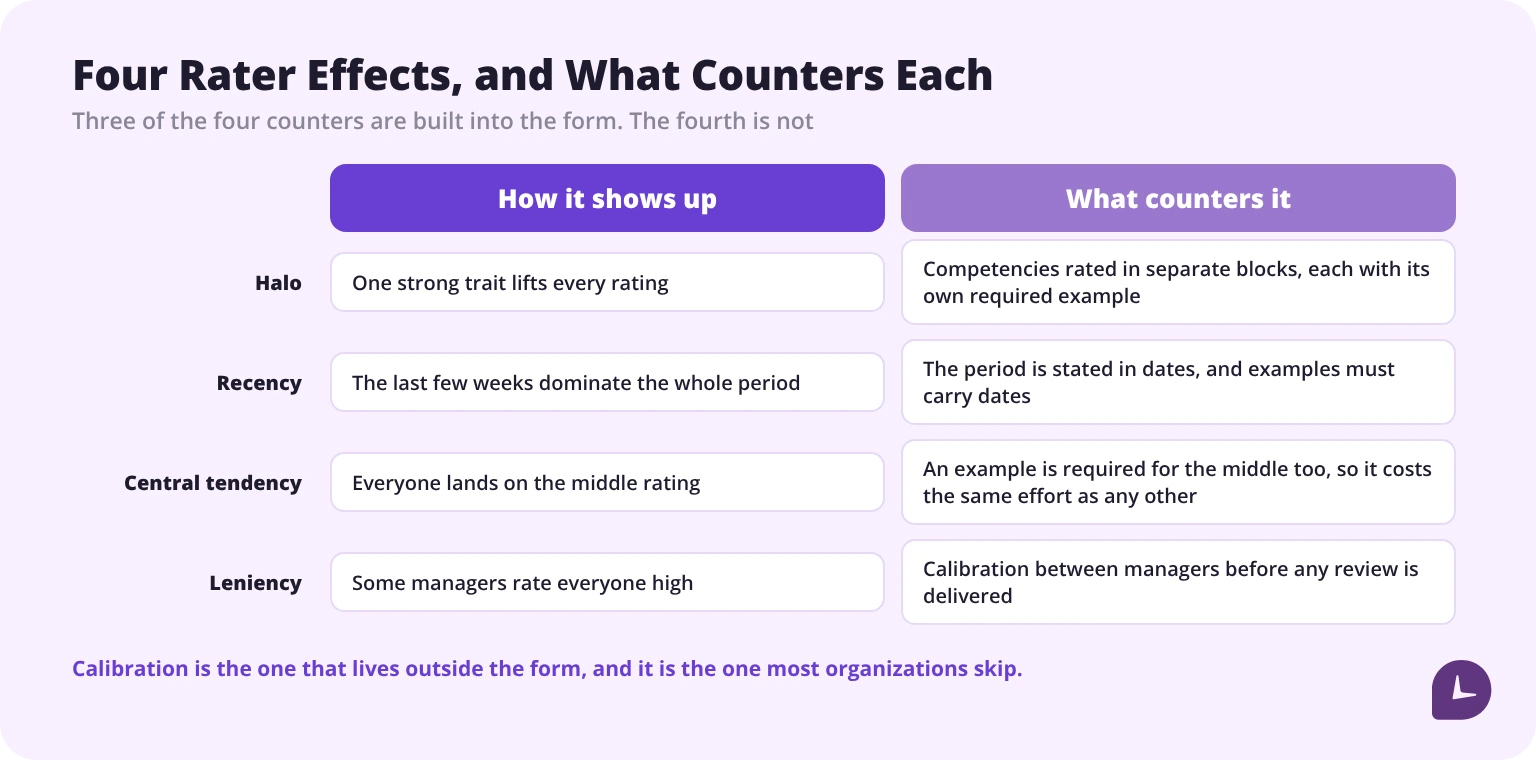
4, and each one has a counter built into the template above. This is the part of form design that actually determines whether the output means anything.
| Effect | How it shows up | What in the form counters it |
|---|---|---|
| Halo | One strong trait lifts every rating | Competencies rated in separate blocks, each with its own required example |
| Recency | The last few weeks dominate the whole period | The period is stated in dates, and examples must carry dates |
| Central tendency | Everyone lands on the middle rating | An example is required for the middle too, so it costs the same effort as any other |
| Leniency | Some managers rate everyone high | Calibration between managers before any review is delivered |
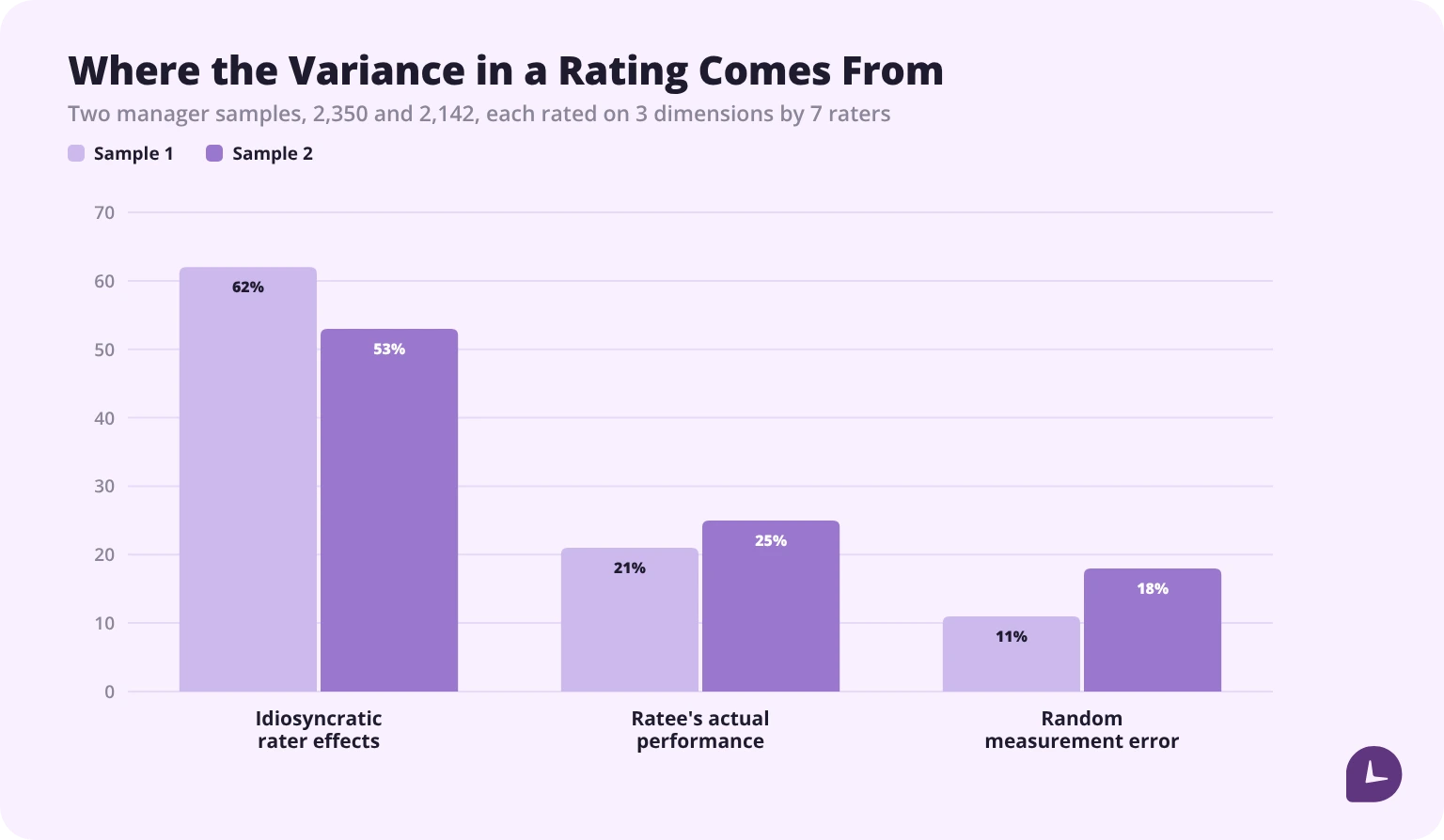
The size of the problem. Scullen, S. E., Mount, M. K., & Goff, M. (2000) measured where the variance in a performance rating actually goes, across two large samples of managers — 2,350 and 2,142 people, each rated on 3 dimensions by 7 raters. They found that idiosyncratic rater effects accounted for over half of the rating variance in both data sets
, and that the combined effects of the ratee’s general and dimensional performance were less than half the size of the idiosyncratic rater effects
.
| Source of variance | Sample 1 | Sample 2 |
|---|---|---|
| Idiosyncratic rater effects | 62% | 53% |
| Ratee performance, general and dimensional | 21% | 25% |
| Random measurement error | 11% | 18% |
Three things to hold alongside those numbers, because this finding is widely quoted and usually quoted badly. Two numbers, not one: 62% is the higher of two samples. The paper’s own summary says idiosyncratic rater effects accounted for over half of the variance in both. Quoting 62 alone is picking the better number. “Effects” is not “bias”: The paper’s term is idiosyncratic rater effects – a variance component specific to that rater and ratee. Whether all of it is error, or partly real information only that rater can see, is an open question in the literature and not something this paper settled. Later work found much smaller effects: A 2020 Journal of Applied Psychology paper using an unconfounded design put rater effects between roughly 17% and 4% across two samples, and noted that the 2000 estimates depend on the modelling approach used.
What survives all of that is the direction, not the decimal: who does the rating explains more of the result than how the person performed. Which is an argument for the form, not against the exercise.
How solid are the four effects themselves? Less uniformly than most templates imply:
| Effect | Standing in the literature | Why |
|---|---|---|
| Halo | Contested as an error | A 1993 critical analysis argued the standard conception is wrong and called for a moratorium on measuring it |
| Leniency | Well established as a construct | Defined in the literature of record, with the caveat that a high mean rating is not proof of it |
| Central tendency | Well established as a construct | Same caveat: clustering is not proof of error if the ratees really are similar |
| Recency | The thinnest of the four | The classic experimental test found no recency effect within a single session, and one across several days only where the weak performance came last |
Halo is defined in the literature of record as a rater’s failure to discriminate among conceptually distinct and potentially independent aspects of a ratee’s behavior
, and central tendency as the case where ratings are clustered about the midpoint of the rating scale
. But a 1993 critical analysis in the Journal of Applied Psychology concluded that all of the major elements of this conception of halo are either wrong or problematic
and recommended a moratorium on the use of halo indices as dependent measures
in applied research. And the same authors who supplied the definitions warn that a high mean rating is not proof of leniency, and clustering is not proof of central tendency, if the ratees really are good or really are similar.
None of which changes what the form should do. Separate blocks, dated examples and a required example for the middle rating are good design whether or not the underlying construct is cleanly measurable — they make a rating explain itself, which is the only test that matters when someone reads the file two years later.
The practical move most organizations skip is calibration: managers compare their draft ratings against each other before anything is shared with employees. It is the only one of the 4 counters that lives outside the form, and it is the one that catches leniency. Our guide to the performance appraisal process covers running the meeting, and reviews with remote employees covers doing it without a room.
How do written reviews turn into evidence?
Because a written review outlives the conversation, and it is the first document anyone looks at when a performance decision is challenged.
It is also a record you are required to keep. The Equal Employment Opportunity Commission’s rule is short: EEOC Regulations require that employers keep all personnel or employment records for one year
, running from the date of the record or the personnel action, whichever is later, under 29 C.F.R. § 1602.14. The duty attaches to any personnel or employment record made or kept by an employer
, which plainly covers an appraisal even though the Commission’s pages do not name appraisals specifically. On termination, his/her personnel records must be retained for one year from the date of termination
. And the clock changes entirely once a charge is filed: these records must be kept until the final disposition of the charge or any lawsuit based on the charge
, with final disposition where no suit follows a right-to-sue notice being the date of expiration of the 90-day statutory period
.
The Commission also publishes guidance on the appraisals themselves, and it is worth reading as practice rather than as law. It asks employers to Ensure that employees are not held to higher standards or given negative evaluations because of
a protected characteristic, to Apply the performance standards consistently when conducting performance evaluations
, and notes that Including factual details in evaluations may help employees understand the basis for evaluation decisions
and help ensure managers apply the standards consistently. The EEOC’s small-business page on performance evaluations describes practices that help prevent discrimination. It does not state legal requirements for how an appraisal is written.
The pattern that causes trouble is not harshness. It is inflation followed by a sudden change:
| Record | What it supports later |
|---|---|
| Three years of 4s, then termination for poor performance | A question about what changed, with the file arguing against the employer |
| Ratings of 3 with specific examples, then documented shortfalls, then termination | A consistent record |
| Vague positive comments and no examples | Nothing either way — the file is empty |
| A rating of 1 that was never raised before the review | A question about why the employee was not told |
Three habits that keep the record usable:
- Rate what happened, not what you hope. A 3 recorded honestly is more useful in two years than a kind 4.
- Raise problems before the review, in writing. A review should confirm what the employee already knows, not introduce it — which is what an employee write-up form and a documented progressive discipline path are for.
- Keep the overall rating consistent with the parts. An overall 4 sitting on top of two 2s needs the explanation line filled in.
Whether your records support a particular decision is a question for your own counsel against your own facts.
What should never go in a written review?
7 items. Each either creates exposure or records something the company cannot support.
| Do not write | Why |
|---|---|
| Health, disability, or medical leave | Protected and irrelevant to performance |
| Age, family status, pregnancy, religion, national origin | Protected characteristics |
| Anything about a complaint, investigation or protected leave | Raises retaliation exposure whatever the outcome |
| Personality characterizations — “negative attitude”, “not a culture fit” | Unverifiable, and the hardest thing to defend |
| Comparisons to named colleagues | Invites a claim from the colleague |
| Promises — a raise, a promotion, a title change | Becomes something to point at |
| “Permanent”, “secure”, “as long as performance continues” | Cuts against at-will |
Replace characterizations with behavior: not “poor attitude” but “interrupted colleagues in three team meetings, with the dates, and after being asked to stop, it continued”. The second version is checkable; the first is an opinion with a date on it.
How often should reviews happen?
Annually for the full form, quarterly for the short form, and continuously for the thing that actually matters — telling people where they stand before the review.
| Cadence | What it is for |
|---|---|
| Continuous | Telling people where they stand, before any review |
| Quarterly | The short form: scale, three competencies, goals |
| Annually | The full form, including development and the summary |
The annual review is a summary, not a surprise. If the first time an employee hears about a problem is in the form, the form has already failed, whatever it says. Where the cadence and the rules live is a performance review policy, which is a different document from this one.
What the form cannot fix
It cannot make a manager observe. Every required example assumes somebody was paying attention during the period. A form cannot manufacture evidence that was never collected.
It cannot calibrate itself. Three of the 4 counters are in the document. Leniency is not, and no amount of form design substitutes for managers comparing drafts before anything is delivered.
It cannot settle whether the ratings mean anything. The variance research above is sobering and it is also not a reason to stop. The form narrows the gap between what a rating records and what the rater happened to feel; it does not close it, and anyone presenting a rating as a measurement is overstating what it is.
Output and activity data for the review period, so the required example is something you can look up rather than something you have to remember.
See Monitask's productivity reporting
This article supplies a performance review form and summarizes research on rater effects and recordkeeping obligations. It is not legal advice, and it does not tell you whether your records support any particular employment decision — that depends on your facts and your jurisdiction. The research described here is reported with its own limits; where a finding is contested, the article says so.
Sources
- Scullen, S. E., Mount, M. K., & Goff, M. (2000). Understanding the latent structure of job performance ratings. Journal of Applied Psychology, 85(6), 956-970. doi:10.1037/0021-9010.85.6.956. The variance figures and both quoted phrases are the paper’s own, read in the published abstract. Verified 12 November 2026.
- Jackson, D. J. R., Michaelides, G., Dewberry, C., Schwencke, B., & Toms, S. (2020). The implications of unconfounding multisource performance ratings. Journal of Applied Psychology, 105(3), 312-329. doi:10.1037/apl0000434. Cited for the later, smaller estimates of rater effects and for the note that the 2000 figures depend on the modelling approach. Verified 12 November 2026.
- Saal, F. E., Downey, R. G., & Lahey, M. A. (1980). Rating the ratings: Assessing the psychometric quality of rating data. Psychological Bulletin, 88(2), 413-428. doi:10.1037/0033-2909.88.2.413. The definitions of halo, leniency and central tendency, and the warning that the rater-error framing is loaded. Verified 12 November 2026.
- Murphy, K. R., Jako, R. A., & Anhalt, R. L. (1993). Nature and consequences of halo error: A critical analysis. Journal of Applied Psychology, 78(2), 218-225. doi:10.1037/0021-9010.78.2.218. The critique of halo as an error construct. Verified 12 November 2026.
- Steiner, D. D., & Rain, J. S. (1989). Immediate and delayed primacy and recency effects in performance evaluation. Journal of Applied Psychology, 74(1), 136-142. doi:10.1037/0021-9010.74.1.136. Cited for the standing of recency in appraisal specifically. Verified 12 November 2026.
- Berger, J., Harbring, C., & Sliwka, D. (2013). Performance appraisals and the impact of forced distribution – an experimental investigation. Management Science, 59(1), 54-68. doi:10.1287/mnsc.1120.1624 and Bond, B. M. (2026). Cut to the curve: underrecognition and talent loss from forced ranking in a multinational firm. Management Science, 72(4), 3487-3507. doi:10.1287/mnsc.2023.01204. The two forced-distribution findings, quoted from the publisher’s own abstracts. Verified 12 November 2026.
- Heidemeier, H., & Moser, K. (2009). Self-other agreement in job performance ratings: a meta-analytic test of a process model. Journal of Applied Psychology, 94(2), 353-370. doi:10.1037/0021-9010.94.2.353 and Harris, M. M., & Schaubroeck, J. (1988). A meta-analysis of self-supervisor, self-peer, and peer-supervisor ratings. Personnel Psychology, 41(1), 43-62. Self-supervisor and peer-supervisor agreement. Verified 12 November 2026.
- Preston, C. C., & Colman, A. M. (2000). Optimal number of response categories in rating scales. Acta Psychologica, 104, 1-15. Cited for the response-category finding and for its own limits. Verified 12 November 2026.
- U.S. Equal Employment Opportunity Commission, Recordkeeping Requirements and I’m Conducting Performance Evaluations, with the one-year rule at 29 C.F.R. § 1602.14. All quotations read at source on eeoc.gov. Verified 12 November 2026.
- What could not be read in full:
- The full text of Scullen, Mount and Goff. The abstract was read and the figures are the paper’s own. APA PsycNet and the DOI resolver both refuse automated access, so the citation was confirmed on the publisher’s own deposited metadata and the figures corroborated against a later peer-reviewed paper that tabulates them.
- Steiner and Rain (1989). Reached only through a peer-reviewed 2021 article describing its findings. The citation is confirmed on publisher-deposited metadata.
- Scullen, Bergey and Aiman-Smith (2005). The forced-distribution simulation most often cited for the opposite conclusion could not be reached at all. No figure from it is used, and any number sourced from the press coverage of it should be treated as unverified.
FAQ
What rating scale is best for performance reviews?
5 levels with each one defined behaviorally on the form, and the middle level stated as the expected outcome. The number of levels matters less than defining them: the research on response categories does not settle an optimal number for appraisal, and an undefined five-point scale is worse than a defined three-point one.
Does removing the middle rating stop everyone being rated "average"?
It stops them parking there. It does not appear to make the ratings more accurate. The survey research finds that omitting a midpoint redistributes those responses to adjacent points rather than eliminating them, and studies disagree about which direction they move. A defined middle plus a required example achieves the same thing without the distortion.
Should we use forced ranking?
The evidence is mixed rather than simply negative. A controlled experiment found productivity productivity is significantly higher under a forced distribution by about 6% to 12%
, with the effect weakening on repeat exposure and reversing where sabotage was possible. Field data from a real firm found that downgraded employees are at least 34% more likely to voluntarily exit
. If the goal is to stop rating inflation, a defined middle and a required example do it without the quota.
How long do you have to keep performance reviews?
EEOC Regulations require that employers keep all personnel or employment records for one year
under 29 C.F.R. § 1602.14, measured from the record or the personnel action, whichever is later, and one year from the date of termination for a departing employee. Once an EEOC charge is filed, the records relating to it must be kept these records must be kept until the final disposition of the charge or any lawsuit based on the charge
.
How much of a performance rating is actually about the employee?
Less than people assume. In two large manager samples, idiosyncratic rater effects accounted for over half of the rating variance in both data sets
— 62% and 53% — while the ratee’s own general and dimensional performance accounted for 21% and 25%. Read that as an argument for defining the scale and requiring examples, not as a reason to abandon ratings.