The Pitman schedule covers a 24/7 operation with four teams on 12-hour shifts, running a two on, two off, three on pattern across a 14-day cycle. Every team gets every other weekend off and never works more than three days in a row.
It is popular for good reasons. It is also the schedule most likely to produce an overtime bill nobody budgeted, because 84 hours per fortnight means alternating 36-hour and 48-hour weeks, and the second one is over the federal threshold.
Depending on who you are, that comes to 209 overtime hours a year per employee, or none at all. The difference is not the schedule. It is which overtime regime you are entitled to use.
How the pattern works
Four teams, two 12-hour shifts, one 14-day cycle.
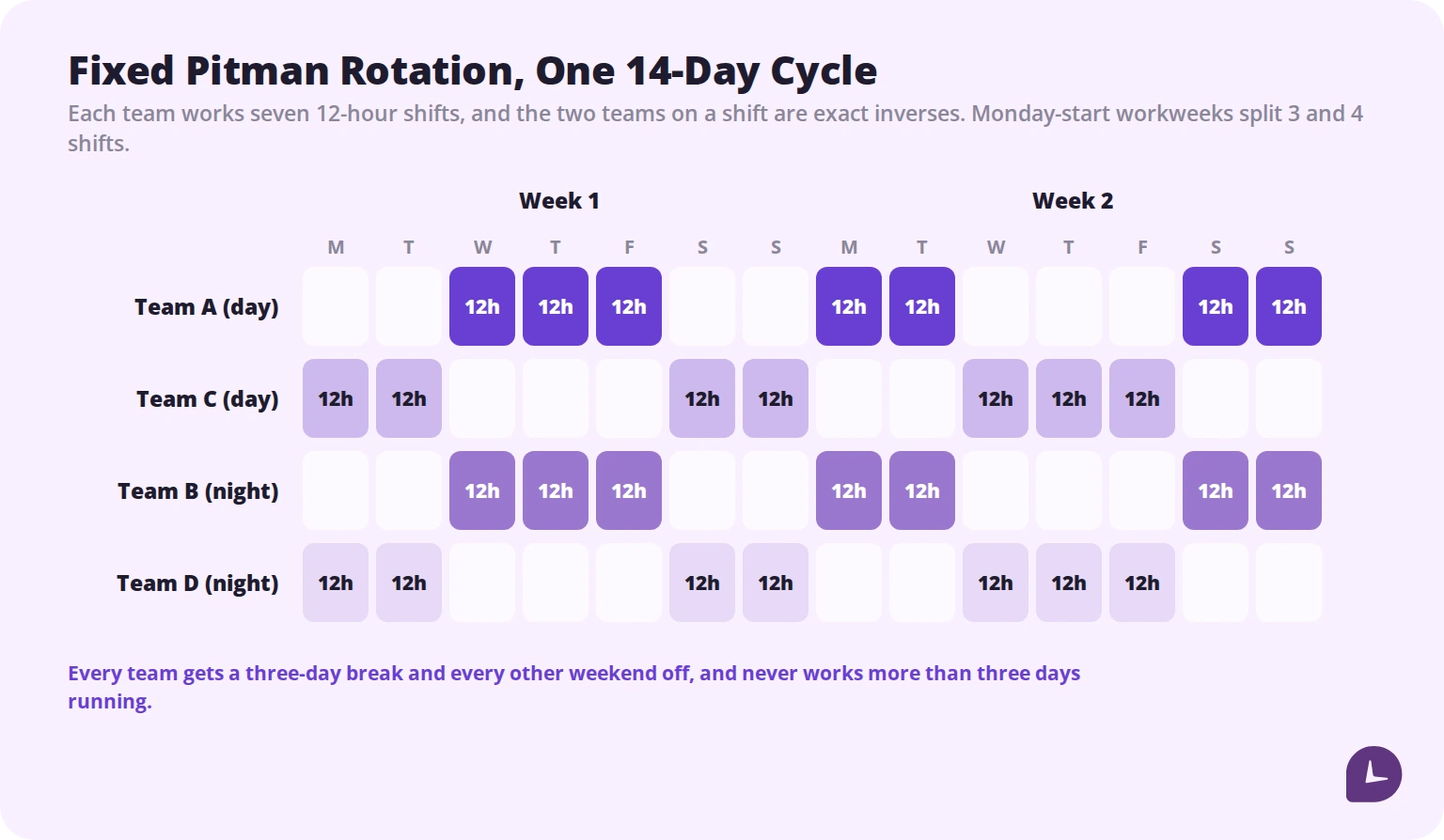
Written out, one team’s fortnight runs: two days on, two off, three on, two off, two on, three off. The second team on that shift runs the exact inverse, so between them the shift is always covered. The night teams mirror the same arrangement.
Three properties follow directly from the pattern, and they explain its popularity:
- Nobody works more than three consecutive days.
- Every team gets a three-day break in each fortnight.
- Every team has every other weekend fully off, which is unusual in continuous operations.
Fixed and rotating versions
Fixed Pitman. Two teams permanently on days, two permanently on nights. Circadian rhythms stabilise because nobody switches, and the schedule is trivially predictable. The obvious problem is fairness: the night teams carry the night burden indefinitely, which usually has to be reflected in pay.
Rotating Pitman. Teams alternate between days and nights, typically every two or four weeks, with the changeover placed at a three-day break so there is recovery time built in. Fairer, and harder on sleep. Rotation across a 28-day cycle is the common arrangement.
There is no correct answer. Fixed is better for health if you can staff it and pay for it; rotating is better for equity and usually easier to recruit into.
Pitman, Panama and 2-3-2: sorting out the names
The naming is genuinely inconsistent across published sources, and it is worth being precise because the terms get used in job ads and union agreements.
Pitman and Panama are, in most usage, the same schedule: the 2-2-3 rotation on 12-hour shifts with four teams. Most workforce management sources treat the terms as interchangeable.
2-3-2 is the same fortnight described from a different starting point. Two on, two off, three on, two off, two on, three off is a continuous loop. Start reading it at a different day and you get 2-3-2. Several sources present these as distinct schedules; they are the same cycle with a different entry point.
At least one source distinguishes Panama as the 2-2-3 and Pitman as a separate 2-3-2 pattern. That distinction is not widely followed, and if you encounter the terms in a contract the safest approach is to ignore the label and read the actual 14-day grid.
Genuinely different neighbours worth not confusing it with:
| Schedule | Pattern | Annual hours |
|---|---|---|
| Pitman / Panama | 2-2-3, 12-hour shifts | 2,190 |
| DuPont | 4-week rotation with a 7-day break | About 2,190 |
| 4 on 4 off | Four on, four off, 12-hour shifts | About 2,190 |
| 24/48 (firefighter) | 24 hours on, 48 off | About 2,920 |
The hours
The arithmetic is fixed by the pattern.
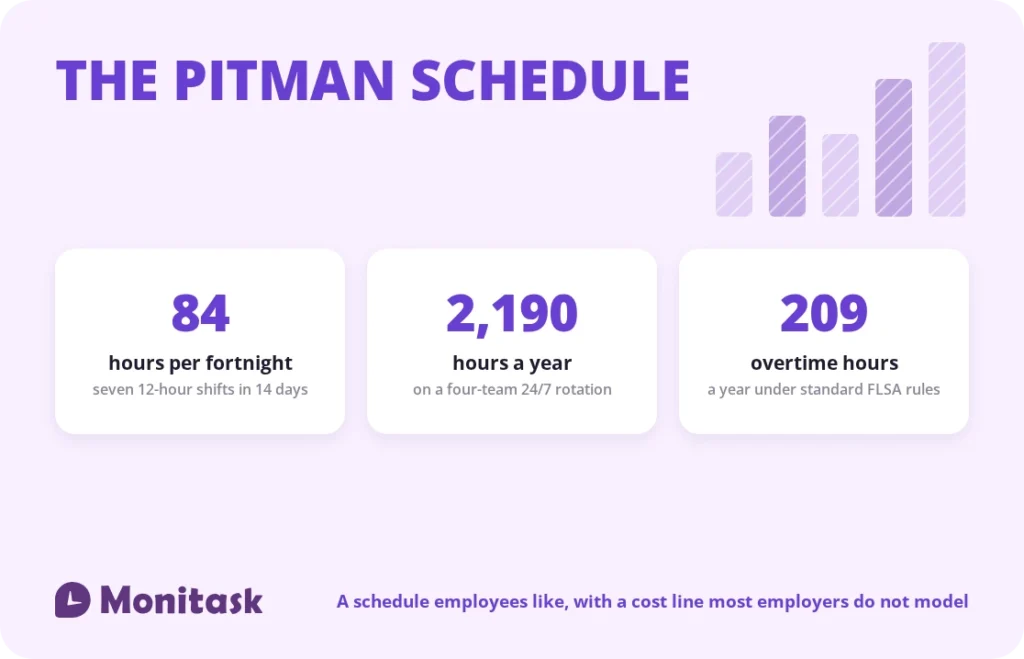
- 7 shifts per 14 days × 12 hours = 84 hours per fortnight
- 42 hours per week on average
- 26.07 cycles a year × 84 = 2,190 hours a year
- 182.5 shifts a year
Against a standard 40-hour week’s 2,080 hours, Pitman runs about 110 hours a year longer. That is not a rounding difference. It is nearly three additional 40-hour weeks per employee, and it needs to be in the labour budget from the start.
The overtime problem
Here is what almost no guide to this schedule mentions.
The 84 hours are not distributed evenly. One week has three shifts, the next has four:
- Week A: 3 shifts = 36 hours. Under the threshold, no overtime.
- Week B: 4 shifts = 48 hours. Eight hours of overtime.
The FLSA assesses overtime within a fixed seven-day workweek, and averaging across two weeks is not permitted. A 36-hour week does not offset a 48-hour week.
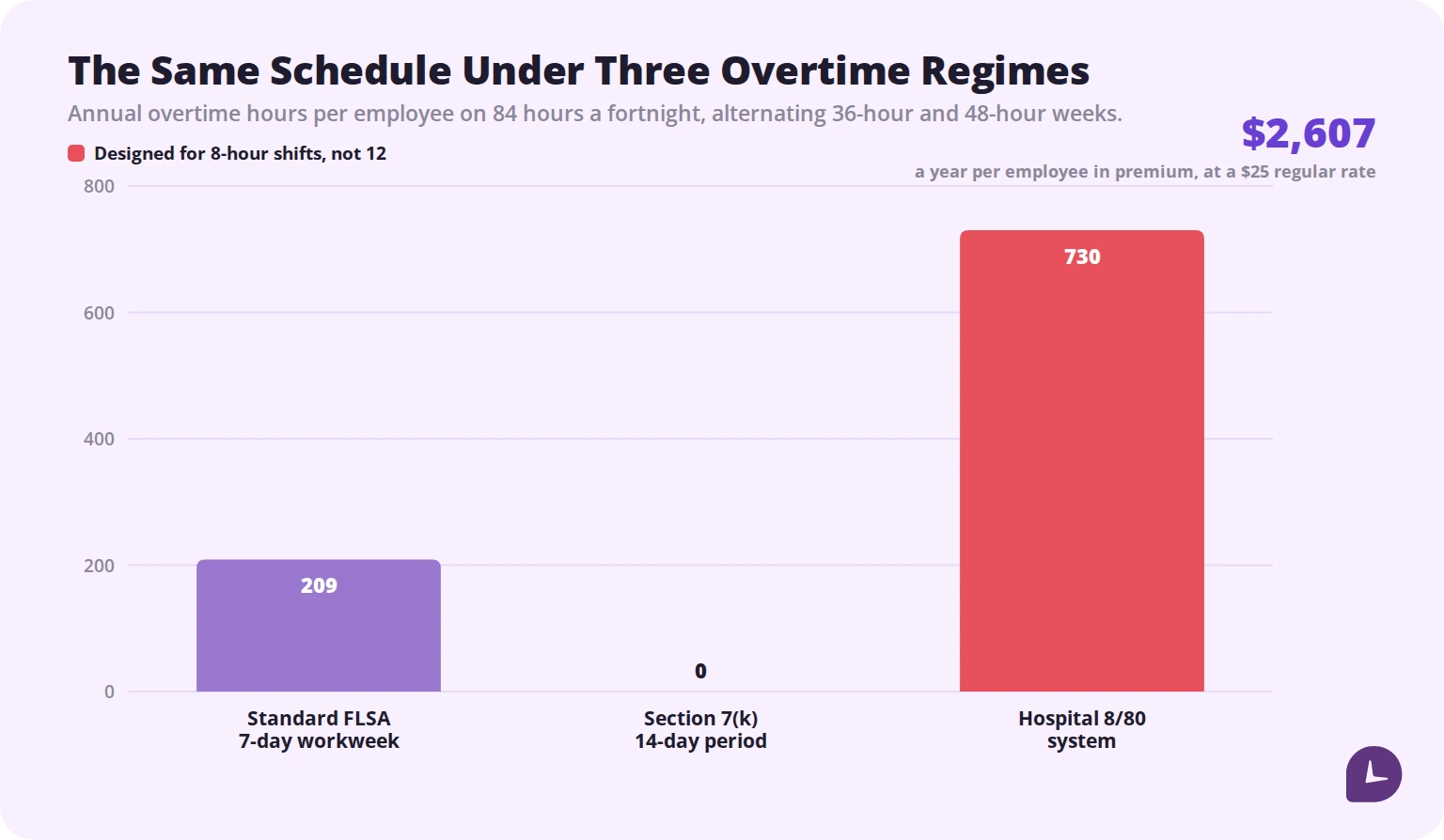
So under standard FLSA rules, a Pitman employee earns 8 overtime hours every fortnight, which is 209 overtime hours a year.
At a $25 regular rate, the half-time premium on those hours costs about $2,607 per employee per year. Across a four-team operation of 24 people that is over $62,000 annually, and it is entirely predictable from the schedule design.
This is not a reason to avoid Pitman. It is a reason to price it correctly before adopting it, and to check whether one of the two exemptions below applies to you.
Section 7(k): why police and fire escape it
Section 7(k) of the FLSA lets public agencies compute overtime for employees engaged in law enforcement or fire protection on a work-period basis rather than a weekly one. The work period can run from 7 to 28 consecutive days.
The thresholds over a 28-day period are 171 hours for law enforcement and 212 hours for fire protection, applied proportionally for shorter periods. For a 14-day work period that is 86 hours for police and 106 for fire.
Now compare that against Pitman: 84 hours per 14 days.
Under a 14-day 7(k) work period, a Pitman schedule generates no overtime at all for covered law enforcement staff, sitting two hours under the threshold. For fire protection the margin is 22 hours.
This is almost certainly why the schedule is so entrenched in policing. It delivers every other weekend off and full 24/7 coverage while landing just inside the statutory threshold.
Three limits worth knowing. The exemption is available only to public agencies, so a private security firm running the identical schedule does not get it. It applies to sworn officers and fire service members with firefighting authority; it generally does not cover EMS staff unless they are cross-trained and legally authorised in one of those roles. And Section 13(b)(20) provides a complete overtime exemption for agencies employing fewer than five people in those activities.
Why hospitals should not use 8/80 with Pitman
Hospitals and residential care establishments may, by agreement with employees, use the 8 and 80 system: a 14-day work period with overtime owed for hours beyond 8 in a day or 80 in the period.
That option is designed for 8-hour shifts and it is actively harmful with 12-hour ones.
Under 8/80, every 12-hour shift generates 4 hours of daily overtime, regardless of the fortnightly total. Seven shifts produce 28 overtime hours per fortnight, or roughly 730 hours a year per employee.
Against 209 hours under the standard weekly rule, 8/80 is more than three times worse for this schedule. A hospital running 12-hour shifts under an 8/80 agreement is paying a large premium for an election it made voluntarily.
The rule of thumb: 8/80 suits 8-hour shifts, the standard 40-hour week suits 12-hour shifts, and neither is a substitute for checking the arrangement against your own roster.
Pros and cons
In favour
- Every other weekend off, in full, which most 24/7 patterns cannot offer
- Never more than three consecutive working days
- A three-day break in every fortnight
- Predictable years in advance, which matters for childcare and second jobs
- Only 182 working days a year, so fewer commutes and fewer handovers
Against
- 12-hour shifts, with fatigue rising sharply in the final hours
- 2,190 annual hours, about 110 more than a standard year
- Overtime exposure unless 7(k) applies
- Night shifts are a permanent burden on fixed teams and a rotating burden otherwise
- Four full teams needed, so it does not scale down to small operations
- A single absence is harder to cover, because there is no adjacent shift to extend
Who it suits
Pitman works where coverage must be continuous, shifts are 12 hours, and there are enough people to build four teams. Common in police departments, hospitals and clinical units, manufacturing with continuous processes, utilities, dispatch and emergency communications, and correctional facilities.
It suits you poorly if the work is cognitively demanding in the twelfth hour, if demand is uneven rather than constant, or if you cannot staff four teams with enough depth to absorb leave and sickness. Most operations need more than the theoretical minimum of two people per team for exactly that reason.
Boost your business productivity
Track performance and streamline teamwork
Implementing it
Model the overtime before you commit. Establish which regime applies to you, then multiply. This is a five-minute calculation that changes the business case.
Decide fixed or rotating deliberately, and if fixed, decide what the night differential is before you announce anything.
Place the rotation changeover at a three-day break so there is recovery between opposite shifts.
Check your state’s rules. California applies daily overtime above 8 hours and double time above 12 regardless of the weekly total, which changes the calculation completely for a 12-hour shift.
Check the notice requirement. Oregon and ten US cities require schedules to be posted 14 days ahead with premium pay for later changes. A fixed rotation makes this easy to satisfy; ad hoc changes to it do not.
Build in absence cover explicitly. The pattern has no slack, so cover has to come from a relief position or from overtime, and overtime is the expensive answer.
Consult employees before deciding. Twelve-hour shifts and every other weekend off is a trade, and whether it is a good one depends on the workforce you have.
Common mistakes
Budgeting 2,080 annual hours. It is 2,190.
Averaging the two weeks for overtime. Not permitted. Each fixed workweek stands alone.
Assuming 7(k) applies. It is limited to public agencies and to sworn law enforcement and fire protection roles.
Electing 8/80 with 12-hour shifts. It triples the overtime exposure.
Staffing four teams with the bare minimum. One person on leave and the pattern collapses into overtime.
Ignoring state daily overtime rules. In California a 12-hour shift generates a premium on its own.
Treating the naming as meaningful. Read the grid, not the label.
How Monitask helps
A rotating 12-hour pattern is exactly where scheduled hours and worked hours diverge, and where the overtime consequences of that divergence are largest.
Monitask records hours as they happen. Employees clock in when they start and clock out when they stop, so nothing runs in the background without their knowledge.

- Hours by workweek align with the fixed seven-day period the FLSA uses, so the alternating 36 and 48 hour weeks are visible rather than averaged.
- Clock-in records show shift overruns, which on a 12-hour pattern are the difference between 48 hours and 51.
- Attendance across the rotation shows where cover is repeatedly bought with overtime, which is usually a staffing problem in disguise.
- Retained history supports the record-keeping periods that apply to time and payroll records.
See how it works: Monitask employee time clock software.
Sources
- US Department of Labor, Fact Sheet #8: Law Enforcement and Fire Protection Employees Under the FLSA — Section 7(k) work periods of 7 to 28 days, the 171 and 212 hour thresholds, and the Section 13(b)(20) small-agency exemption.
- 29 CFR Part 553 — regulations governing the 7(k) partial exemption and its proportional thresholds for work periods shorter than 28 days.
- US Department of Labor, Fact Sheet #23: Overtime Pay Requirements of the FLSA — the fixed seven-day workweek and the prohibition on averaging across weeks.
- Hours, cycle and overtime figures calculated from the 14-day pattern at 12 hours per shift.
Related reading
- Maximizing Productivity With the 2-2-3 Schedule
- The DuPont Schedule: What It Is and How to Implement It
- Overtime Calculator
- Daily Schedule Template
- Choosing the Best Employee Scheduling Software
- How Many Hours in a Month?
FAQ
Is the Pitman schedule the same as 2-2-3?
Yes. Pitman, Panama and 2-2-3 describe the same rotation in most usage, and 2-3-2 is the same fortnight read from a different starting day.
How many hours a week is the Pitman schedule?
It alternates between 36 and 48 hours, averaging 42 hours a week and 84 hours per 14-day cycle.
How many hours a year is the Pitman schedule?
About 2,190 hours across 182.5 shifts, roughly 110 hours more than a standard 2,080-hour year.
Does the Pitman schedule create overtime?
Under standard FLSA rules, yes: eight hours every other week, around 209 hours a year. Public agencies using a Section 7(k) work period for police or fire staff generally owe none.
Why does 7(k) remove the overtime?
A 14-day 7(k) work period sets the threshold at 86 hours for law enforcement. A Pitman fortnight is 84 hours, which falls two hours short of it.
Can hospitals use the 8/80 system with a Pitman schedule?
They can, but it is expensive. Under 8/80 every 12-hour shift generates four hours of daily overtime, around 730 hours a year, against 209 under the standard weekly rule.
What is the difference between the Pitman and DuPont schedules?
Both cover 24/7 on 12-hour shifts with similar annual hours. DuPont runs a four-week rotation containing a full seven-day break; Pitman runs a two-week cycle with a three-day break each fortnight.
How many employees do you need for a Pitman schedule?
Four full teams. The theoretical minimum is two people per team, but most operations need more to absorb leave and sickness without falling back on overtime.
Is the Pitman schedule good for employees?
The trade is 12-hour shifts against every other weekend off, never more than three consecutive working days, and only 182 working days a year. Whether that is a good trade depends on the workforce.