A Sisyphean task is work whose output is destroyed or ignored before it can matter. The name comes from the Greek myth of a man condemned to roll a boulder uphill for eternity, watching it roll back down each time. The distinction that matters at work is one most articles on this skip: repetitive is not the same as futile. Backups, cleaning and support tickets recur forever and are not Sisyphean. A report nobody reads is Sisyphean the first time you write it.
Key takeaways
- The test is not whether work repeats. It is whether the output is used.
- Work that is ignored demotivates almost as much as work that is actively destroyed.
- Managers consistently underestimate how much output futile work costs — in one experiment, by a factor of about four.
- Five patterns cover most cases: meetings without decisions, documents in permanent revision, unread reports, approval steps that approve nothing, and manual work a machine should do.
- Each has a specific fix. Generic advice about continuous improvement does not touch any of them.
Repetitive Is Not the Same as Futile
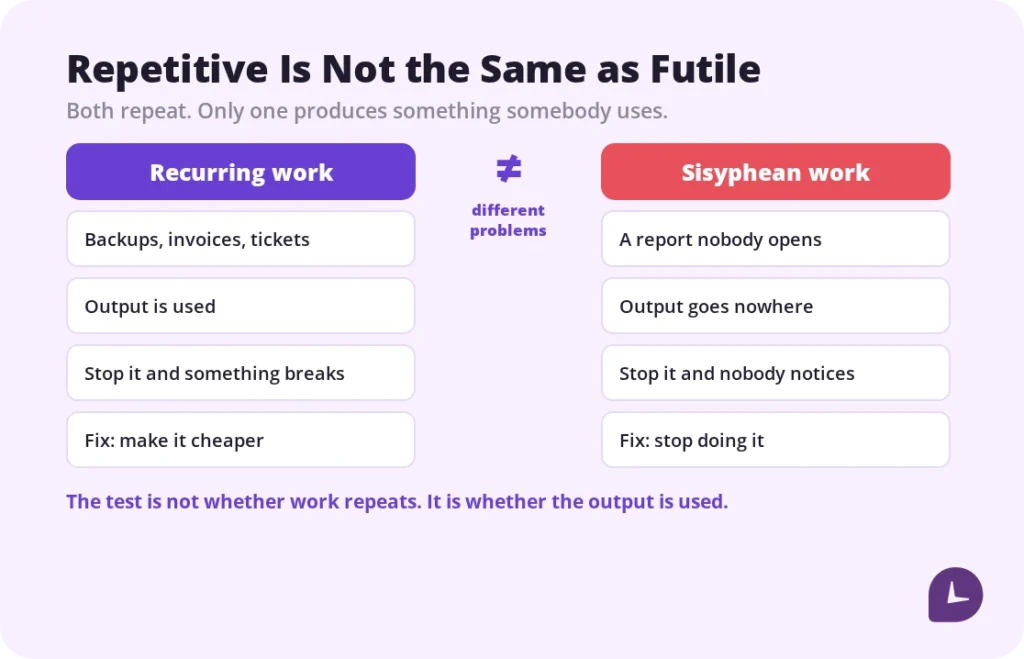
This distinction is worth establishing before anything else, because getting it wrong leads managers to eliminate work they need.
| Recurring work | Sisyphean work | |
|---|---|---|
| Repeats | Yes | Yes |
| Output is used | Yes | No |
| Example | Weekly backups, invoice processing, support tickets | A report nobody opens, a document revised forever, a meeting that decides nothing |
| Correct response | Make it cheaper: automate, batch, streamline | Stop doing it, or fix what makes the output useless |
| What happens if you stop | Something breaks | Nobody notices |
That last row is the diagnostic. If you quietly stopped producing it for a month, would anyone ask? For genuinely Sisyphean work, the answer is no — and that is worth testing rather than debating.
Boost your business productivity
Track performance and streamline teamwork
What Futile Work Actually Costs
The intuition that meaningless work demoralises people is not controversial. The size of the effect is more surprising than most managers expect.
In a well-known experiment, participants were paid a declining amount for each Lego model they assembled and could stop whenever they liked. One group had their completed models set aside. The other group watched each model being taken apart in front of them to supply parts for the next one. The second group built roughly four fewer before quitting — despite identical earning potential.
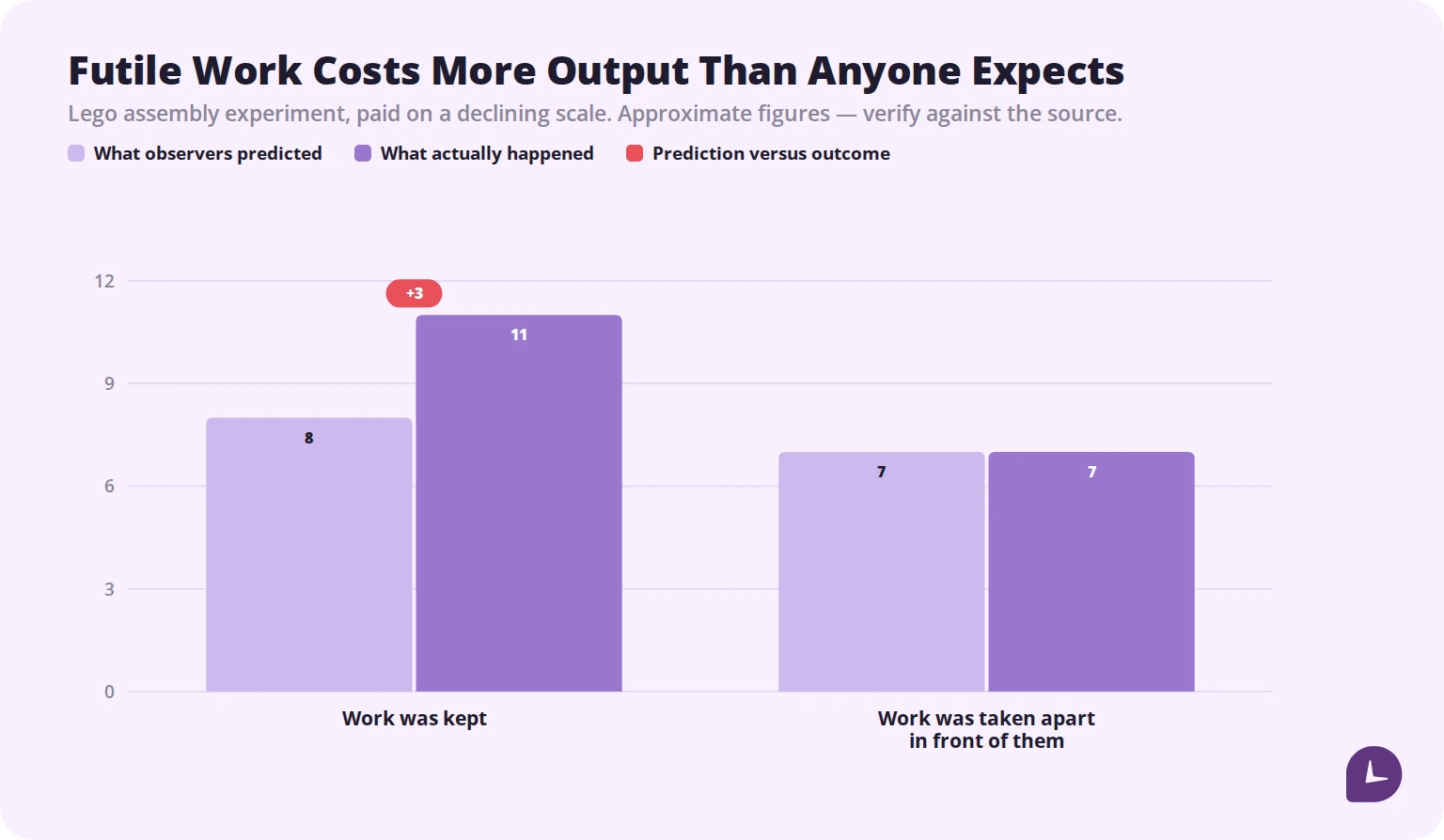
Two findings from that work matter more than the headline number.
People underestimate the effect. Asked to predict the gap, observers guessed about one model. The actual difference was around four. Managers generally accept that meaning matters; they price it far too cheaply.
Futility severs the link between caring and producing. In the condition where work was kept, how much someone enjoyed the task predicted how long they persisted. In the futile condition, that relationship disappeared entirely. Enthusiasm stopped predicting output — which is a precise description of what a demoralised team looks like from the outside.
A follow-up finding is the one most applicable to office work: output from people whose work was simply ignored was nearly as low as from those whose work was destroyed. You do not have to visibly undo someone’s work to produce the Sisyphean effect. Not reading it is close enough.
The Five Common Patterns, and What Actually Fixes Each
Generic advice — clarify goals, streamline processes, empower employees — is true and does not tell anyone what to do on Monday. These are specific.
| Pattern | What makes it futile | The specific fix |
|---|---|---|
| Meetings that decide nothing | Discussion without a decision owner or a decision to make | Require a named decision and a named decider in the invite. No decision, no meeting |
| Documents in permanent revision | No definition of done and no final approver | Name one approver and a version that ships. Circulate for comment once, not repeatedly |
| Reports nobody reads | Reporting requirement outlived the decision it supported | Stop sending it for one cycle. If nobody asks, stop permanently |
| Approval steps that approve nothing | An approver who has never rejected anything | Audit rejection rates. An approval that is never withheld is a delay, not a control |
| Manual work a machine should do | The task was automatable years ago and nobody owned the change | Count the hours first, then price the automation against them |
Get more out of your business.
Start Your 10-Day Trial
The stop-doing test
The most useful of these is the third, and it generalises. For any recurring output nobody has explicitly asked for recently, stop producing it for one cycle and see who notices. This is faster and more honest than a process audit, and it costs one cycle.
Two cautions. Tell your manager first — this is a diagnostic, not an act of quiet rebellion. And do not apply it to anything with a compliance or safety function, where the absence of complaints is exactly what success looks like.
What It Costs the Organisation
Four consequences, in the order they usually appear.
- Time misallocated. The hours spent on futile work are hours not spent on work that changes something. This is the visible cost and the smallest one.
- Effort stops correlating with results. As the experiment above showed, once work is futile, how much someone cares stops predicting how much they produce. Your most engaged people become indistinguishable from your least engaged ones.
- Learned helplessness. People who repeatedly experience that their effort changes nothing stop initiating, including on work that would have mattered. This spreads beyond the futile task, and it compounds with ordinary overload.
- Turnover of the wrong people. The people most bothered by pointless work are usually the ones with the most options. They leave first.
How to Find Them
Sisyphean work is rarely created deliberately. It accumulates: a report requested for a decision made three years ago, an approval added after one incident, a meeting that outlived its purpose. Nobody decided to keep any of it.
Three ways to surface it, in ascending order of effort.
Ask directly. “What do you spend time on that you think nobody uses?” Employees almost always know. The obstacle is that raising it feels like criticising whoever set it up, which is why the question has to come from a manager and be visibly safe to answer.
Look at the time data. Where hours actually go is usually different from where anyone assumes. Recurring blocks of time producing outputs with no downstream consumer show up clearly once the work is measured rather than estimated. Time and project tracking makes this visible without anyone having to keep a manual log, and a formal time audit or productivity reporting turns it into a list you can act on. It is also the fastest way to separate genuinely futile work from ordinary time-wasting work, which needs a different fix.
Trace outputs to decisions. Take each recurring report, document and meeting, and name the decision it feeds. Anything that cannot be traced to a decision is a candidate. This is slower but produces the most defensible list.
How to Fix Them Without Making It Worse
Two failure modes are common when organisations tackle this, and both are worth knowing before starting any process improvement work.
Cutting the wrong things. Recurring maintenance work looks identical to Sisyphean work on a spreadsheet. Apply the test from the first section before removing anything: is the output used, and would anyone notice if it stopped?
Fixing the symptom. Making a futile meeting shorter, or a useless report faster to produce, means doing the wrong thing more efficiently. If the output is not used, the correct action is to stop producing it, not to optimise it.
When work genuinely cannot be eliminated — regulatory reporting is the usual example — the remaining lever is to close the loop. Show people what the output is used for. Work that feels futile because its purpose is invisible is a different problem from work that is actually futile, and it has a much cheaper fix.
Key Takeaways
Repetition is not the problem. Output that goes nowhere is. Before removing recurring work, check whether anyone uses it; before optimising it, check whether it should exist at all.
And treat the cost as larger than it looks. The measurable loss is the hours. The expensive loss is that in futile work, effort stops predicting results — which is what a disengaged team is, described precisely.
Finding this work starts with seeing where the hours go. Monitask records time by project and task automatically, which makes recurring effort with no visible output easy to spot. Try it on a 10-day free trial, no card required.
Reliable employee tracking software. Clear visibility and insights into how employees work. Even remotely.
Try Monitask free for 10 days
Frequently Asked Questions
Is all repetitive work Sisyphean?
No, and the distinction matters. Backups, invoice processing and support tickets repeat forever and produce used output. They are recurring work, and the right response is to make them cheaper. Sisyphean work should be stopped, not optimised.
How do I know if a task is futile?
Ask whether anyone would notice if it stopped. For recurring outputs, the cleanest test is to stop producing one for a single cycle and see who asks. Do not apply this to anything with a compliance or safety purpose.
Why is futile work so demotivating?
Because it breaks the link between effort and result. Experimental work found that when output was destroyed, how much people enjoyed the task no longer predicted how long they persisted at it. Being ignored produced nearly the same effect as being destroyed.
What are common examples in a workplace?
Meetings without a decision to make, documents revised indefinitely with no final approver, reports nobody opens, approval steps that never reject anything, and manual data work that could have been automated years ago.
What if the work cannot be eliminated?
Some outputs are required regardless — regulatory reporting is the usual case. Where the work must continue, make its purpose visible. Work that feels pointless because nobody sees where it goes is a much cheaper problem to fix than work that genuinely goes nowhere.