Business etiquette is the set of unwritten rules that keep professional relationships working. In a remote team those rules stop being obvious: nobody sees you arrive, tone disappears from writing, and silence is ambiguous. The practical version is a small number of agreements about response times, channels and video calls — and knowing what to say when you get one wrong.
Most of what follows is about being easy to work with, which is the part of what makes a good team member that nobody writes down. In an office it is learned by watching. Remotely there is nothing to watch, so it has to be said out loud.
What are the four kinds of business etiquette?
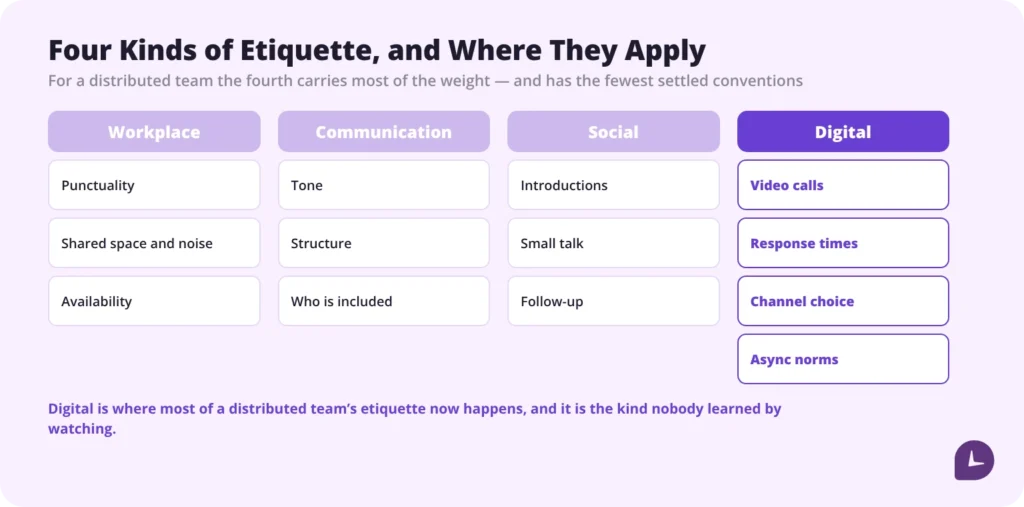
There is no authoritative list. The Emily Post Institute, which is the nearest thing to an authority on the subject, does not enumerate types at all, and the counts you will find elsewhere range from four to six depending on who is writing. The only named classification belongs to Courtland Bovée, who sets out five zones of professional etiquette rather than four. So treat the grouping below as a way of organising the subject — ours, not a standard — and useful mainly for what it shows about where the weight now sits.
| Type | Where it applies | What it covers |
|---|---|---|
| Workplace | How you show up and collaborate | Punctuality, shared space, noise, availability |
| Communication | Email, chat, meetings | Tone, structure, who is included |
| Social | Networking, events, informal contact | Introductions, small talk, follow-up |
| Digital | Everything virtual | Video calls, response times, channels, async norms |
For a distributed team, the fourth carries most of the weight — and it is the one with the fewest established conventions, which is why so much remote friction turns out to be about etiquette rather than about work.
Boost your business productivity
Track performance and streamline teamwork
What is the difference between etiquette and protocol?
Etiquette is the everyday behaviour that shows respect: addressing someone the way they prefer, not using your phone during a meeting, replying when somebody needs an answer.
Protocol is the formal set of rules and procedures an organisation defines: dress codes, meeting structures, escalation paths, published policies.
The distinction matters practically. Protocol you can look up in a handbook. Etiquette you have to infer — which is exactly why it goes wrong when nobody shares an office and there is nothing to observe. The useful move for a distributed team is to write a little of its etiquette down — to turn the smallest workable part of it into protocol — and the last section of this page is about how much.
The basics: appearance, behaviour, communication
Business conduct reduces to three areas, and the principles hold whatever the industry.
Appearance — how you and your surroundings present. Not formality: a video call background that is not chaos, a dress standard that matches the meeting, a workspace that does not distract whoever you are talking to.
Behaviour — punctuality, reliability, discretion, and how you treat people regardless of their seniority.
Communication — clarity, tone, and choosing the right channel for the message.
Does informal mean impolite?
No, and the assumption that it does is the most common misreading of this topic.
As workplaces move away from traditional formality, treating informality as bad manners has itself become a mistake. A team that works in t-shirts and first names is not a team with poor etiquette.
What etiquette actually asks for is respect for other people’s time, attention and space. A formal email that ignores someone’s question is worse etiquette than a three-word reply that answers it.
The test: does this behaviour make it easier or harder for the other person? That question answers almost every etiquette question you will have, and it does not depend on how formal your workplace is.
How should you write a work email or message?
Structure:
- A subject line that makes sense to someone who was not in the conversation — and check it still does when you forward it
- A greeting, however brief
- The ask in the first two lines, not the last
- One topic per message where possible
Tone: written text has no tone, so it borrows one from the reader’s mood. A three-word reply reads as curt; a message with no greeting reads as cold. Neither was necessarily meant that way. Adding four words fixes it, and those four words are cheaper than the misunderstanding.
Who should you copy, and when?
The most reliably annoying etiquette failure in any organisation.
| Situation | Who goes where |
|---|---|
| They need to act | To |
| They need to know, no action | Cc |
| Introducing two people | Both in To, explain in the first line |
| Moving someone off a thread | Move to Bcc and say so in the first line |
| You are not sure | Ask |
If you are unsure whether to copy someone, ask your manager or ask them directly. It takes one message and prevents both the “why wasn’t I told” and the “why am I on this” conversation.
How should you behave in a meeting?
- Arrive on time, which in a remote context means being ready at the start, not joining at the start
- Send an agenda, or at least a purpose. A meeting with neither is a request for other people’s time without saying what for
- Do not eat during a meeting, or drink anything distracting, unless the organiser has said otherwise
- Do not do other work. It is visible, on video more than in person
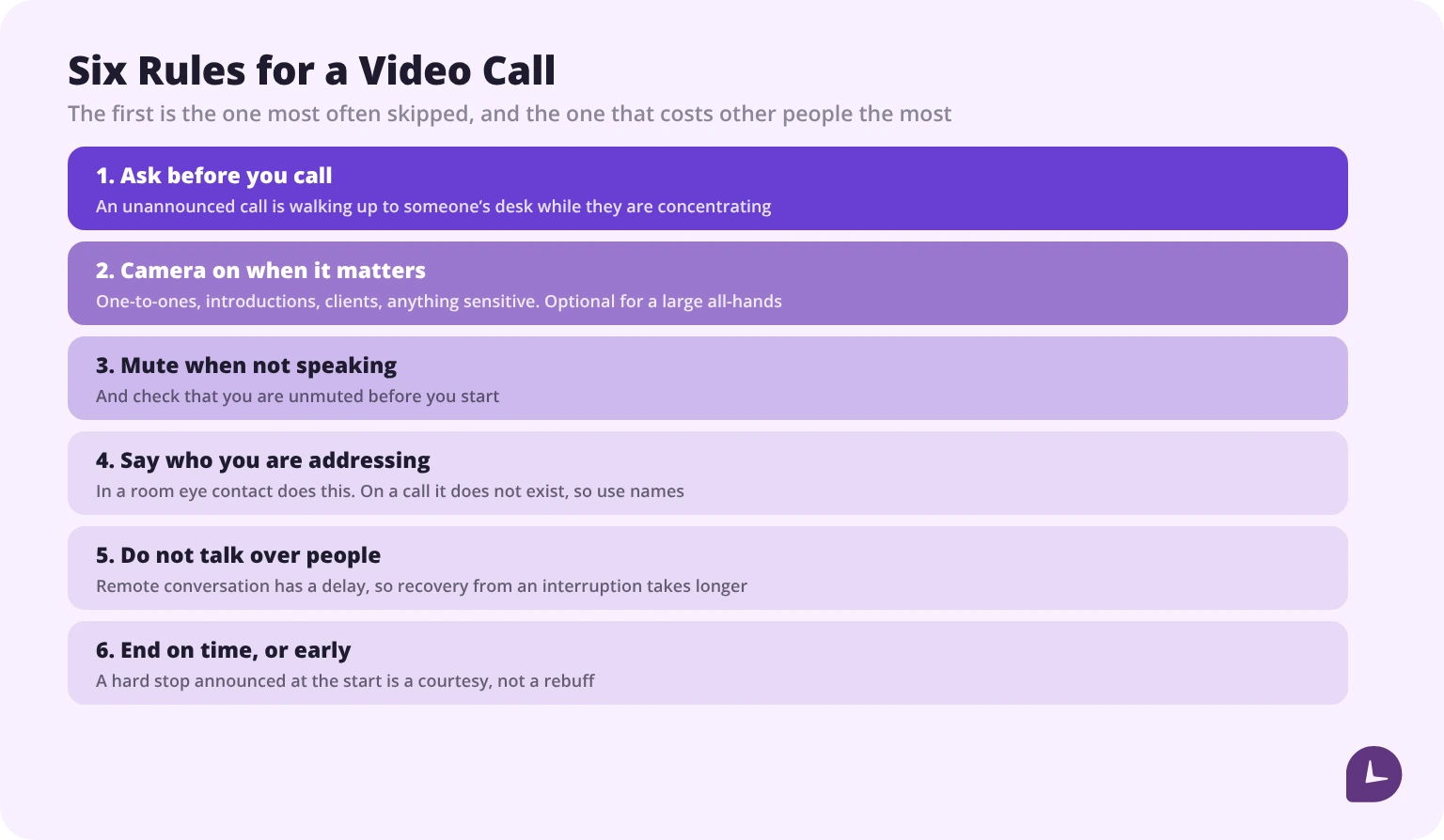
- End on time, and end early when you are done
What are the rules of a video call?
The rules that matter most, and the ones least often stated.
Check availability before calling. An unannounced call is the remote equivalent of walking up to someone’s desk while they are concentrating. A message asking “free for five minutes?” costs nothing.
Camera on for the meetings that matter. Introductions, difficult conversations, anything with a client, anything where you need to read the room. Camera off is fine for a large all-hands; it is not fine for a one-to-one about something sensitive.
Dress as though someone might screenshot you. Not formally — presentably.
Mute when not speaking, and check you are unmuted before you start.
Say who you are addressing. In a room, eye contact does this. On a call it does not exist, so use names.
Do not talk over people. Remote conversation has a delay, so the recovery from an interruption takes longer and lands harder.
Background: anything that does not require the other person to look at it.
What are the unwritten rules of asynchronous work?
This is the part the general etiquette guides leave out, and it is the source of most remote friction. Four rules cover almost all of it, and the fourth one is now law in several countries.
How fast should you reply?
The single biggest cause of avoidable tension in a distributed team is a mismatch between what the sender expects and what the recipient thinks is reasonable. Neither has said a number out loud, so both are guessing, and both are slightly annoyed.
Agree it explicitly. A workable default:
| Channel | Expected response |
|---|---|
| Chat, marked urgent | Within the hour, during working hours |
| Chat, normal | Same working day |
| Within one working day | |
| Ticket or task comment | By the next working day |
| Anything outside working hours | Next working day |
The number matters less than the fact that it exists. A team where everyone knows email gets answered within a day stops reading an unanswered email as being ignored. This is where accountability and responsibility at work becomes concrete rather than a value on a wall: an agreed response time is a commitment somebody can be held to, and an assumed one is not.
If you cannot answer properly, acknowledge. “Seen this, need until Thursday to give you a proper answer” takes ten seconds and removes the whole problem.
Those numbers are a starting point, not a finding. No primary source publishes an expected response time for distributed teams, and a guide that gives you one with a percentage attached is quoting a vendor survey. Pick numbers your team can meet.
But there is good evidence about what goes wrong, and it is not what you would expect. Across eight preregistered experiments with just over four thousand participants, Laura Giurge and Vanessa Bohns found that people receiving non-urgent work email consistently overestimate how quickly the sender expects a reply. The gap is widest for messages sent outside normal hours, and the overestimation tracked higher stress and lower wellbeing.
Which puts the fix on the sender. The same work found that one line saying a quick reply is not needed reduces the effect. So the etiquette rule is not send fewer messages — it is say what you expect. “No rush, any time this week” is four seconds of typing that buys back somebody’s evening, and its absence is read as urgency you never intended.
Eurofound’s 2022 survey of employees in Belgium, France, Italy and Spain found more than 80% receiving work communications outside contracted hours in a typical week, and 57% feeling obliged to reply. It sampled sectors with a lot of remote-capable work in four countries that had already legislated, so read it as a description of where the problem is concentrated rather than an average.
When should you call instead of messaging?
| Message | Call |
|---|---|
| Information, or a question with a factual answer | Anything with disagreement in it |
| Something that needs a written record | Anything sensitive, or about performance |
| The other person is in a different time zone | Something that has gone back and forth more than three times |
| Not urgent | Genuinely urgent |
The three-message rule. The writer Phil Simon puts it in his own email signature: “I abide by a three-email rule. After three, we talk.” It is worth borrowing, with the caveat that it is one person’s habit rather than an established convention — he proposed it in Message Not Received and has repeated it since, and nobody has studied whether it works. The reasoning is sound enough on its own: text is efficient at transferring information and poor at resolving disagreement, and three rounds is about the point where that becomes obvious.
Can you message someone outside working hours?
If you work unusual hours, say so, and schedule the send. A message at 23:00 reads as an expectation even when it is not one, and the recipient’s evening is affected whether or not they reply.
If you receive one, you are often not obliged to answer — and in some countries that is no longer a matter of manners. This is the one part of business etiquette that has moved into law, and most guides on the subject have not noticed.
Australia has had a right to disconnect since August 2024, extended to small business employers in August 2025, so it now covers employees of every national-system employer. It is precisely a right to refuse contact rather than a ban on sending it: an employee may refuse to monitor, read or respond to work contact outside working hours unless that refusal is unreasonable, judged on things like why the contact was made, how disruptive it was, whether the person is paid to stay available, and how senior the role is. Employers may still make contact. The Fair Work Commission handles the disputes.
France requires employers to negotiate how the right to disconnect is exercised, or, failing an agreement, to publish a charter after consulting the works council. The duty is procedural: it obliges the conversation, not any particular outcome. The headcount threshold usually quoted for it is not in the text at all; the duty turns on union representation instead.
Belgium requires employers with at least twenty workers to agree arrangements at company level. Ireland has a code of practice rather than a right: guidance that can be produced in evidence, which is not nothing and is not a rule either.
Ontario is the one most often misreported. Employers with twenty-five or more employees in the province must have a written policy on disconnecting from work and give every employee a copy. But the Act requires the policy to exist, not to contain anything in particular, and the ministry says plainly that the requirement does not create a right to disconnect. If your employer’s policy says you answer at ten at night, that is the policy.
There is no binding rule at EU level. What exists is a European Parliament resolution from 2021 asking the Commission to propose a directive, and a consultation that began in 2025. Anyone telling you the EU has a right to disconnect is describing something that has not happened yet.
What to do with all that, wherever you are. The legal position is a floor, not a norm, and the team-level agreement is what people actually live by. Agree whether an out-of-hours message carries an expectation, write the answer down, and have whoever sends the most messages be the first to follow it.
When should you tag someone?
- Tag someone when you need them specifically. Tagging a channel of forty people for something two of them care about trains everyone to ignore tags
- @here and @channel are for things that genuinely cannot wait
- If you tag someone in a thread they are not following, give the context in the same message. “@name thoughts?” on message forty of a thread is a request to read forty messages
Core hours and response times are easier to agree when everyone can see where the hours are actually going, rather than arguing from impressions.
See how Monitask tracks time across a distributed team
What to say in the awkward moments
The thing every etiquette guide describes in principle and none of them supplies. Take these and change the words to sound like you.
Declining a meeting you do not need to be in:
> “I don’t think I’ll add much here — happy to read the notes and follow up if anything needs me. Shout if you’d rather I joined.”
Asking to be taken off a thread:
> “Moving myself to bcc — ping me directly if you need me.”
Interrupting on a call, when you have to:
> “Sorry to jump in — quick check before we move on.”
Chasing something overdue, the first time:
> “Hi — just checking in on the draft. Is it still on track for Friday, or has something come up?”
Chasing the second time:
> “Following up on this. I need it by Friday to get the release out on time — can you let me know either way?”
Saying no to a request:
> “I can’t take this on this week without dropping the migration. Which would you rather I did?”
Asking someone to stop something irritating:
> “Small thing — when the call runs over, I end up late to the next one. Could we keep a hard stop at the hour?”
Ending a call that is over-running:
> “I’ve got a hard stop in two minutes — what’s the one thing we need to settle before I drop?”
What do you do when you get it wrong?
Everyone does. The etiquette that matters is what happens next.
Sent to the wrong person. Say so immediately and directly to whoever received it. Do not hope. If it contained something sensitive, tell whoever needs to know before they find out another way.
Said something that landed badly. Address it the same day, on a call rather than in writing. “That came out wrong — what I meant was” repairs most of it. Waiting a week does not, and a small misreading left alone is how two people who work fine together stop working fine together.
Missed a meeting. Apologise once, briefly, without a long explanation, and propose the fix. An extended apology makes the other person manage your discomfort.
Missed a deadline. Tell them before the deadline, not after. This is the single largest etiquette difference between people who are easy to work with and people who are not, and it matters most when tight deadlines are the normal condition rather than the exception.
Was short with someone because you were busy. Say so. “Sorry, I was curt earlier — nothing to do with you” costs nothing and prevents a story forming.
The general rule: name it, fix it, move on. Over-apologising makes it larger; ignoring it makes it permanent.
How does etiquette differ across cultures?
Norms are not universal, and a distributed team is frequently distributed across countries.
What varies: directness, formality of address, attitudes to interrupting, how disagreement is expressed, the meaning of silence, punctuality conventions, and how much personal conversation precedes business.
What to do: if you work regularly with colleagues or clients in another country, spend twenty minutes reading about professional norms there — both the country’s and the organisation’s, which are not the same thing.
The general principle: assume difference is difference, not rudeness. A colleague whose messages are blunter than yours is probably not being blunt.
And one practical consequence. The working-hours rules in the section above are national, not universal. A team spread across countries may have members whose right to ignore an evening message is written into law and others whose is not. The workable answer is to apply the strongest standard in the team to everyone, rather than running two sets of norms in one channel.
How do managers set norms instead of hoping?
Every other guide on this topic writes for the employee. This part is for whoever runs the team, and in a distributed team it matters more than anything above.
Office etiquette is learned by watching. Remotely there is nothing to watch, so norms either get stated or they get invented individually — which produces forty different sets of expectations in a team of forty.
Write down the small number that matter:
- Response time expectations per channel
- Core hours, and what happens outside them
- Camera expectations, by meeting type
- When to message versus call
- What @channel is for
- Whether messages outside working hours carry an expectation
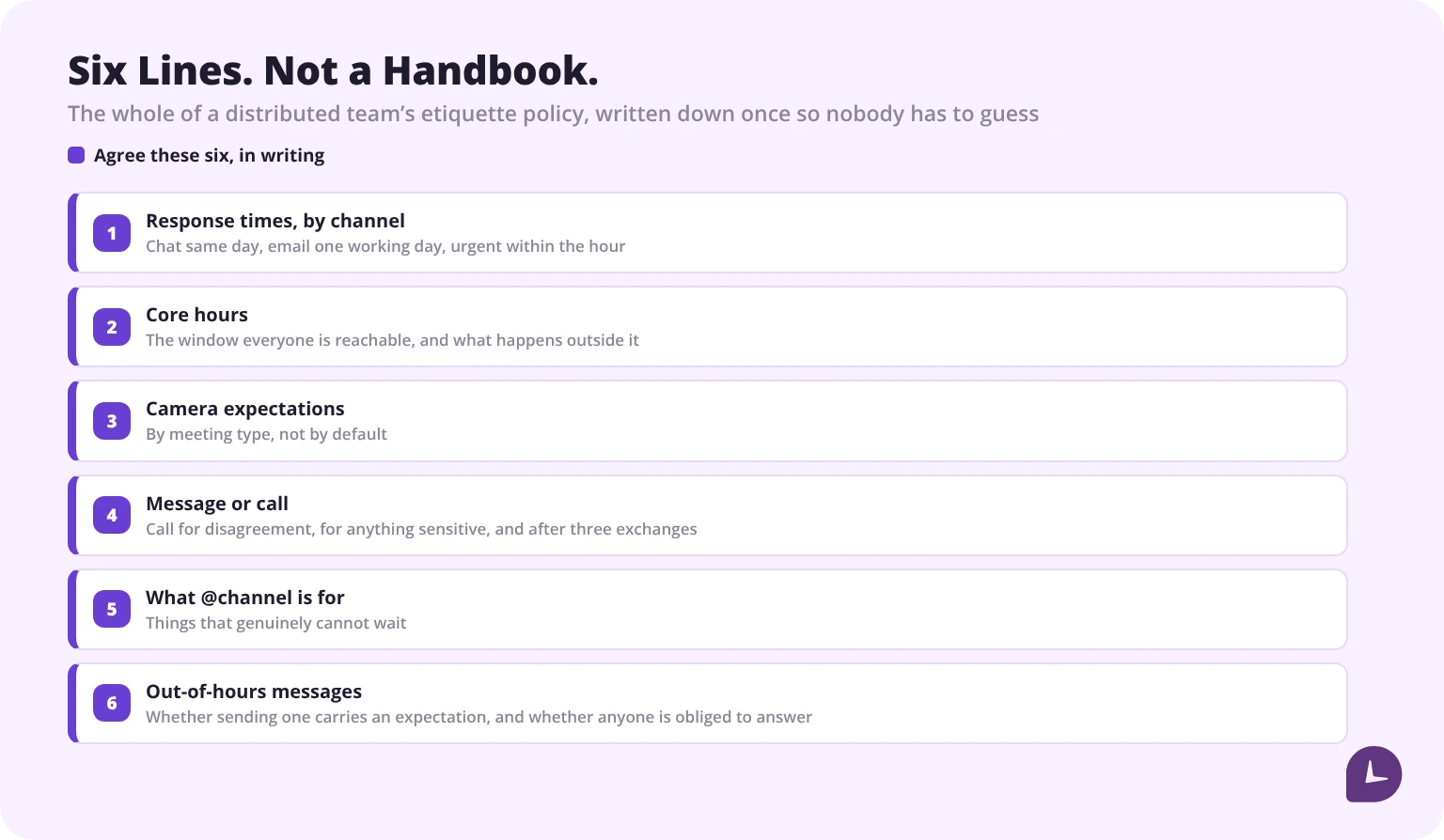
Keep it to one page. A document nobody reads is worse than nothing. If you already keep a team plan, it belongs there rather than in a document of its own — the same argument as how to write a work plan makes about plans that live somewhere people already look.
Then model it. A manager who sends messages at midnight has set a norm regardless of what the document says, and it is the one people follow. Scheduling the send is a thirty-second habit that makes the written rule true.
Do not substitute watching for agreeing. The failure mode this page is most often read next to is a manager who responds to uncertainty about what people are doing by measuring more of it. Norms answer the question that monitoring only restates, and how to build trust in your remote team is the longer version of that argument.
Revisit it when the team changes shape. New joiners, a new time zone, a new tool — each one is a moment where the unwritten rules stop matching reality.
Agreed norms beat assumed ones, and the same is true of hours. A record of where the time went settles the arguments that etiquette alone cannot.
See how Monitask reports time across a remote team
Sources
- Laura M. Giurge and Vanessa K. Bohns, “You don’t need to answer right away!”, Organizational Behavior and Human Decision Processes, volume 167, 2021, pages 114 to 128. Eight preregistered experiments, 4,004 participants.
- Fair Work Ombudsman, right to disconnect. Commenced 26 August 2024 for other than small business employers and 26 August 2025 for small business employers.
- Department of Employment and Workplace Relations, Australia, right to disconnect fact sheet. The source of the point that the right does not prohibit employers from making contact.
- Government of Ontario, Your Guide to the Employment Standards Act: written policy on disconnecting from work. The source of the 25-employee threshold, the 1 March deadline, and the statement that the requirement creates no right to disconnect.
- Code du travail, Article L2242-17, France. The right to disconnect within mandatory periodic negotiation, and the charter that follows if no agreement is reached.
- Service public fédéral Emploi, Belgium, on the law of 3 October 2022 and the twenty-worker threshold.
- S.I. No. 159/2021, Ireland, declaring the Workplace Relations Commission code of practice on the right to disconnect an approved code.
- European Parliament resolution of 21 January 2021 with recommendations to the Commission on the right to disconnect, P9_TA(2021)0021. A request for a directive, not a directive.
- Eurofound, Right to Disconnect: Implementation and Impact at Company Level, EF23002, 29 November 2023, drawing on its 2022 survey in Belgium, France, Italy and Spain.
- Phil Simon, Message Not Received, 2015, and his subsequent writing on the three-email rule.
Frequently Asked Questions
What is the difference between etiquette and protocol?
Etiquette is everyday behaviour that shows respect. Protocol is the formal rules and procedures an organisation defines — dress codes, meeting structures, escalation paths. Protocol is written down and you can look it up; etiquette usually is not, which is why it has to be inferred, and why remote teams get it wrong more often than co-located ones.
What are the main types of business etiquette?
There is no authoritative list. Guides variously give four, five or six, and the Emily Post Institute does not enumerate types at all. A useful grouping is workplace, communication, social and digital. For a distributed team the digital one carries most of the weight and has the fewest settled conventions.
How quickly should I respond to a work message?
Agree it as a team rather than guessing: a common default is same day for chat, one working day for email, and no expectation outside working hours. There is no researched correct number. What the research does show is that recipients overestimate how fast senders want a reply, so the more useful habit is for senders to say when they actually need it.
Should my camera be on in video calls?
For one-to-ones, introductions, client meetings and anything sensitive, yes. For a large all-hands it is usually optional. The point of the camera is reading the room, and a meeting of sixty people has no room to read. Agreeing this by meeting type saves everyone the daily guess.
Is it rude to message someone outside working hours?
It creates an expectation even when none is intended, so schedule the send if you work unusual hours. Whether the recipient may ignore it now depends on where they are: Australia gives employees a right to refuse out-of-hours contact, France and Belgium require employers to agree arrangements, and most places have nothing at all.
Do employees have a right to disconnect?
In some countries. Australia’s right to refuse out-of-hours contact covers every national-system employer since August 2025. France and Belgium oblige employers to negotiate or publish arrangements. Ontario requires a written policy but explicitly does not create a right. There is no binding EU-wide rule — only a 2021 Parliament resolution asking for one.
When should I call instead of messaging?
When there is disagreement in it, when the topic is sensitive or about performance, when it is genuinely urgent, or when a thread has gone round several times without resolving. The writer Phil Simon puts the threshold at three emails; that is his own heuristic rather than a researched rule, but it is a reasonable place to draw the line.
Who should I copy on an email?
People who need to act go in To; people who need to know but do not need to act go in Cc. Moving someone off a thread means Bcc plus a line saying so. If you are unsure, ask rather than defaulting to copying everyone — one message prevents both the why-wasn’t-I-told and the why-am-I-on-this conversation.
What should I do if I break a rule of etiquette?
Name it, fix it, move on. Address it the same day, preferably by voice, and keep the apology brief: a long apology makes the other person manage your discomfort. The one that matters most is a missed deadline, and the fix there is to say so before the deadline rather than after it.