What Makes a Good Team Member

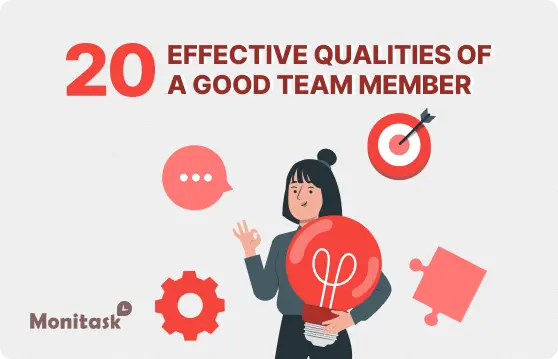
Lists of team player qualities tend to describe a person nobody has met: proactive but deferential, critical but positive, generous with time they apparently have. The ten below are the ones that survive contact with a real team, each with the tension it carries and a question that reveals it in an interview. One caveat worth stating first, because it reframes the rest: the best available research suggests how a team works together matters more than who is on it.
Key takeaways
- Google’s Project Aristotle studied more than 180 teams and found psychological safety was the strongest predictor of effectiveness — ahead of talent, tenure or team size.
- Individual qualities still matter, but they express themselves differently depending on whether the team is safe to speak up in.
- Most published lists overlap heavily. Ten distinct traits cover what twenty usually describe.
- Several of these qualities are in tension with each other. Initiative and restraint are the obvious pair, and knowing which the moment calls for is the actual skill.
- Interview questions about past behaviour reveal these traits; questions about hypothetical behaviour do not.
Reliable employee tracking software. Clear visibility and insights into how employees work. Even remotely.
Try Now
What Research Says About Team Effectiveness
Before the individual qualities, the finding that puts them in context. Google ran a multi-year study called Project Aristotle, examining more than 180 teams to identify what separated the effective ones. The result surprised the researchers: individual composition explained less than the norms the team operated under.
Five dynamics emerged, and one of them mattered far more than the rest. The finding sits alongside the older account of what separates a team from a group of people with a shared manager, set out in Harvard Business Review by Katzenbach and Smith.
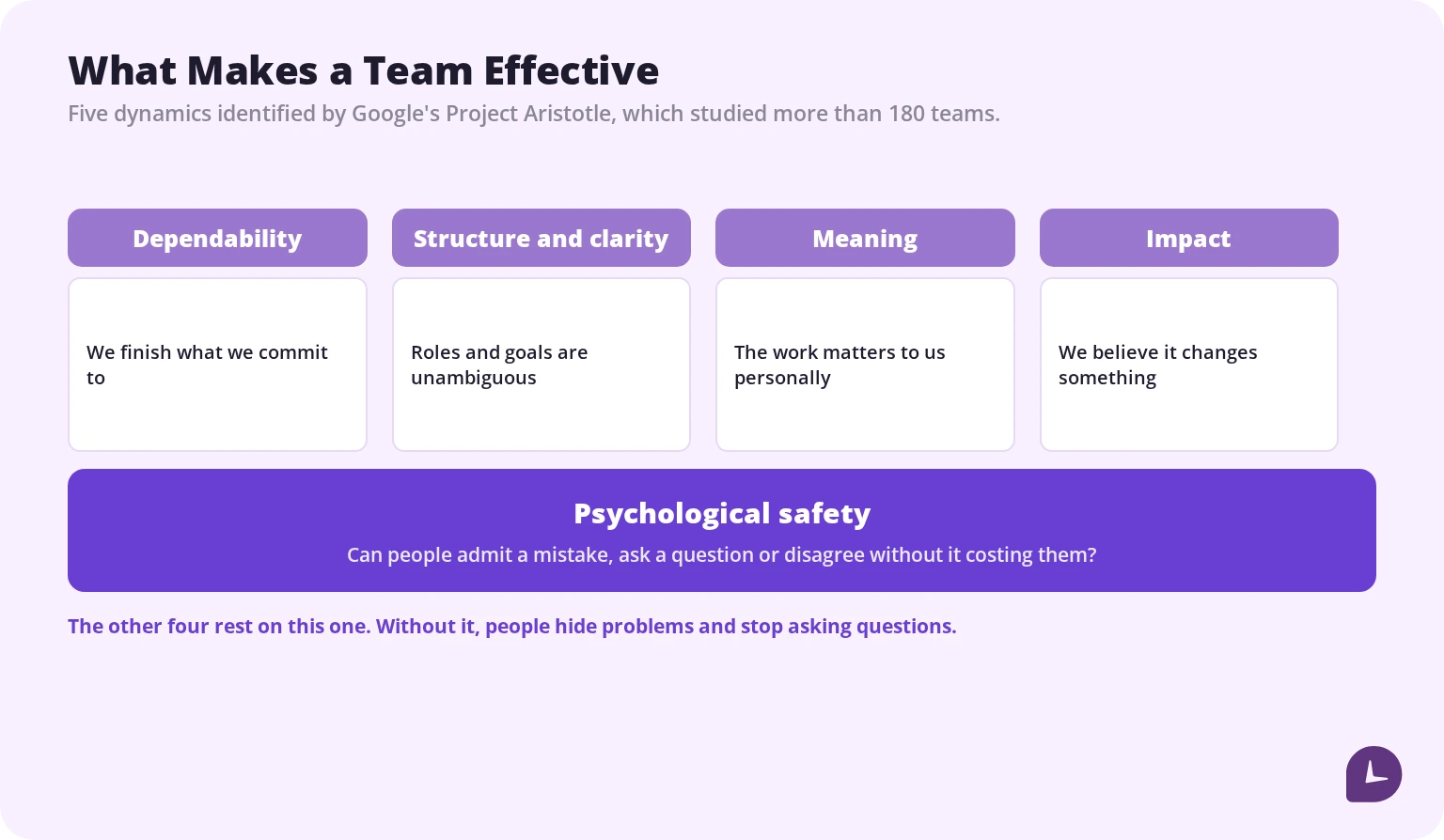
Psychological safety — whether people can admit a mistake, ask a basic question or disagree without it costing them — was the foundation the other four depended on. Where it is missing, dependability erodes because people hide problems until they are unfixable, and clarity suffers because nobody asks the question that would have surfaced the misunderstanding.
This does not make individual qualities irrelevant. It changes what to do with them. A manager who hires ten dependable people into a team where raising a concern is punished will get ten people who stop raising concerns. The qualities below describe what to look for in a person; the environment determines whether you ever see them.
Boost your business productivity
Track performance and streamline teamwork
The 10 Qualities That Actually Distinguish Team Members
1. Dependability
The most boring quality on the list and the one that matters most day to day. A dependable colleague finishes what they committed to, and when they cannot, says so early enough for it to matter.
The second half is the real test. Anyone can deliver when things go well. What separates dependable people is the flag raised on Tuesday rather than the apology on Friday.
Interview question: tell me about a commitment you could not meet. When did you know, and what did you do?
2. Clear communication
Not eloquence — clarity. Saying what you mean in language the audience already understands, and asking when you do not understand rather than guessing and proceeding.
The most useful communicators in a team are usually the ones willing to look uninformed by asking the obvious question. That behaviour is downstream of psychological safety, which is why it varies more by team than by person.
Interview question: describe a time you realised halfway through that you had misunderstood the brief.
3. Active listening
Listening to understand rather than to reply. In practice: not interrupting, asking follow-up questions that build on what was said, and being able to restate someone else’s position accurately before disagreeing with it.
That last one is the test. Someone who can state your argument better than you did has actually listened.
Interview question: tell me about a time a colleague changed your mind.
4. Taking responsibility
Owning outcomes without redistributing the explanation. When something goes wrong, the useful colleague reports what happened and what they are doing about it, not who else was involved.
This is distinct from blame-taking. Accepting fault for things outside your control is not accountability, it is a different problem.
Interview question: tell me about a mistake that had consequences for other people.
5. Initiative, and knowing when to hold it
Two qualities that most lists separate and that only make sense together. Initiative is seeing what needs doing and doing it. Restraint is recognising when someone else has a better grasp of the problem and staying out of the way.
Someone with initiative and no restraint takes over. Someone with restraint and no initiative waits. The skill is reading which the situation calls for, and it is the hardest quality on this list to assess in an interview — it also sits close to the centre of developing leadership skills.
Interview question: tell me about something you decided not to get involved in, and why.
6. Openness to feedback
Receiving criticism as information rather than as a verdict. The observable version is not gracious acceptance in the moment — most people manage that — but whether the behaviour changes afterwards.
The reciprocal half matters too: giving feedback directly enough to be useful. Colleagues who only ever agree are pleasant and not much help.
Interview question: what is the most useful piece of critical feedback you have received, and what changed?
7. Adaptability
Adjusting when priorities shift without treating every change as a betrayal of the plan. Teams reorganise, projects get cut, requirements move. The adaptable colleague absorbs that and re-plans; the rigid one relitigates the decision.
Adaptability is not the same as having no opinion about direction. Disagreeing and then committing is adaptability. Agreeing and then quietly continuing as before is not.
Interview question: describe a project whose direction changed significantly. What did you do?
8. Generosity with knowledge and credit
Sharing what you know rather than holding it as leverage, and naming who actually did the work. Knowledge hoarding is usually a symptom rather than a character flaw — people hoard when expertise feels like the only thing protecting their position — but the effect on a team is the same either way.
Interview question: tell me about something you learned that you then made easier for others to learn.
9. Constructive conflict
Disagreeing about the work without making it about the person, and being willing to disagree at all. Teams that never argue are usually not aligned — they are silent, which is a different and worse thing.
The useful colleague surfaces the disagreement early, argues the substance, and then commits to whatever is decided rather than continuing the argument in private.
Interview question: tell me about a disagreement with a colleague that you handled well, and one you handled badly.
10. Self-awareness
Knowing what you are good at, what you are not, and how you land on other people. It is the quality that makes the other nine adjustable, because someone who cannot see their own effect cannot correct it.
The practical signal is someone who can describe their weaknesses in specific, unflattering, non-strategic terms. “I take on too much” is a rehearsed answer. “I go quiet when I disagree with someone senior, and it has cost us twice” is a real one.
Interview question: what do your colleagues find difficult about working with you?
How to Assess These in an Interview
Three rules make the difference between questions that produce information and questions that produce prepared answers.
- Ask about the past, not the hypothetical. “What would you do if a project changed direction?” invites the candidate to describe an ideal person. “Tell me about a project that changed direction” invites them to describe themselves.
- Ask for the second example. The first story is prepared. The second one, on the same theme, is usually not, and it is where the useful detail lives.
- Follow the specifics. Ask when they knew, who else was involved, what they said, what happened next. Invented examples run out of detail quickly; real ones have too much of it.
One caution: these qualities are not evenly distributed across communication styles, cultures or personalities. An interview measures how someone performs in an interview, which correlates with being a good team member less than most hiring processes assume.
What This Looks Like on a Remote Team
Distributed work changes how these qualities become visible, not which ones matter. In an office, dependability and initiative are partly observed through presence. Remotely, they are observed through output and communication, which means people who are quiet become invisible regardless of what they deliver.
Two practical consequences. Written communication carries more weight, so clarity in writing is worth more than it used to be. And problems surface later, because nobody walks past a struggling colleague’s desk — which makes the willingness to flag things early the single most valuable quality on a remote team, and the reason building trust remotely is mostly about making it safe to raise things.
Boost your business productivity.
Start Your 10-Day Trial
Key Takeaways
Ten qualities cover what most lists stretch to twenty, and several of them pull against each other in ways that make the judgement more important than the trait. Look for the past behaviour rather than the stated value, and treat improving teamwork as an environment problem before a hiring one.
And keep the research in view: the environment shapes whether these qualities appear. A dependable person on a team where bad news is punished becomes a person who delivers bad news late.
For distributed teams, the practical version of dependability is shared visibility — everyone seeing the same picture of what is committed and what is done, without anyone having to ask. Monitask tracks hours and project progress automatically so that picture exists by default. Try it on a 10-day free trial, no card required.
Reliable employee tracking software. Clear visibility and insights into how employees work. Even remotely.
Try Monitask free for 10 days
FAQ: Being Good Team Member
What does research say makes a team effective?
Google’s Project Aristotle, which studied more than 180 teams, found that how a team works together predicts effectiveness better than who is on it. Psychological safety was the strongest of the five factors identified, ahead of dependability, structure and clarity, meaning and impact.
What is psychological safety?
The shared belief that you can admit a mistake, ask a question or disagree without being embarrassed or penalised for it. It is not comfort or the absence of disagreement — teams with high psychological safety typically argue more, not less.
How do I become a better team member?
Pick the one that would change the most. For most people it is flagging problems earlier: saying on Tuesday that a deadline is at risk rather than apologising on Friday. It is uncomfortable once and saves the team a week.
How do I assess these qualities when hiring?
Ask about specific past situations rather than hypothetical ones, then ask for a second example on the same theme. Prepared answers run out after the first story; real experience has detail that keeps going.
Do these qualities differ on remote teams?
The qualities are the same; their visibility is not. On a remote team, willingness to raise problems early matters more, because nothing surfaces by accident and a quiet struggle can run for weeks.