When Two Employees Don’t Get Along: A Manager’s Playbook

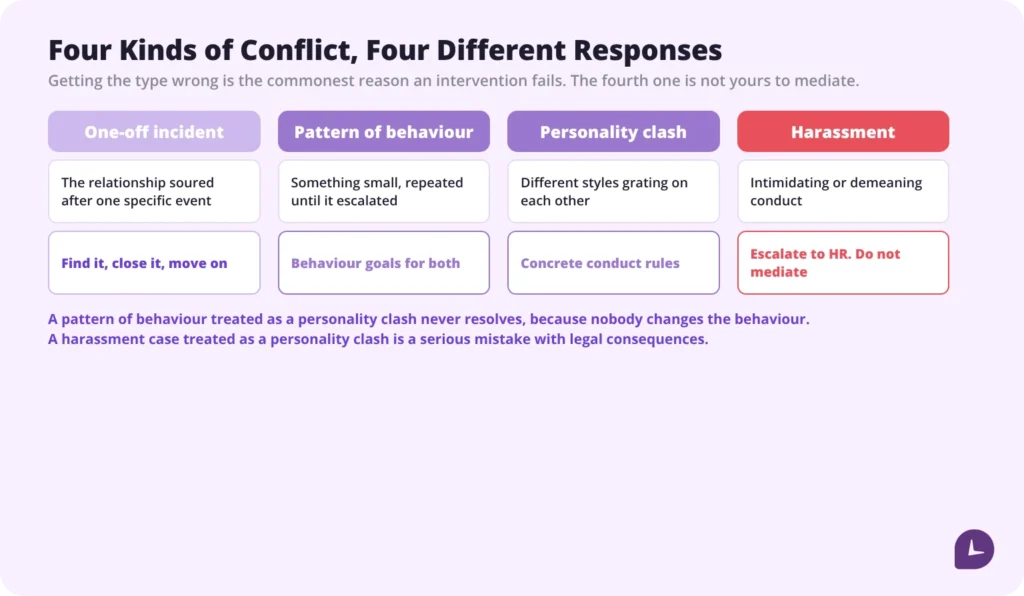
Start by establishing which of four things you are dealing with: a one-off incident, a pattern of behaviour, a personality clash, or harassment. They need different responses, and getting the type wrong is why most interventions fail. Before anything else, rule out harassment or discrimination — that is a separate process with HR, not a conversation you mediate.
Which of the four kinds of conflict is this?
| Type | What it looks like | Your response |
|---|---|---|
| One-off incident | The relationship soured after one specific event | Find it early, close it, move on. Often needs only an apology |
| Pattern of behaviour | Something small, repeated until it escalated | Behaviour goals for both, plus better feedback habits |
| Personality clash | Different communication styles grating on each other | Concrete conduct rules; separate work streams if needed |
| Harassment, discrimination, bullying | Intimidating or demeaning conduct | Immediate escalation to HR and a formal process |
Why the type matters. A pattern of behaviour treated as a personality clash never resolves, because nobody changes the behaviour. A harassment case treated as a personality clash is a serious mistake with consequences that reach well past the two people involved.
These four are an operational grouping rather than an academic one. They sort conflicts by what you should do next, which is the only question a manager actually has.
Boost your business productivity
Track performance and streamline teamwork
Is this a conflict, or a compliance issue?
Rule this out before you do anything else, because the answer changes who handles it and what the organisation is already obliged to do.
Under US federal law the protected characteristics include race, colour, religion, sex — which covers transgender status, sexual orientation and pregnancy — national origin, age from 40, disability and genetic information. Complaining about harassment, or taking part in an investigation, is protected too.
The standard is not ‘was it meant badly’. The EEOC asks whether the conduct was severe or pervasive enough that a reasonable person would find the environment intimidating, hostile or abusive — and whether the person on the receiving end actually experienced it that way. Both halves have to be true. “They were only joking” does not answer either of them. The EEOC is equally clear about the floor: “Petty slights, annoyances, and isolated incidents (unless extremely serious) will not rise to the level of illegality.”
The part that changes what you do today is the trigger. An employer becomes liable where it “knew, or should have known about the harassment” and failed to take immediate and appropriate corrective action. Where a supervisor harasses someone and a negative employment action follows, the employer is automatically liable.
Read that again as a manager rather than as a lawyer. The moment you hear about it, the organisation knows. You cannot sit with it for a fortnight to see whether it settles down, because the clock has already started and it started with you.
Signals to escalate rather than mediate:
- Comments or conduct touching a protected characteristic
- Yelling, cursing, threats or intimidation
- Conduct that targets someone’s identity
- One party is afraid of the other
- A power imbalance between the two people
- Anything that has already been reported once before
If any of these apply, stop here. Involve HR, write down what you know, and follow the formal process. Everything below applies to ordinary interpersonal conflict.
Should you step in at all?
Not every disagreement needs a manager. Reacting to every complaint raises the drama and can look like favouritism.
There is a longer-term cost too. As Amy Gallo put it to SHRM, “Oftentimes people will expect you to do that over and over if you start playing referee instead of manager.”
Signs to stay out, for now:
- Both are professionals who have not tried talking yet
- The issue is small and recent
- Neither has raised it with you
- It is a single disagreement about work, not about each other
Signs you must step in:
- It is visible to you, or to other people on the team
- Neither party recognises there is an issue, or neither will act
- Others are being drawn in, or taking sides
- Work is being affected — handoffs, deadlines, information not shared
- One of them has come to you
- It has gone on long enough that neither will move first
The middle path most guides skip. You can support without taking over: give each person talking points and encourage them to have the conversation themselves. Facilitating is not fixing, and the line matters — you are their manager, not their parent.
What are the early signals, before anyone complains?
By the time a conflict is reported it is usually months old. These are the things visible earlier.
| Signal | What it often means |
|---|---|
| Two people stop copying each other on messages | Communication has broken down |
| Handoffs between them start going wrong | Neither wants to ask the other for anything |
| One consistently routes questions around the other | Avoidance |
| Meetings get quieter when both are present | Other people can feel it |
| One asks to be moved off a shared project | It is already advanced |
| Sudden formality between people who were informal | Something happened |
None of these proves anything. They are prompts for a question, not conclusions. But a manager who notices the third or fourth is intervening months earlier than one who waits for a complaint.
The handoff row is the one to watch hardest, because it is where the cost shows up first and where it is easiest to mistake for something else. Work that stops moving between two specific people is a symptom before it is a scheduling problem.
How should you run the one-on-one?
Speak to each person separately first. Not together: putting two people in a room before you understand the problem can escalate it, and somebody with a legitimate grievance may not say it in front of the person causing it.
What should you ask?
Open neutrally and move toward specifics.
> “I’ve noticed some tension between you and Priya. Is there a problem between the two of you?”
> “Has Priya done something specifically that has made it harder to work with her?”
> “Priya has said you’ve been hostile toward her. Do you think there’s any truth in that?”
> “Have you spoken to Priya directly about this? If so, what happened? If not, why not?”
The last question is the most useful one you have. If they have not raised it directly, the answer to why tells you what you are actually dealing with: fear, futility, or not having thought it mattered. Those three lead to completely different conversations, and you cannot tell them apart from the outside.
How do you separate fact from impression?
One sentence does most of the work here.
When someone says a colleague always or never does something, ask them to estimate how many times it has happened in the past month.
Sometimes the answer is twelve and you have a pattern. Sometimes it is twice and you have a strong feeling about two events. Both are worth knowing and they need different responses.
Ask for evidence where it should exist. If the complaint is that someone is rude in writing, ask whether there is a thread. If it is that they undermine people in meetings, ask who else was there. Impression turns into he-said-she-said quickly; a message thread does not.
And discount the gossip. Deal with the two people involved. What other team members have told you is not evidence, and acting on it will cost you the trust of everyone in the room.
How do you make cooperation a job expectation?
This is the framing that makes everything else enforceable, and it comes from Alison Green of Ask a Manager: “Having civil, cooperative relationships with coworkers is as much a part of your job expectations as any work I assign you.”
Her second point matters as much as the first: “But from there, you hold them to that just like you would any other performance expectation.”
Why it works. It moves the conversation from “please get along”, which is a request, to a performance expectation, which is something you can follow up on. A request has no second step. An expectation does.
> “Working well with the team is part of this job, the same as anything else I assign you. I’m asking you to resolve this, and I’ll check in on it in two weeks the same way I’d check in on any other commitment.”
What this is not: a threat, and not a requirement that they become friends. They do not have to like each other. They have to work together.
When should you put them in a room together?
Only after you understand both sides, and only if the hostility level allows it.
- Each person gets uninterrupted time to give their account. Facts, not feelings about the other person.
- Then each proposes how it could be resolved and how they would move forward.
- You do not take a side. Taking one makes it worse and costs you the other person permanently.
- Keep the focus on the behaviour and the problem, not on the people.
- Agree specific commitments from both, and a date to review them.
Two things that help. Encourage “I felt” rather than “you did”; it is a small change that keeps the conversation from turning defensive. And remember that resolution does not require agreement — agreeing to disagree respectfully, with a workable arrangement, is a legitimate outcome.
One thing to avoid entirely: do not run this by email. Written exchanges strip out tone and body language, which is exactly what this conversation needs most, and they leave a permanent record of everybody’s worst phrasing.
What actually changes the behaviour?
Most interpersonal conflicts at work are patterns in which both parties are right and neither is. Each has a legitimate grievance that was never communicated properly.
The technique that resolves it is impact feedback: each person describes the behaviour and its effect on them, rather than characterising the other person.
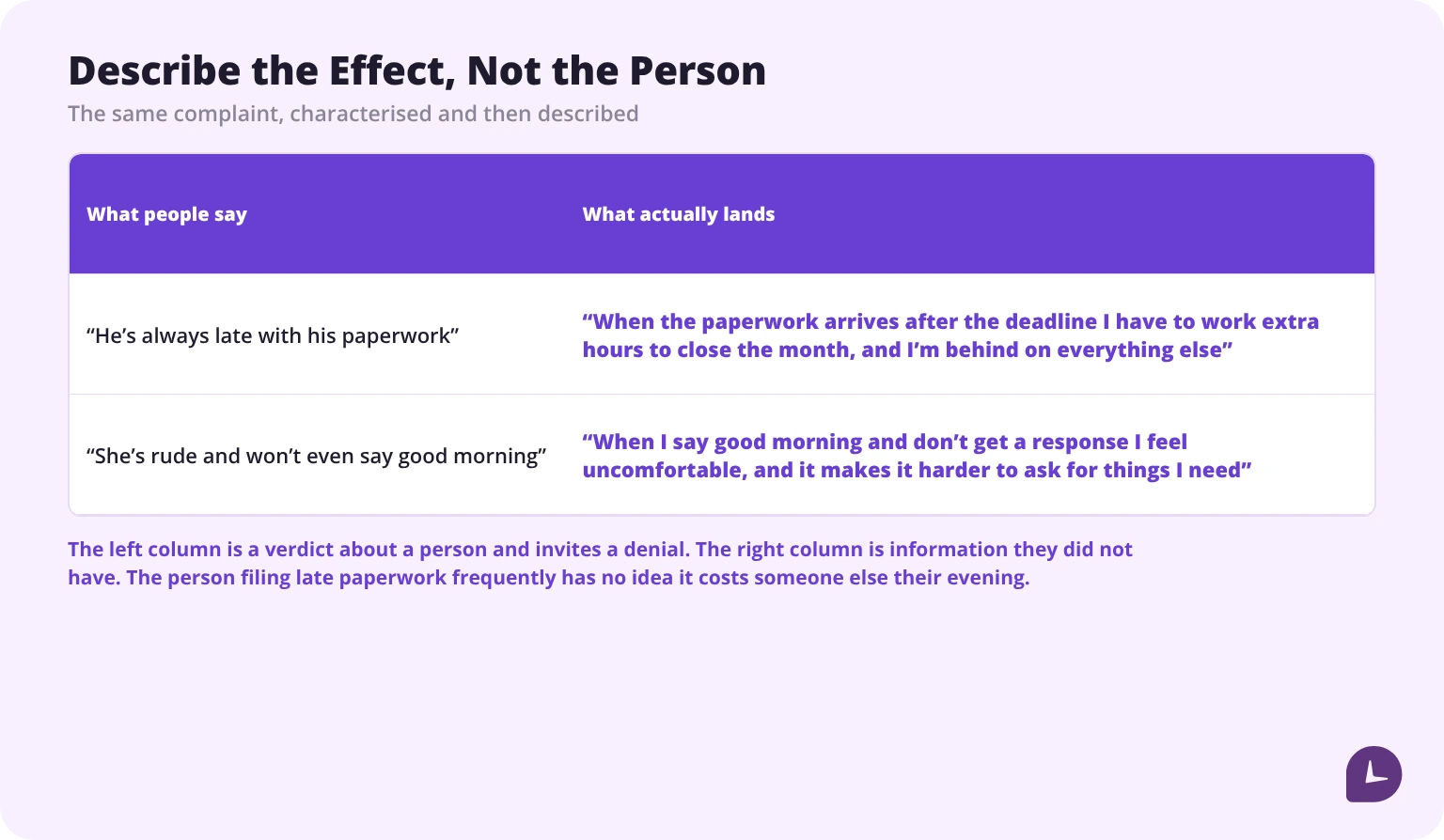
Why it works is that it gives each person information they did not have. The person filing late paperwork frequently has no idea it costs someone else their evening. The person not saying good morning is often deep in focus rather than hostile. Neither of those is discoverable from a complaint about character.
Teach it before you need it. A team that knows how to give impact feedback resolves a large share of this without a manager at all, which is the only version of this that scales.
Why is remote conflict a different problem?
The mechanics genuinely differ, and this is the part with no equivalent in comparable guides.
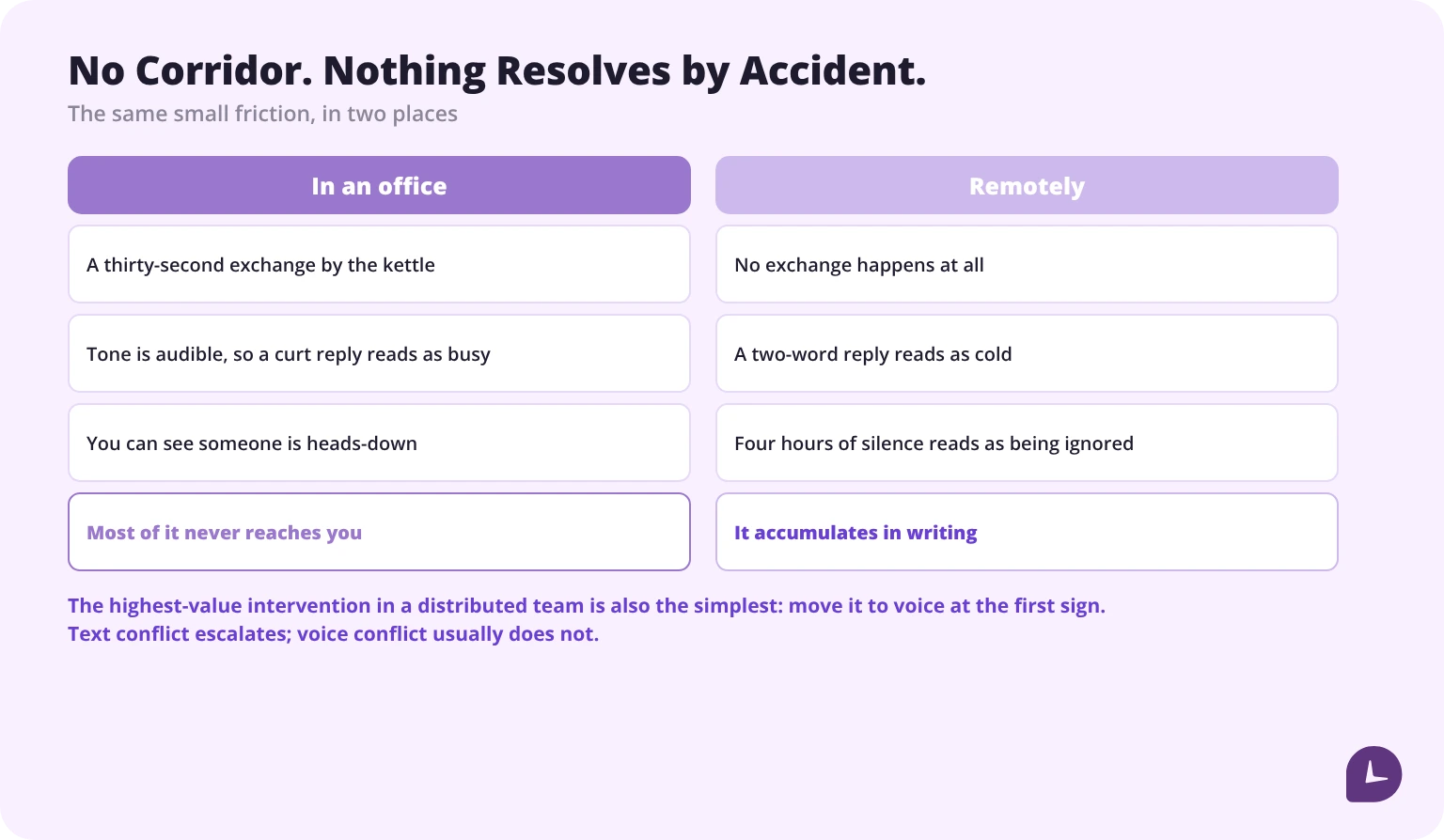
There is no corridor. In an office most friction resolves in a thirty-second exchange by the kettle. Remotely that exchange does not happen, so small things stay unresolved and accumulate.
Everything is in writing, and writing has no tone. A two-word reply reads as curt. A message without a greeting reads as cold. Neither was necessarily meant that way and neither can be checked quickly.
Silence is ambiguous. In an office you can see that someone is heads-down. Remotely, four hours without a reply reads as being ignored.
You cannot see it. A manager in a room notices tension. A manager on a video call sees two people who both have their cameras off.
And it escalates in public. Office disagreements happen at a desk. Remote ones happen in a channel with fifteen people in it, and the audience changes the behaviour.
What to do differently:
- Move to voice or video at the first sign. The single highest-value intervention available to you. Text conflict escalates; voice conflict usually does not.
- Never mediate in a channel. One-to-one call, every time.
- Ask about it directly, because you will not see it. “How are things working with Priya?” in a one-on-one costs nothing and surfaces things months earlier.
- Set expectations about response times explicitly. A large share of remote friction is one person’s assumption about what an unanswered message means.
- Watch the handoffs. In a distributed team the visible symptom is usually work not moving between two people, rather than anything that looks like hostility.
None of this works if the team has no baseline of trust to draw on. building trust in a remote team is the preventive half, and it is considerably cheaper than any of the above.
What should you document, and why?
Write it down. Not because you expect a dispute, but because you might have one.
What to record:
- Who, what, when, where and how — facts, not characterisations
- What each person said, in their own words where it matters
- What was agreed, by whom, and by when
- The date of the follow-up
- Any policy you referenced
Where it goes. A written warning or formal counselling belongs in the HR file. Your own notes of an ordinary conversation do not necessarily, but keep them anyway.
Two reasons this matters. Repeat patterns only become visible in records — a person who has had three of these conversations in a year looks very different from one who has had one, and nobody notices the difference from memory. And if a claim follows later, contemporaneous notes are the difference between a documented process and your recollection of one.
If it reaches the formal stage, an employee write-up form has the template. free HR forms and policy templates covers the policy side, and it is worth checking your own handbook while you are there: your company’s conduct and conflict-resolution policies may already settle what happens next, and sticking to written rules that apply to everybody is the easiest way to stay objective.
What should you not do?
- Do not become the referee. If you resolve it for them, they will bring you the next one, and the one after that.
- Do not act on gossip. Deal only with the people involved.
- Do not take a side. It fans the flames and costs you the other person permanently.
- Do not mediate by email. No tone, no body language, and a permanent record of the worst phrasing anyone used.
- Do not put them in a room together before you understand the problem.
- Do not treat harassment as a personality clash. Different process, different consequences, and the organisation is already on the clock.
- Do not let someone slide because they are senior or a strong performer. Nothing costs a manager authority faster, and everyone watching learns what the rules actually are.
- Do not treat emotional symptoms as the problem. Calm is not resolution.
- Do not skip the follow-up. An agreement with no check-in is a conversation, not a resolution.
- Do not expect them to become friends. They have to work together. That is the whole requirement.
Several of these are the difference between managing and presiding, which boss versus leader is a reasonable account of. And on the temptation behind number seven and number eight: why punishment does not work covers what happens when a manager reaches for consequences instead of a conversation.
How do you follow up?
Check in with both people within a week or two. Separately.
What to ask: whether the agreed behaviour has actually changed, whether anything new has come up, and whether they consider it resolved.
Why this matters more than the conversation itself. The follow-up is what turns an agreement into an expectation. It also demonstrates that you are invested in the outcome rather than in closing the ticket, and people who believe that bring you things earlier next time — which is worth more than any single resolution.
Tell both of them to come back if it recurs. That puts the situation in their hands while making clear you are still there.
If commitments were made and not kept, the recurrence is a performance matter rather than a fresh mediation, and it follows a different path. what actually justifies termination is the far end of that path, and worth understanding before you are anywhere near it.
When is separating them the answer?
Reorganising teams, reassigning projects or giving people time apart is a legitimate tool. It is also badly over-used.
When it works: a genuine personality clash where neither party is behaving badly, and where the work does not require them to collaborate closely.
When it does not:
- When one party is behaving unacceptably. Separating them rewards the behaviour and moves it to the next person
- When the work genuinely requires them to work together
- When it is being used to avoid a conversation you do not want to have
- When the team is small enough that everyone can see what happened
The honest test: if you would be uncomfortable explaining the reason for the reassignment to both people, it is the wrong reason.
What does unresolved conflict cost?
Not a soft cost, though it is a hard one to put a number on. You will find a figure quoted widely — so many hours a week per employee — which traces back to a 2008 survey commissioned by the publisher of a conflict-styles assessment, whose own report gives two different numbers in two places. It is not worth repeating. What the cost actually looks like is this, in order:
Work slows at the handoff. Two people who avoid each other do not ask each other questions, and information that should take a minute takes a day.
Other people get pulled in. Colleagues take sides, or spend energy staying neutral. The conflict expands past the two people in it.
You lose time. The conversations, the mediation, the follow-up. None of it is free and none of it was in your week.
And people leave. This one does have evidence behind it. Analysis published in MIT Sloan Management Review, drawing on 34 million employee profiles and more than 1.4 million Glassdoor reviews, found that a toxic corporate culture was by far the strongest predictor of attrition — roughly ten times more predictive than compensation. That is culture rather than any individual conflict, and it predicts rather than proves. But the direction is not in doubt, and the person who leaves is frequently not the one causing the problem.
How should you review your own handling?
The step almost nobody takes, and the one that improves the next one.
- Did I intervene too early, or too late?
- Did I understand the type correctly at the start?
- Did I stay objective — including in how I am recalling it now?
- What did the people involved think of how I handled it, and have I asked them?
Then look past the individuals.
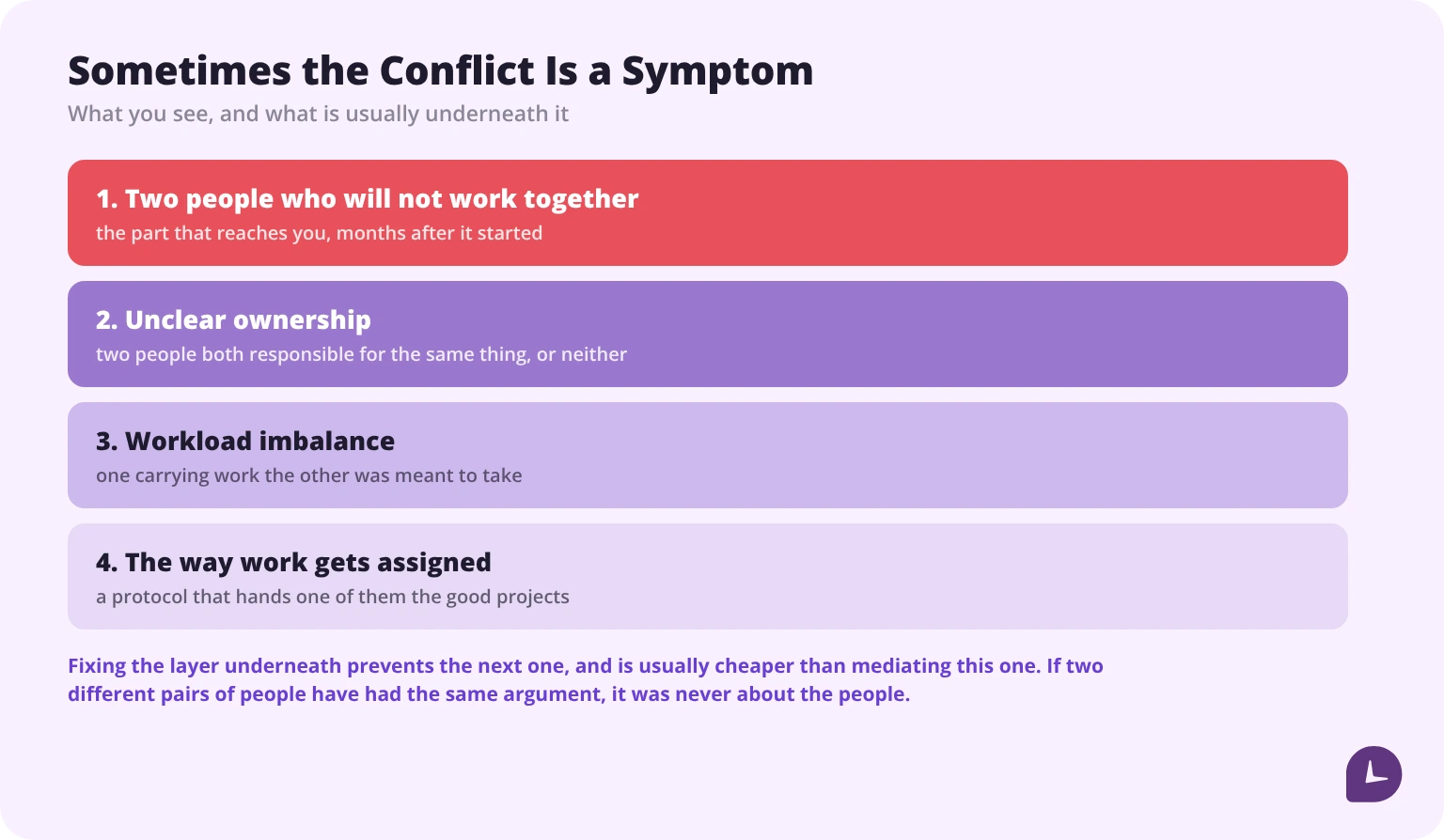
Was there something structural underneath: an unclear division of responsibility, a process that sets two people against each other, a workload imbalance, an assignment protocol that creates resentment? Fixing that prevents the next one, and fixing it is usually cheaper than mediating this one.
The test is simple. If two different pairs of people have had roughly the same argument, it was never about the people. what makes a good team member is useful for hiring and for setting expectations, but no amount of it compensates for a process that makes colleagues compete.
Work that stops moving between two people is visible in the project record long before anyone complains.
See where project time is actually going
The earliest sign of a conflict is usually work that stops moving, not an argument you can hear.
Try Monitask free for 10 days
Sources
- US Equal Employment Opportunity Commission, harassment and prohibited employment policies and practices, eeoc.gov
- Alison Green, Ask a Manager, “two of my employees won’t speak to each other”, November 2019
- Cinnamon Janzer, “How to Handle Employee Conflict on Your Team”, SHRM, 14 July 2021
- Donald Sull, Charles Sull and Ben Zweig, “Toxic Culture Is Driving the Great Resignation”, MIT Sloan Management Review, January 2022
- De Dreu, Carsten K. W. and Laurie R. Weingart (2003), Journal of Applied Psychology, 88 (4), 741–749.
- De Wit, Frank R. C., Lindred L. Greer and Karen A. Jehn (2012), Journal of Applied Psychology, 97 (2), 360–390.
- Sigal Barsade, “The Ripple Effect: Emotional Contagion and Its Influence on Group Behavior”, Administrative Science Quarterly, 47 (4), 644–675 (2002).
FAQ
Should I let employees work it out themselves?
Often yes, if the issue is recent and small and neither has tried talking to the other. Step in when it is visible to other people, when work is being affected, when others are being drawn in, or when it has gone on long enough that neither will move first. There is also a middle option most guides skip: give each of them talking points and let them have the conversation themselves.
How do I talk to an employee about a conflict?
One-to-one, starting neutrally and moving to specifics. Ask what happened, whether they have raised it directly with the other person, and if not, why not. That last question is the most useful one you have, because the reason someone has not raised something — fear, futility, or not thinking it mattered — points at three completely different problems.
Should I meet both employees together?
Only after you understand both sides separately, and only if hostility is low enough that the room will hold. A joint meeting held too early escalates rather than resolves, and someone with a legitimate grievance may not say it in front of the person causing it.
What if one employee is clearly at fault?
Address the behaviour directly with that person rather than mediating between equals. Splitting the difference or separating them rewards the behaviour and moves it to whoever sits next to them afterwards. Mediation assumes two people with a shared problem; that is not what you have here.
When should I involve HR?
Immediately, if there is any element of harassment, discrimination, bullying, threats or intimidation, or if there is a power imbalance between the two people. Under the EEOC standard an employer is liable where it knew or should have known about harassment and failed to act — which means that once you have heard about it, the organisation has heard about it.
Do employees have to like each other?
No. A cooperative working relationship is a job expectation; friendship is not. As Alison Green of Ask a Manager puts it, having civil, cooperative relationships with colleagues is as much a part of the job as any work assigned — and you hold people to that the way you would to any other expectation.
How do I handle conflict in a remote team?
Move it to voice or video at the first sign, never mediate in a channel, and ask about it directly in one-on-ones, because you will not see the signals you would see in an office. Set explicit expectations about response times too: a large share of remote friction is one person’s assumption about what an unanswered message means.
Should I document a conflict between employees?
Yes. Facts rather than characterisations, what was agreed and by whom, and the follow-up date. Two reasons: repeat patterns only become visible in records, and if a claim follows later, contemporaneous notes are the difference between a documented process and your recollection of one.
What if the conflict comes back?
Treat the recurrence as a performance matter rather than a fresh mediation. If commitments were made and not kept, that is a different and more serious conversation, and it follows a different path from the first one. Starting the mediation again teaches both of them that the commitments were optional.