Tips to Set SMART Goals in Your Business Plan — Starting With What Doran Actually Wrote



When Doran set out SMART in 1981, the A stood for Assignable — specify who will do it — and that is the letter the framework lost. The modern A is Achievable, which asks whether the goal can be done rather than whose job it is, so the acronym as most people now recite it contains no requirement to name an owner.
The other four letters are a more interesting story than the one usually told, and this page tells it from the 965-word article itself. It also sets out the argument about goal setting that ran across one management journal in 2009 — not one paper with a warning label, but three papers disagreeing with each other, which is a more useful thing for a planner to know about.
What’s behind SMART?
One article, two pages, in a management magazine.
Doran, G. T. (1981). “There’s a S.M.A.R.T. way to write management’s goals and objectives.” Management Review, 70(11), 35–36. November 1981, AMA Forum.
That is the whole origin of a framework now used in performance reviews, business plans and strategy documents worldwide. It is 965 words long, carries no references, and cites no evidence — which is worth knowing, because the version in circulation is not the version in the article.
Doran was writing about one problem, stated in his opening sentences: most managers still don’t know what objectives are and how they can be written
. His answer was a memory aid, offered as a suggestion rather than a standard — Let me suggest, therefore, that when it comes to writing effective objectives, corporate officers, managers, and supervisors just have to think of the acronym SMART
. He does not claim to have invented it; he calls it “the suggested acronym” and names no source, and no earlier published use turned up for this page either. Coinage is plausible and unproven.
He also drew a limit around his own idea that almost nothing written since has repeated: the suggested acronym doesn’t mean that every objective written will have all five criteria
. SMART was a guideline, not a checklist, and its author said so on the page where he introduced it.
A note on where this text comes from, since it matters for what follows. The article is not open access; no publisher or library full-view copy was reachable. A reader-uploaded page scan with an OCR text layer is at the Internet Archive, and its running heads, byline and author credit all match the published bibliographic record. The five criteria are independently corroborated, word for word including the gloss on Assignable, by a peer-reviewed 2022 review in Health Psychology Review. Two independent sources that agree is enough to quote from; a single scan would not have been.
Boost your business productivity
Track performance and streamline teamwork
What did the original five letters actually say?
This, with the glosses Doran gave each one:
| Letter | Doran, 1981 | What he said it meant |
|---|---|---|
| S | Specific | target a specific area for improvement |
| M | Measurable | quantify or at least suggest an indicator of progress |
| A | Assignable | specify who will do it |
| R | Realistic | state what results can realistically be achieved, given available resources |
| T | Time-related | specify when the result(s) can be achieved |
Two of those glosses carry requirements the modern framework does not.
Assignable meant: specify who will do it. Not whether the goal can be done, but whose job it is. Read the acronym as it is usually recited now — Specific, Measurable, Achievable, Realistic or Relevant, Time-bound — and notice that no letter requires an owner to be named. The requirement dropped out of the common reading, and a goal with no owner is among the more reliable ways not to achieve one.
Realistic meant: state what results can realistically be achieved, given available resources. The resource constraint is explicit in Doran’s gloss and is usually dropped from the modern one, which tends to be read as general plausibility. Where Realistic has been replaced by Relevant, as it sometimes is, the acronym has swapped a resource test for an alignment test — a different and also useful question, but not the same one.
Both are easy to add back:
| Add back | The question to ask |
|---|---|
| Assignable | Who, by name, owns this? Not which team — which person |
| Realistic, as Doran meant it | With what resources? If the answer is “the same as now, plus this”, the goal is a hope |
The practical version: write the goal to whichever five letters your organisation uses, then ask those two questions before signing it off. A goal that survives both is better specified than almost anything the standard template produces.
What does SMART stand for today?
There is no single answer, and that is a measured finding rather than a hedge. The one review that has counted the words — Swann and colleagues, in Health Psychology Review in 2022 — went through 147 studies and recorded which word each used for each letter. What they found:
| Letter | Words used, with the number of studies using each |
|---|---|
| S | Specific 101 |
| M | Measurable 99, meaningful 1, manageable 1 |
| A | Achievable 52, attainable 31, acceptable 6, action-oriented 5, assignable 3, … |
| R | Realistic 72, relevant 27, results-focused 1, recorded 1 |
| T | Time-bound 25, timely 25, time-based 11, timed 10, time-specific 6, … |
Three things in that table are worth a planner’s attention, and the first contradicts what the standard account of SMART says.
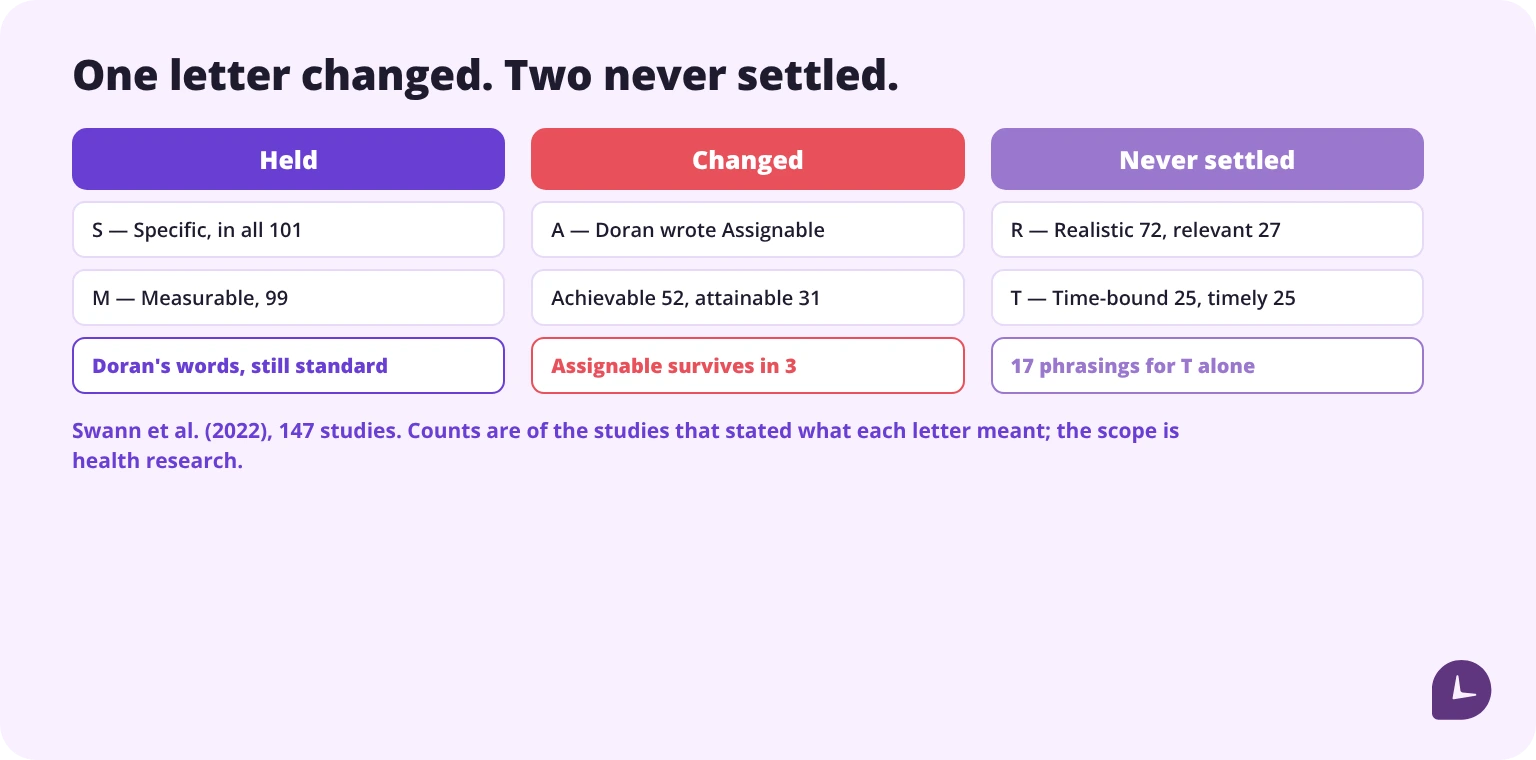
The commonest modern R is Realistic — Doran’s own word — by 72 studies to 27. A ratio of about 2.7 to one. The widely repeated claim that R “became” Relevant describes a minority usage. If you want to know what your own organisation means by R, the only reliable method is to ask, because both readings are in live circulation and they test different things.
The T never settled at all. Time-bound and timely are tied at 25 studies each, with 15 further phrasings behind them. Whatever the T stands for, it means a date; the words are interchangeable and the requirement is not.
The A is the letter that genuinely changed. Achievable leads at 52, attainable follows at 31, and assignable survives in 3 of the 101 studies that stated what their A meant. Every one of the common modern A-words asks whether the goal is possible. None asks who owns it.
Two caveats, because the numbers are only as good as their scope. Those 147 studies are physical-activity and health research rather than management writing, so the counts describe one literature well and others by inference. And only 65.97% of them (k = 97) said what they meant by all five letters at all. The same review notes that an earlier paper identified over 55 possible terms usable as SMART criteria in one field alone.
The useful conclusion is not that SMART is broken. It is that “we use SMART goals” conveys less agreement than the people saying it assume, and that the five minutes spent writing down which five words you mean is the cheapest improvement available to any goal-setting process.
SMART: definition and criteria
The modern five, with the test each one actually applies.
| Criterion | What it requires | The test it fails |
|---|---|---|
| Specific | A single outcome, stated without ambiguity | “Improve customer service” — improve what, measured how |
| Measurable | A metric, a baseline and a target value | “Increase traffic by 25%” — from what? See below |
| Achievable | Possible with available capacity and skill | A target nobody can describe a route to |
| Relevant or Realistic | Connected to a stated objective, or deliverable with the resources at hand | A goal nobody can trace to a priority, or one with no resources behind it |
| Time-bound | A date, not a duration | “By the end of the year” with no interim checkpoint |
Each row’s failure mode is more useful than its definition, because definitions are not where goals go wrong. Three notes on the rows that cause the most trouble.
Specific and Measurable are not the same test. A specific goal names one outcome; a measurable one can be checked. “Reduce support ticket volume” is specific and not measurable. “Improve things by 20%” is measurable and not specific.
Achievable is the easiest criterion to fake, because nobody can disprove it in advance. The honest version asks for the route: what changes, who does it, with what. That is where Doran’s Assignable and his resource-constrained Realistic do the work.
Time-bound means a date. “Within six months” shifts whenever the conversation is revisited; “by 30 June” does not.
For team-level framing see our glossary entry on goal setting for teams, and for the first cycle, initial goal setting.
How do you use SMART goals in a business plan?
Seven steps. The order matters because the later steps constrain the earlier ones, not the reverse.
- Start from the objective, not the goal. A business plan states where the business is going. Goals are the measurable commitments that get it there, so write the objective first and derive goals from it.
- Limit the number. More goals do not mean more progress; see the side-effects section. Three to five per plan period is enough for most teams, and each additional one divides the same capacity further.
- Name the owner for each one. One person, by name. This is Doran’s Assignable, and it is the step most often skipped.
- State the baseline and the target. Both numbers, same metric, same measurement method. Without a baseline you cannot report progress.
- State the resources. What the owner gets that they do not have now. A goal funded by “existing capacity plus effort” is a hope with a date on it.
- Set the checkpoints, and decide how they will be read. Quarterly is usual. Whether “on track” is judged on a linear or a compound path matters more than people expect — see the checkpoint section.
- Write down what you will stop doing. Every goal consumes capacity that was doing something else. If nothing is dropped, the goal is additive and the plan is over-committed.
Step seven is the test of whether a plan is real. A business plan with six new goals and no removals is describing a longer working year, not a strategy.
Three worked examples, each with all seven elements:
| Element | Example 1 | Example 2 | Example 3 |
|---|---|---|---|
| Objective it serves | Grow recurring revenue | Reduce delivery risk | Improve retention |
| Metric | Monthly recurring revenue | Average cycle time, intake to delivery | Voluntary 12-month attrition |
| Baseline | $82,000 | 19 working days | 23% |
| Target | $98,400 | 12 working days | 16% |
| Deadline | 31 December | 30 September | 31 December |
| Owner | Head of Sales, by name | Delivery Lead, by name | People Lead, by name |
| Resources provided | Two additional account executives from Q2 | One process analyst, 3 months | Budget for a market pay review |
| What stops | Outbound to sub-$5k accounts | Custom scoping for pilot clients | Two recurring engagement surveys |
| The change, stated | +20% | −36.84% | −7 points, which is −30.4% of the starting rate |
The numbers are illustrative; the structure is the point. The last row is there because two of these three goals improve by going down, and a percentage without a direction is the single most common source of confusion in goal reporting. Note also that attrition is measured in percentage points, so a move from 23% to 16% is 7 points and 30.4% — two different numbers describing the same change, and the one you report should be the one you agreed.
Baselines are easier to agree when somebody has been recording the period before the goal was written.
See what the last quarter actually contained
How do you know a goal is really measurable?
One rule, and it eliminates most goals that claim to be measurable: a measurable goal contains two numbers, not one. The current value and the target value, on the same metric, measured the same way.
A single target number has nothing to be measured against, so progress toward it cannot be calculated. It is a common defect in published SMART examples, including ones offered as models.
| Goal as written | Measurable? | Why |
|---|---|---|
| “Increase website traffic by 25%” | No | No baseline. 25% of what? |
| “Increase traffic from 40,000 to 50,000 monthly visits by 30 June” | Yes | Two numbers, one metric, a date |
| “Improve customer satisfaction” | No | No metric, no baseline, no target |
| “Raise CSAT from 85 to 92 on the same survey by 31 December” | Yes | Named instrument, both values, and the 7-point move is unambiguous |
| “Grow the team by 100%” | No | No date, and no starting headcount |
| “Grow from 12 to 24 engineers by 31 March” | Yes | Complete |
Three additions that make the rule stronger in practice.
Name the measurement method, not just the metric. CSAT measured by a different survey next year is not the same number. Changing the instrument mid-goal is how goals get met on paper.
Record the baseline before the period starts. A baseline reconstructed afterwards tends to move in a convenient direction, and nobody has to be dishonest for that to happen — the data simply gets selected.
Check the direction, and the unit. Some goals improve by going down: attrition, cycle time, defect rate. Reducing cycle time from 19 to 12 days is a 36.84% reduction, which rounds to 36.8%, and stating that figure without the direction reads as an increase to anyone skimming.
What should a quarterly checkpoint actually read?
Every guide insists on a deadline. Few say how to read the halfway point, and there are two defensible answers that disagree with each other.
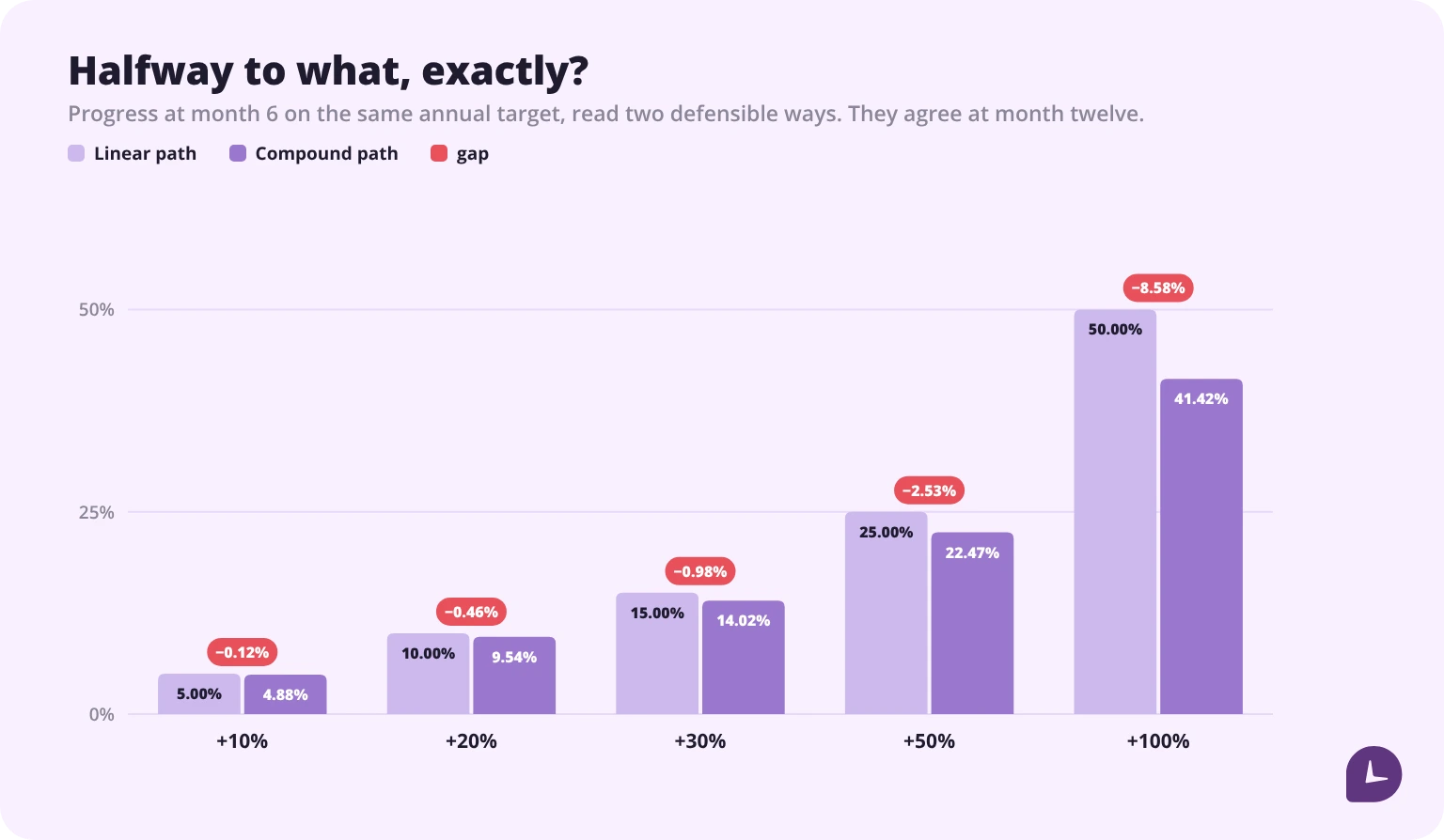
A goal of “+X% over 12 months” can be planned as an equal monthly increment of X ÷ 12, or as compound growth of (1+X)^(1/12) − 1 per month. Those produce different answers to “are we on track?”
| Annual target | Linear per month | Compound per month | Month 6, linear | Month 6, compound | Difference |
|---|---|---|---|---|---|
| +5% | 0.417% | 0.407% | 2.50% | 2.47% | 0.03 pp |
| +10% | 0.833% | 0.797% | 5.00% | 4.88% | 0.12 pp |
| +20% | 1.667% | 1.531% | 10.00% | 9.54% | 0.46 pp |
| +30% | 2.500% | 2.210% | 15.00% | 14.02% | 0.98 pp |
| +50% | 4.167% | 3.437% | 25.00% | 22.47% | 2.53 pp |
| +100% | 8.333% | 5.946% | 50.00% | 41.42% | 8.58 pp |
On a goal to double something, the linear halfway mark is 50% and the compound path reads 41.42% at month 6. A team exactly on a compound plan looks 8.58 points behind when it is checked against the linear midpoint, and gets asked to explain a shortfall that does not exist.
Quarterly checkpoints for a +20% annual goal:
| Quarter | Linear | Compound |
|---|---|---|
| 1 | 5.00% | 4.66% |
| 2 | 10.00% | 9.54% |
| 3 | 15.00% | 14.65% |
| 4 | 20.00% | 20.00% |
Said honestly: for modest targets the distinction barely matters — 0.03 of a percentage point at +5%. It matters for aggressive targets, and it matters most exactly where the pressure is highest. Both paths land on the same number at month twelve, which is why the disagreement is invisible until somebody checks early.
Which path to use depends on the metric. Growth that builds on itself — recurring revenue, a compounding user base — follows a compound path. Throughput improvements from a one-off process change arrive as a step rather than a curve. Decide which it is when the goal is written, record the decision next to the goal, and read the checkpoints accordingly.
What are the side effects of goal setting?
There is an argument about this in a leading management journal, and the argument is more informative than either side of it.
Ordóñez, Schweitzer, Galinsky & Bazerman (2009). “Goals Gone Wild: The Systematic Side Effects of Overprescribing Goal Setting.” Academy of Management Perspectives, 23(1), 6–16.
The authors begin from a position of respect. Their Executive Overview opens: Goal setting is one of the most replicated and influential paradigms in the management literature
. Their argument is not that it fails, but that the beneficial effects of goal setting have been overstated and that systematic harm caused by goal setting has been largely ignored
.
The framing is the memorable part. Rather than dispensing goal setting as a benign, over-the-counter treatment for motivation
, they say it should be treated as a prescription-strength medication that requires careful dosing, consideration of harmful side effects, and close supervision
. They conclude: We offer a warning label to accompany the practice of setting goals
.
The six side effects they identify, in the order the paper lists them:
| Side effect | What it looks like in practice |
|---|---|
| A narrow focus that neglects non-goal areas | Everything outside the goal stops being attended to |
| Distorted risk preferences | Behind on the goal, people take bets they otherwise would not |
| A rise in unethical behaviour | The number gets met in ways nobody intended |
| Inhibited learning | Effort goes to hitting the metric rather than understanding the work |
| Corrosion of organisational culture | Goals compete, and so do the people holding them |
| Reduced intrinsic motivation | Work that was interesting becomes work that is measured |
Now the part that is usually left out. Two articles later in the same issue, Locke and Latham — between them the authors of most of the goal-setting research being criticised — published a rejoinder:
Locke & Latham (2009). “Has Goal Setting Gone Wild, or Have Its Attackers Abandoned Good Scholarship?” Academy of Management Perspectives, 23(1), 17–23.
Their objection is not that goal setting has no downsides. It is about where the six came from: Rather than conducting or integrating research, they chose to draw their central theme from anecdotal evidence
. They also argue that the pitfalls listed are not new, and that almost all the pitfalls of goal setting they cite, rather than being original, have already been published—by us
.
Ordóñez and colleagues replied later the same year, in issue 3 of the same volume — “On Good Scholarship, Goal Setting, and Scholars Gone Wild” — restating the medication analogy and calling for further academic research to examine the full range of goal setting’s effects
.

Three things follow for anyone writing goals, and the first is about how to read the list above.
Treat the six as hypotheses with support, not as findings. “Goals Gone Wild” is a conceptual critique and review: it collected no new data, and its evidence is other people’s studies plus a set of corporate examples. That is exactly what the rejoinder disputes. The six are worth planning around because each is individually plausible and several are separately researched — but a page that presents them as six documented findings is overstating a contested paper, which is the thing the paper itself was accused of.
Fewer goals, not more. A narrow focus is a function of how many things are not goals. A plan with twelve goals has made almost everything else invisible, and this is the side effect with the least controversy attached to it.
Pair every numeric goal with the thing it could damage. A cycle-time goal pairs with a defect rate; a revenue goal pairs with a churn or discount measure. The pairing is the guard against distorted risk-taking and against the number being met in the wrong way — and it costs nothing to write down at the moment the goal is set. Watch the pairing hardest near the deadline, which is where both effects concentrate.
A note on sourcing. The six above are the six named in the paper’s Executive Overview, which is what that journal heads its abstracts. The full article was not read for this page, so the conditions under which each effect appears are not set out here; nor was the rejoinder read in full beyond its own overview. Where this page quotes either, it quotes the published overview.
When should you not set a SMART goal?
Four situations where the framework is the wrong instrument — which follows from the section above and from Doran’s own caveat about measurability.
| Situation | Why SMART fails | What to use instead |
|---|---|---|
| The output cannot be counted | A proxy metric gets optimised instead of the work | Committed-versus-delivered review on a fixed cadence |
| The work is exploratory | A target presumes you already know the answer | A time and money budget, with a decision point |
| The main risk is quality or ethics | The number is the thing that gets met | A standard to hold, not a target to reach |
| The goal belongs to nobody in particular | No owner, so no accountability | Fix the ownership first, then write the goal |
The fourth row is Doran’s Assignable, stated as a stopping condition. If a candidate goal has no single named owner, writing it in SMART form does not improve it. It makes an unowned commitment look rigorous.
The first row is Doran’s own caveat, and he put it immediately after the five criteria: Notice that these criteria don’t say that all objectives must be quantified on all levels of management
. He went further, warning that organisations can lose the benefit of a more abstract objective in order to gain quantification
, and that what matters is the combination of the objective and its action plan
. 45 years of acronym use has not improved on that.
Related reading: best practices for working toward SMART goals covers execution, time management goals the personal application, and the evolution of career goals the individual’s side.
A goal needs a baseline, and a baseline needs a record of the period before the goal existed.
Start recording the baseline
Sources
- Doran, G. T. (1981). “There’s a S.M.A.R.T. way to write management’s goals and objectives.” Management Review, 70(11), 35–36, November 1981, AMA Forum — the origin of the acronym, in which the five criteria are Specific, Measurable, Assignable, Realistic and Time-related, each with the gloss quoted on this page. Not open access; no publisher or library full-view copy was reachable. Read from a reader-uploaded page scan with an OCR layer at the Internet Archive, whose running heads, byline and author credit match the published bibliographic record, and corroborated word for word by the peer-reviewed review below. Bibliographic details separately confirmed from three library catalogue records.
- Swann et al. (2022). “The (over)use of SMART goals for physical activity promotion: A narrative review and critique.” Health Psychology Review, 17(2), 211–226 — the source for every count on this page: which words 147 studies used for each SMART letter, how many specified all five, and the independent confirmation of Doran’s original wording. Its scope is physical-activity and health research, which is stated wherever its numbers are used.
- Ordóñez, Schweitzer, Galinsky & Bazerman (2009). “Goals Gone Wild: The Systematic Side Effects of Overprescribing Goal Setting.” Academy of Management Perspectives, 23(1), 6–16 — the six side effects and the warning-label framing. A conceptual critique and review rather than a report of new evidence, which this page says where it uses it. Quoted from the published Executive Overview.
- Locke & Latham (2009). “Has Goal Setting Gone Wild, or Have Its Attackers Abandoned Good Scholarship?” Academy of Management Perspectives, 23(1), 17–23 — the rejoinder, in the same issue, immediately after the article it answers. Quoted from its own published overview.
- Ordóñez, Schweitzer, Galinsky & Bazerman (2009). “On Good Scholarship, Goal Setting, and Scholars Gone Wild.” Academy of Management Perspectives, 23(3), 82–87 — the reply to the rejoinder, later in the same volume.
- What this page is not a source for. Whether Doran coined the acronym. What Management Review‘s editorial process was — it was the American Management Association’s own periodical, and no record reached says whether it was refereed. The conditions under which each of the six side effects appears. And any claim about what other guides to SMART goals do or do not mention, which is not checkable over an unbounded set.
- What is this page’s own. The linear-against-compound tables and the quarterly checkpoint table, computed with exact decimal arithmetic and asserted against the published figures; the worked examples, whose numbers are illustrative; and the reading of the 2022 counts as a finding about disagreement rather than a correction to one word.
- A note on method. Every quotation was read at source and, where longer than about 125 characters, reconstructed from consecutive short fragments, which is the retrieval tool’s cap, then matched against a second independent record of the same text.
FAQ
Who invented SMART goals?
The acronym was set out by George T. Doran in “There’s a S.M.A.R.T. way to write management’s goals and objectives,” Management Review, 70(11), 35–36, November 1981. Whether he invented it is a different question: he writes “let me suggest” and refers to “the suggested acronym”, names no source, and the article carries no references. No earlier published use was found for this page, which is not the same as there being none.
What did "Assignable" mean?
Specify who will do it. The common modern A-words — achievable, attainable — ask whether the goal is possible instead. Assignable still appears in 3 of the 101 studies in the 2022 review that stated what their A meant, so it has not vanished; it has become rare.
Did the R really change from Realistic to Relevant?
Less than everyone says. The only study that has counted finds Realistic ahead of Relevant 72 to 27 across 147 studies — about 2.7 to one in favour of Doran’s original word. Relevant is a real and widely used reading, and it is the minority one. The practical answer is to write down which you mean.
Were Evaluate and Revise part of the original SMART?
No. SMARTER and similar variants are later extensions, not elements of Doran’s 1981 criteria that were subsequently dropped. The 2022 review records SMARTS and SMARTER among the extensions in circulation.
How many goals should a team have?
Fewer than most plans contain. A narrow focus that neglects non-goal areas is the first of the six side effects Ordóñez and colleagues identify, and it is a function of how much is left outside the goals. Three to five per plan period is a reasonable default.
What makes a goal measurable?
Two numbers on the same metric: the current value and the target. A single target number has nothing to measure progress against. Name the measurement instrument as well, because changing it mid-period is how goals get met on paper.
Is "increase traffic by 25%" a SMART goal?
No. It has no baseline, so progress cannot be calculated, and no date. “From 40,000 to 50,000 monthly visits by 30 June” is.
How do I tell whether we are on track at six months?
Decide when you write the goal whether the path is linear or compound, and record it. On a doubling target the two readings are 8.58 percentage points apart at month 6 — 50% against 41.42% — while on a +5% target they differ by 0.03. Both paths agree at month twelve.
What are the risks of goal setting?
Ordóñez, Schweitzer, Galinsky and Bazerman (2009) identify six: a narrow focus that neglects non-goal areas, distorted risk preferences, a rise in unethical behaviour, inhibited learning, corrosion of organisational culture and reduced intrinsic motivation. Locke and Latham replied in the same issue that the list was drawn from anecdotal evidence and that most of the pitfalls had already been published by them. Both papers are worth knowing about; neither settles it.
Does that mean SMART goals do not work?
No, and neither side of the 2009 argument says so. The critics open by calling goal setting one of the most replicated and influential paradigms in the management literature; their case is about over-prescription. Doran’s own position was the same shape: a guideline, explicitly not a requirement that every objective carry all five criteria.