Fully Remote Companies: Who Is Still Hiring Remotely

A fully remote company has no office that employees are expected to attend. That is rarer than job listings suggest, because three different arrangements get described with the same word: fully distributed, remote-first with optional offices, and hybrid with a required number of office days. The list below covers companies that publicly describe themselves as fully distributed, with the date we checked. The section after it matters more: how to verify a company’s model yourself, because these policies change faster than any article can track.
Key takeaways
- “Remote” covers three different models, and the one you want is usually the narrowest of them.
- Company policies on remote work change frequently, so any list — including this one — carries a date rather than a guarantee.
- The reliable signal is not what a company says on a careers page but where its current job listings say the roles are based.
- Check the country list before you apply. Many fully remote companies hire remotely only within specific countries or time zones.
- A role advertised as remote with a location requirement attached is a hybrid role.
Reliable employee tracking software. Clear visibility and insights into how employees work. Even remotely.
Try Now
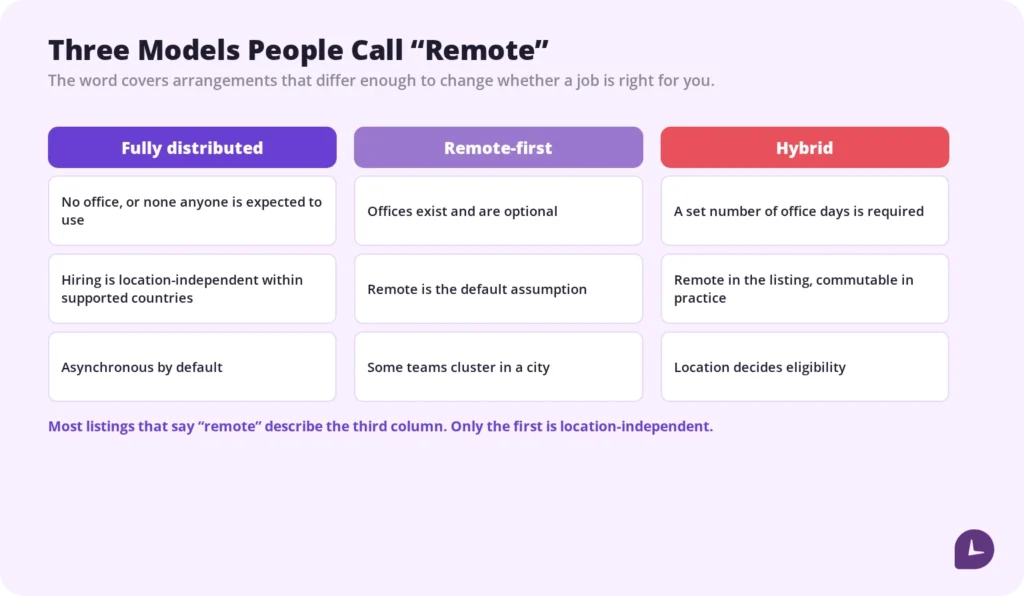
Three Models People Call “Remote”
The word covers arrangements that differ enough to change whether a job is right for you.
| Model | What it means | What to expect |
|---|---|---|
| Fully distributed | No offices, or offices nobody is expected to use. Hiring is location-independent within supported countries | Asynchronous by default, written communication, occasional company-wide meetups |
| Remote-first | Offices exist and are optional. The default assumption is remote | Mostly remote, with some teams clustering in a city and some meetings assuming presence |
| Hybrid | A set number of office days per week or month is required | Remote in the listing, commutable in practice. Location matters |
Most job listings that say “remote” describe the third model. The distinction is worth establishing before you read any list, including the one below, and it shapes most of the remote work challenges people report.
Boost your business productivity
Track performance and streamline teamwork
The Return-to-Office Shift
Worth stating plainly, because it explains why lists like this need dates. Since 2022 a substantial number of large employers have reintroduced office requirements, and several companies that described themselves as remote-first now require attendance.
Two consequences for anyone searching. First, a company’s stated policy from two or three years ago tells you very little about today. Second, the companies that have remained fully distributed tend to be ones where it was a founding decision rather than a pandemic adaptation — which is a useful filter in itself, and the clearest through-line in the rise of remote-first companies.
Companies That Describe Themselves as Fully Distributed
Checked in September 2026. Each of these publicly describes itself as operating without a required office. Policies change — verify on the company’s own careers page before applying.
| Company | What they do | Notes |
|---|---|---|
| Automattic | WordPress.com, WooCommerce, Jetpack, Tumblr and related products | One of the earliest distributed companies; its careers page reports staff across roughly 90 countries and lists active openings across five regions |
| Zapier | No-code automation between apps | Fully distributed since founding, no headquarters; around 800 people across 40+ countries, with twice-yearly company retreats |
| GitLab | DevOps platform | Describes itself as all-remote with no company-owned offices; publishes an extensive public handbook documenting how it operates |
| Buffer | Social media management | Fully remote team across 22 countries, 51 cities and 11 time zones; publicly transparent about salaries and practices |
| Help Scout | Customer support software | Remote since founding, roughly 140 people. Note: engineering, design and product roles have recently been advertised as US-only with core hours 9am–1pm ET |
| Doist | Todoist and Twist | Asynchronous by design, around 100 people in 34 countries. Note: describes itself as remote-first rather than strictly fully distributed |
The list is deliberately short. A shorter list of companies whose status has been verified is more useful than a longer one where two entries turn out to have closed — which is what the previous version of this article contained.
The two notes above are there because they are exactly what the next section tells you to look for. A company can be genuinely remote and still restrict a role to one country or require overlap with one time zone.
How to Check a Company Yourself
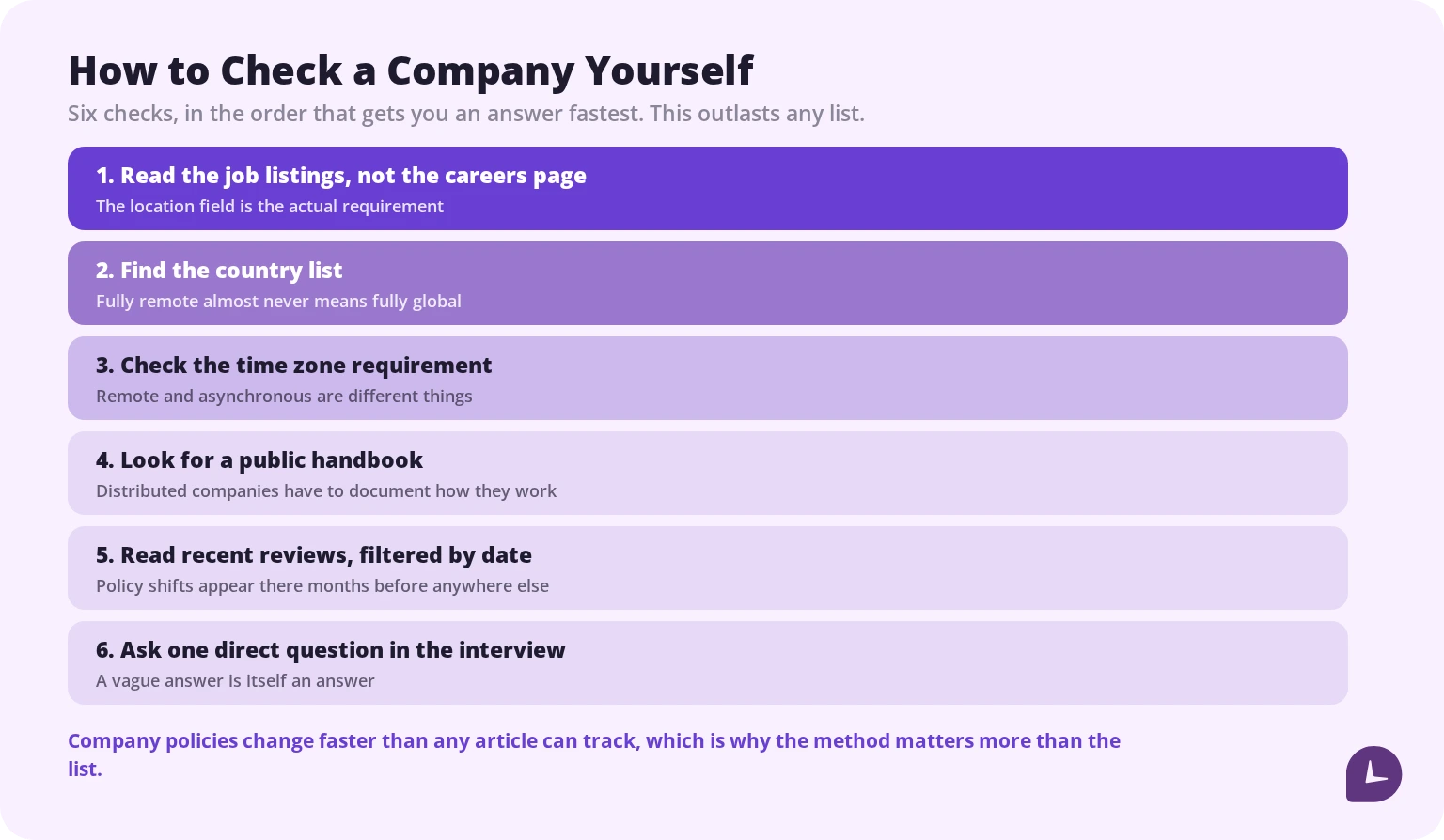
This section outlasts the list. Six checks, in the order that gets you an answer fastest.
1. Read the job listings, not the careers page
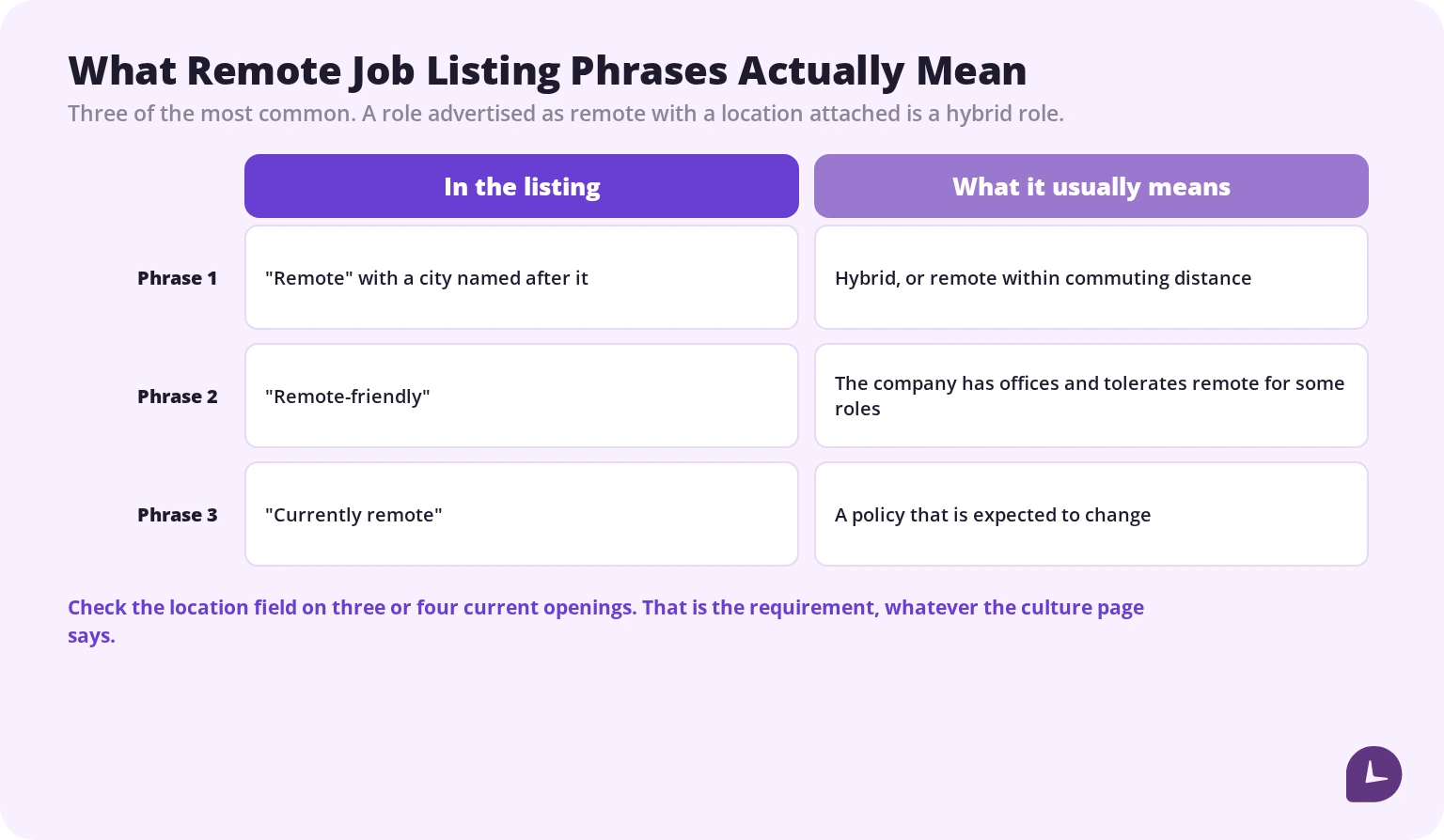
The careers page describes the company’s self-image. The listings describe the actual requirement. Open three or four current openings and look at the location field. If it says “Remote — New York” or “Remote (hybrid)”, the role is not location-independent regardless of what the culture page says.
2. Find the country list
Fully remote almost never means fully global. Employment law, payroll and tax make it expensive to hire in a country where a company has no entity, so most distributed companies maintain a list of countries they hire in. If you cannot find that list, ask in the first conversation — it is the question most likely to end an application late rather than early.
3. Check the time zone requirement
“Remote” and “asynchronous” are different things. A company can be fully distributed and still require four hours of overlap with a specific time zone, which functionally excludes half the world. This is usually in the listing, often in the last paragraph.
4. Look for a written handbook or public documentation
Companies that are genuinely built around distributed work tend to document how it works, because they have to — onboarding someone remotely without written process does not work. A public handbook is one of the strongest available signals, and it tells you a lot about how remote teams document decisions. Its absence is not proof of anything, but its presence is meaningful.
5. Read recent employee reviews, filtered by date
Look only at the last twelve months, and specifically for mentions of office requirements changing. Policy shifts show up in reviews months before they appear in any article. Ignore the star rating and read the text.
6. Ask one direct question in the first interview
“Is there any expectation of office attendance now or planned for the next year?” It is a fair question, it is easy to answer, and a vague answer is itself an answer.
Signs a “Remote” Job Is Not Really Remote
| In the listing | What it usually means |
|---|---|
| “Remote” with a city named after it | Hybrid, or remote within commuting distance |
| “Remote-friendly” | The company has offices and tolerates remote for some roles |
| “Occasional travel to HQ required” | Check the frequency before assuming it is occasional |
| “Must be available during core hours” with no time zone stated | Ask which time zone. It is rarely yours |
| “Currently remote” | A policy that is expected to change |
| No mention of the hiring country list anywhere | Ask early. It may not include yours |
Where to Find Remote Jobs
Company lists go out of date; job boards do not. Three categories worth knowing, and a wider view of the best remote freelance jobs if contract work is also on the table.
- Boards that only list remote roles. The filtering is done for you, though “remote” on these still covers all three models above.
- The careers pages of companies you already know are distributed. Slower, but the listings are first-hand and current.
- General job boards with a remote filter. Widest coverage and the loosest definition of remote, so apply the checks above.
Whichever you use, the checks in the previous section do more for your hit rate than the choice of board.
What to Ask Before You Accept
Four questions that determine what remote work at a company is actually like, none of which appear in job listings.
- How are decisions made and recorded? Distributed companies that work well write things down and lean on asynchronous work. Ones that do not run on meetings you will be attending at inconvenient hours.
- What equipment and home office support is provided? The answer varies enormously and is rarely mentioned until asked.
- How often does the company meet in person, and is attendance required? Most distributed companies hold periodic meetups. Frequency and whether it is optional both matter.
- How is performance measured? On a distributed team this should be about output. If the answer involves hours online or activity monitoring, that tells you the management model — it is worth understanding how performance is measured on remote teams before you are on the receiving end of it.
Key Takeaways
Verify rather than trust the label. Read current listings rather than culture pages, find the country list, check the time zone requirement, and ask directly about office plans in the first conversation. If you are weighing options, top high-paying remote jobs is a reasonable place to see what the market pays.
And treat any list of remote companies, this one included, as a starting point with an expiry date. Policies change; the checks do not.
> Company policies on remote work change frequently. This list reflects publicly stated positions as of September 2026 and is not a guarantee. Confirm on the company’s own careers page before applying.
Reliable employee tracking software. Clear visibility and insights into how employees work. Even remotely.
Try Monitask free for 10 days
FAQ
Which companies are fully remote?
Automattic, Zapier, GitLab, Buffer, Help Scout and Doist are among the longest-established companies that describe themselves as operating without a required office. Policies change, so check the company’s current careers page before applying.
How do I know if a job is really remote?
Read current job listings rather than the careers page and look at the location field. Then check three things: which countries the company hires in, whether a time zone overlap is required, and whether office attendance is planned. Ask directly in the first interview.
Does fully remote mean I can work from anywhere?
Rarely. Most distributed companies hire only in countries where they have a legal entity or an employer-of-record arrangement, and many require overlap with a specific time zone. Find the country list before applying.
Are companies still hiring remotely in 2026?
Yes, though the picture has changed since 2021. A number of large employers have reintroduced office requirements, while companies that were distributed from the start have largely stayed that way. The distinction between those two groups is a useful filter.
What is the difference between remote-first and fully remote?
Fully remote means there is no office to attend. Remote-first means offices exist but are optional and remote is the default assumption. In practice remote-first companies sometimes drift toward expected attendance, which is why the current job listings matter more than the label.