Work Schedule Template: Three Grids, and the Law That Governs When You Publish Them

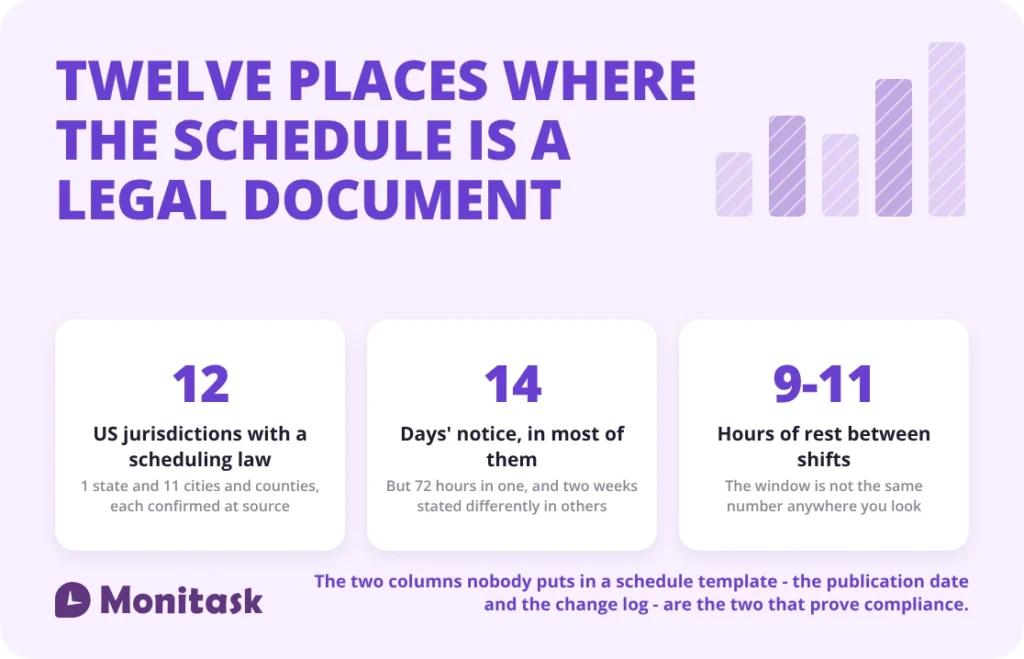
Three grids are below: a weekly staffing schedule, a two-week rotation, and a shift rota with hourly coverage. Each carries fields most templates omit — when the schedule was published, who changed it and when, and whether the employee asked for the change. In 12 US jurisdictions those fields are the difference between a compliant schedule and a payment you owe.
What kind of work schedule template do you need?
3 shapes cover almost everything, and the difference between them is what each one makes visible.
| Grid | What it is for |
|---|---|
| Weekly staffing schedule | One row per person, one column per day, with a publication date and a change log |
| Two-week rotation | The pattern stated as a key, so the next cycle is derivable without rebuilding the grid |
| Shift rota with coverage check | One row per shift, with a minimum-staff column that per-person views hide |
Whichever you use, 4 fields belong in it that almost no template includes:
| Field | Why it matters |
|---|---|
| Publication date | When the schedule was published, which is the fact a notice rule turns on |
| Change log | Who changed what, when, and whether the employee asked for it |
| Written employee request on file | The exception that removes the premium in most jurisdictions |
| Certification expiry | A correctly staffed shift with a lapsed certification is not staffed |
For a single-day planner rather than a week, our daily schedule template is the narrower form of the same thing.
The three grids
Grid 1 — weekly staffing schedule. One row per person, one column per day, and two columns at the right that most templates leave out.
WEEK OF [date]        PUBLISHED: [date and time]        BY: [name]

Employee      Role    Mon    Tue    Wed    Thu    Fri    Sat   Sun   Hrs
[name]        [role]  9-5    9-5    9-5    9-5    9-5    -     -     40
[name]        [role]  -      12-8   12-8   12-8   12-8   12-8  -     40
[name]        [role]  6-2    6-2    -      -      6-2    6-2   6-2   40

CHANGE LOG - every change after publication
Date   Employee   What changed   Requested by   Written request?  Premium?
[date] [name]     [from - to]    [employer /    [yes / no / n-a]  [yes/no]
                                  employee]
The change log is the part that does work later. In a jurisdiction with a notice rule, the question is never “did we change the schedule” — it is who asked for the change and whether you can show it.
Grid 2 — two-week rotation. State the pattern as a key rather than as times, so the next cycle is derivable without rebuilding the grid.
Employee   W1: M  T  W  T  F  S  S   W2: M  T  W  T  F  S  S
[name]         D  D  D  D  D  -  -       -  -  D  D  D  D  D
[name]         -  -  D  D  D  D  D       D  D  D  -  -  -  -
[name]         E  E  -  -  E  E  E       E  E  -  -  E  E  E

Key: D = day shift [hours]  E = evening [hours]  N = night [hours]
     - = off
Grid 3 — shift rota with coverage check. One row per shift rather than per person, with a minimum-staff column.
| Shift | Hours | Minimum staff | Assigned | Names | Covered? |
|---|---|---|---|---|---|
| Early | 06:00-14:00 | 3 | 3 | [names] | Yes |
| Day | 09:00-17:00 | 5 | 5 | [names] | Yes |
| Late | 14:00-22:00 | 3 | 2 | [names] | Short by 1 |
| Night | 22:00-06:00 | 2 | 2 | [names] | Yes |
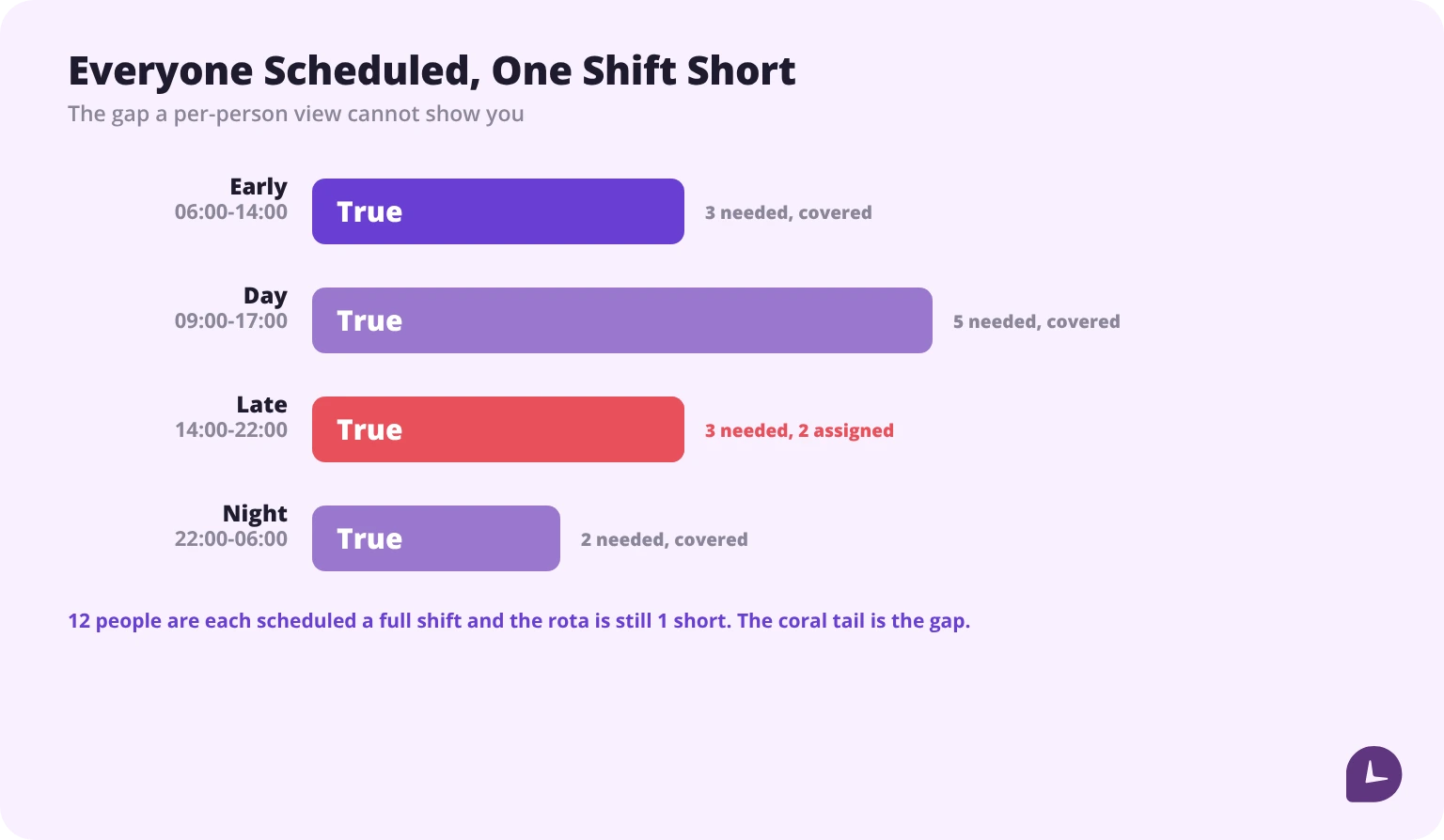
That is the point of the third grid. In the example above, 12 people are each scheduled a full shift — nobody is idle, nobody is overloaded, every individual row looks right — and the rota is still 1 short on the late shift. A per-person view cannot show you that. The per-shift view does it in one column.
Fields to carry in any grid: employee name, role, any certification the shift requires, scheduled hours, weekly total, publication date, and the change log. For roles requiring a license, add an expiry column. A correctly staffed shift with a lapsed certification is not staffed.
Which rotating shift patterns already have names?
If you are building a rotation, you probably do not need to invent one. The established patterns have documented trade-offs for weekend fairness, night-shift load and overtime exposure.
| Pattern | Shape in brief |
|---|---|
| 2-2-3 (Pitman) | Two on, two off, three on, alternating — gives every other weekend off |
| DuPont | Four teams over four weeks, with a full seven-day break in the cycle |
| 4-10 | Four ten-hour days, three days off |
| 9/80 | Eighty hours over nine days in two weeks, with one day off per fortnight |
| Swing shift | Rotating through day, evening and night slots |
Each of these is a decision about fatigue, fairness and overtime, not a template choice. We cover them individually: 2-2-3 schedule, DuPont schedule, Pitman schedule, 9/80 work schedule, swing shift hours. The wider question of how many people you need on each one is workforce scheduling.
How far in advance must a schedule be published?
In most of the United States there is no statutory minimum. In 12 jurisdictions there is — 1 state and 11 cities and counties — and the obligations are specific enough that a schedule built without them triggers payments.
| Jurisdiction | Covered industries | Employer threshold | Advance notice |
|---|---|---|---|
| Oregon (state) | Retail, hospitality, food services | 500+ worldwide | 14 calendar days |
| San Francisco, CA | Formula retail | 40+ establishments worldwide and 20+ in the city | Two weeks |
| Emeryville, CA | Retail and fast food | 56+ globally (fast food also 20+ in the city) | Two weeks |
| Berkeley, CA | Building services, healthcare, hotel, manufacturing, retail, warehouse | 10+ in the city and 56+ globally | 14 days |
| Los Angeles, CA | Retail | 300+ globally | 14 calendar days |
| Los Angeles County, CA | Retail | 300+ globally | 14 days |
| Seattle, WA | Retail and food services | 500+ worldwide (full-service restaurants also 40+ locations) | 14 days |
| New York City, NY | Fast food | 30+ establishments nationally | 14 days |
| New York City, NY | Retail | 20+ workers in the city | 72 hours |
| Philadelphia, PA | Retail, hospitality, food services | 250+ employees and 30+ locations worldwide | 14 days |
| Chicago, IL | Building services, healthcare, hotel, manufacturing, restaurant, retail, warehouse | 100+ employees with 50+ covered (restaurants 250+ and 30+ locations) | 14 days |
| Evanston, IL | Hospitality, retail, warehouse, manufacturing, building services | 100+ globally | 14 days |
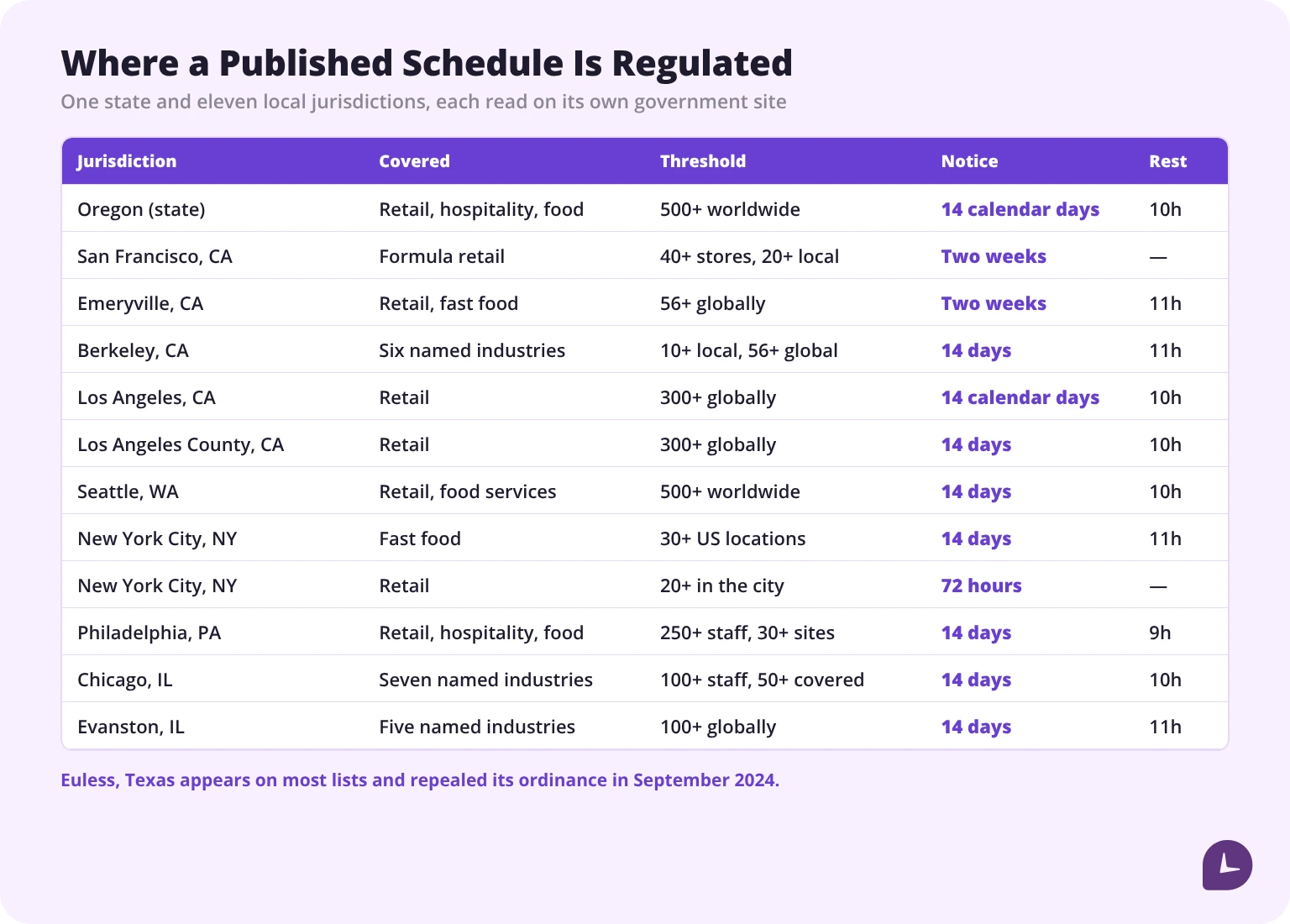
Four things are worth noticing in that table, because they are where national summaries go wrong.
The threshold range is enormous. It runs from 20 workers in the city to 500 worldwide. “500 employees” is an Oregon and Seattle number, not a general one, and an employer that reads it as the rule will miss New York City retail by a factor of 25.
One of them is not fourteen days. New York City’s retail rule is 72 hours, and it works differently — instead of owing a premium for late changes it prohibits on-call shifts outright.
One city appears twice. New York City runs separate regimes for fast food and for retail, with different thresholds, different notice periods and different remedies — 30 or more establishments nationally against 20 workers in the city, 14 days against 72 hours, flat dollar premiums against no premium at all. Treating “NYC” as one rule is how this goes wrong.
One jurisdiction on most published lists is repealed. Euless, Texas adopted Chapter 95, Fair Overtime and Scheduling Standards by a 2020 citizen initiative and repealed it in Ordinance No. 2404, September 2024 — the ordinance says the chapter is hereby repealed in its entirety
, and the ordinance cites Texas HB 2127, which added Texas Labor Code § 1.005 limiting local regulation of scheduling practices. If a compliance list you are using still carries Euless, it is more than two years stale.
Oregon as the worked example. It legislated first and its rules are the clearest. Covered employers are large employers in retail, hospitality and food services — the statute’s wording is A retail establishment that employs 500 or more employees worldwide
, and the same threshold applies to the other two industries. For those employers, An employer shall provide an employee with a work schedule in writing at least 14 calendar days before the first day of the work schedule
.
The notice period has moved, which matters if you are reading an older guide: it was 7 calendar days from 1 July 2018 and became 14 calendar days from 1 July 2020. Anything stating seven days today is out of date.
At hire there is a second duty. An employer shall provide a new employee with a written good faith estimate of the employee’s work schedule at the time of hire
, stating the median number of hours the employee can expect to work in an average one-month period
, explaining the voluntary standby list, and saying whether an employee not on that list can expect on-call shifts.
One structural point that explains why there is no Portland ordinance: Oregon preempts local rules. The State of Oregon preempts all charter and statutory authority of local governments to enact a requirement relating to work schedules
, with narrow exceptions for public employers and public contracts. Most states have no such provision, which is why the rest of the table is cities.
Our guide to shift scheduling covers building the roster itself; this section is about when you are allowed to publish it.
What is predictability pay?
Additional compensation owed when the employer changes a published schedule without the required notice. Oregon splits it by whether the change adds or removes hours:
| Employer-initiated change | What is owed |
|---|---|
| Adds more than 30 minutes to a shift; changes the date or times with no loss of hours; schedules an extra work or on-call shift | One hour of pay at the employee’s regular rate of pay, in addition to wages earned |
| Subtracts hours before or after the employee reports; changes times so hours are lost; cancels a shift; does not call in an on-call employee | One-half times the employee’s regular rate of pay per hour for each scheduled hour that the employee does not work |
The statute carries 13 exceptions, which is more than most summaries mention. The two that come up most are changes caused by a natural disaster or a similar cause outside the employer’s control, and shifts the employee asked for: an employee may request in writing that the employer add the employee to one or more work shifts
, and changes made in response are outside the notice requirement. That written request is why the change log has a column for it. The voluntary standby list works the same way — an employee on it who accepts offered hours is not eligible for additional compensation under ORS 653.455 for the changes
resulting from that acceptance.
Three jurisdictions do not pay in hours. New York City’s fast food rule uses flat dollar amounts rather than a multiple of the rate: $10 for a change on 14 days or less notice where hours stay the same or increase and $20 where they are cut, rising to $15 and $75 inside 24 hours. A clopening there carries a flat $100 premium, and in Philadelphia $40. A payroll rule written as “one hour of pay” will be wrong in both cities.
How much rest is required between shifts?
Federally, none. The Department of Labor’s position on breaks is that Federal law does not require lunch or coffee breaks
, and the Fair Labor Standards Act goes no further: The Fair Labor Standards Act sets no minimum rest between shifts, no maximum hours for adults and no premium for consecutive closing and opening shifts. Sector rules such as the hours-of-service limits for commercial drivers are not general employment law.
Where a rule does exist it is local, and the window is not a single number:
| Jurisdiction | Rest between shifts |
|---|---|
| Oregon | 10 hours |
| Emeryville, CA | 11 hours |
| Berkeley, CA | 11 hours |
| Los Angeles, CA | 10 hours |
| Los Angeles County, CA | 10 hours |
| Seattle, WA | 10 hours |
| New York City, NY | 11 hours |
| Philadelphia, PA | 9 hours |
| Chicago, IL | 10 hours |
| Evanston, IL | 11 hours |
Philadelphia, PA has the shortest window at 9 hours and pays a flat premium rather than a multiple. Oregon’s is the most prescriptive: the employer may not schedule into The first 10 hours following the end of the previous calendar day’s work shift
without the employee’s request or consent, and hours actually worked in that window are paid at one and one-half times the employee’s regular rate of pay
. Note the structure, which guides routinely get backwards — the premium is what is owed if the employee works those hours; scheduling them without consent is itself the violation. Two of the twelve jurisdictions, including San Francisco, have no rest rule at all.
Two California rules are constantly mistaken for a rest requirement. Reporting time pay under IWC Wage Orders 1-16, section 5(C) owes an employee who reports and is sent home half the usual or scheduled day’s work, and in no event less than two hours nor more than four hours, at the regular rate. The split shift premium under IWC Wage Orders 1-15, section 4 owes one hour’s pay at the applicable minimum wage. Both are triggered by showing up to a short or interrupted day, keyed to the same workday. Neither sets any interval between shifts, neither lets an employee decline a shift, and neither requires advance notice of a schedule. New York has a comparable call-in provision at 12 NYCRR § 142-2.3 — at least four hours, or the number of hours in the regularly scheduled shift, whichever is less, at the basic minimum hourly wage — and Massachusetts at 454 CMR 27.04(1).
A day of rest in seven is a different rule again, and three states have one:
| State | Citation | The requirement | Who it covers |
|---|---|---|---|
| California | Lab. Code §§ 551-552 | one day’s rest therefrom in seven | Every person employed in any occupation of labor, subject to a part-time carve-out and monthly averaging |
| New York | Lab. Law § 161 | twenty-four consecutive hours of rest in any calendar week | Factories, mercantile establishments, hotels, restaurants and certain other named employers, plus domestic and farm workers |
| Illinois | 820 ILCS 140 | a minimum of 24 hours of rest within every consecutive 7-day period | Measured on a rolling seven-day period rather than a workweek |
The measuring period differs in all three: California’s workweek, New York’s calendar week, Illinois’s rolling seven days. A single “one day in seven” rule stated flatly would be wrong about at least two of them.
What actually breaks a schedule?
Not the grid. 5 things, and four of them are fixed by a column.
| What goes wrong | What it looks like |
|---|---|
| Nobody owns the publication date | The schedule goes out when it is ready rather than on a fixed day, which is how a notice rule gets missed |
| Changes live in messages | A shift swapped by text is a change nobody can evidence later |
| Coverage is checked per person | Everyone is scheduled and a shift is still short |
| Certifications are tracked somewhere else | The rota is right and the shift is not legally staffed |
| The rotation is stated as times, not as a pattern | Nobody can derive the next cycle, so each one is rebuilt by hand |
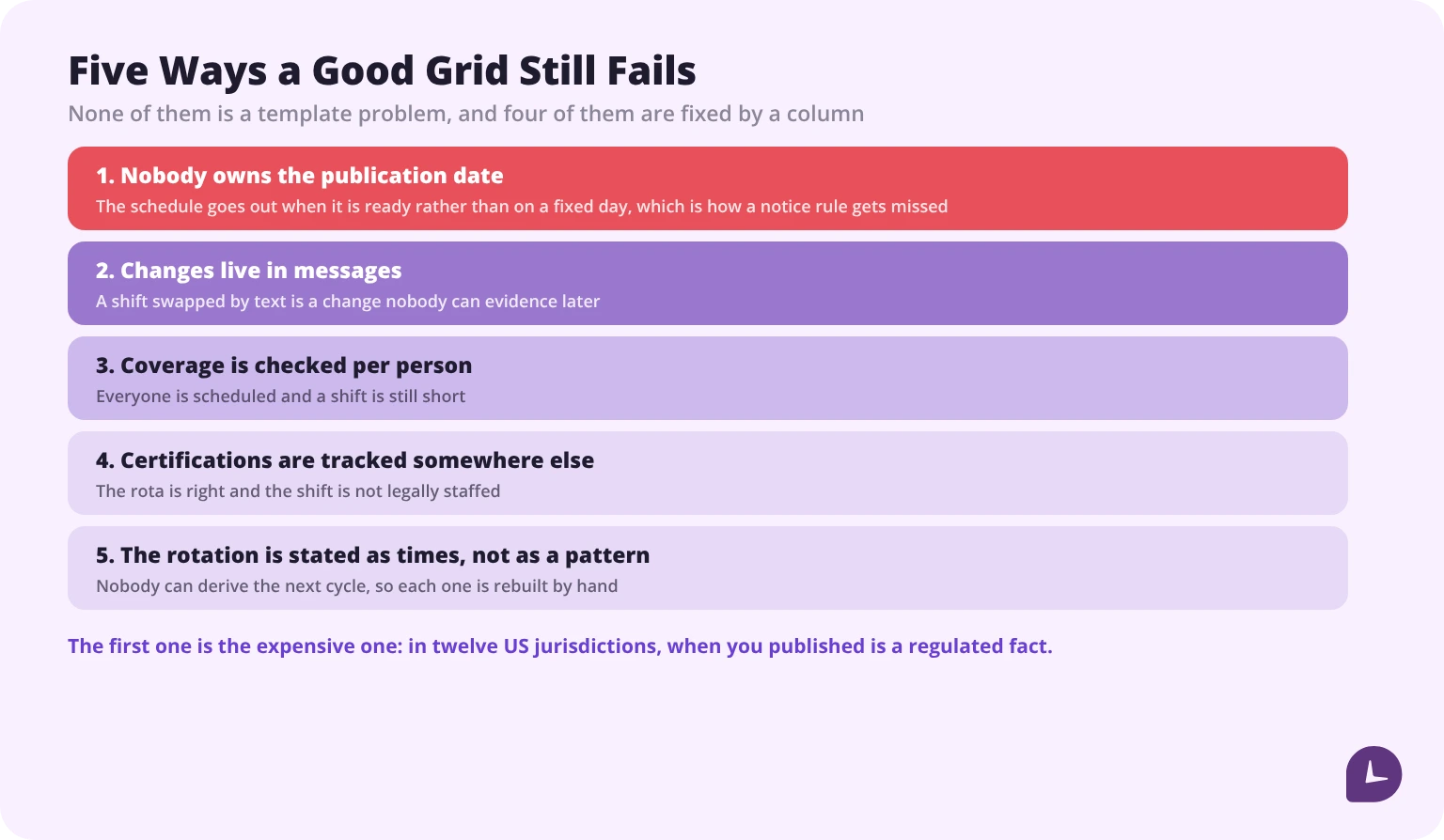
The first one is the expensive one. A schedule that goes out “when it is ready” has no publication date anyone can point to, and in 12 jurisdictions when you published is a regulated fact. Fix it by publishing on a fixed day of the week, recorded, whether or not you think the rules reach you — the discipline costs nothing and the evidence is free.
The gap between the published schedule and what actually happened is schedule adherence, and it is a different measurement from compliance. When the grid stops being maintainable by hand, that is the point to look at employee scheduling software.
What a template cannot settle
Whether the rules reach you. The 12 jurisdictions above cover named industries at stated thresholds, and most employers in most of the country are outside all of them. The table is a list we confirmed at source, not a claim that nothing else exists — states and cities keep adding these, and one has already repealed one.
What your own rules are. Union agreements, sector rules and internal policies routinely require more notice than any statute. The template records a publication date; it cannot know what yours has to be.
Whether the pattern is humane. A rotation can be compliant, fully staffed and still rotate someone through nights in a sequence that nobody can sustain. That judgement belongs to whoever knows the work.
Published shifts, actual clock-ins and the gap between them, with the change history already written down.
See Monitask's time clock software
This article describes work schedule formats and summarizes the scheduling laws in force in the jurisdictions named. It is not legal advice. Coverage, thresholds, notice periods and payments differ between jurisdictions and change; one on this list repealed its ordinance in 2024 and one amended its rules in 2026. Confirm the rules for the places you actually schedule in before relying on them.
Sources
Each jurisdiction below was read on its own government site, its own ordinance, or its official code publisher.
- Oregon — ORS 653.412-653.490. Retail, hospitality, food services, 500+ worldwide. Notice: 14 calendar days. Predictability pay: 1 hour, or half rate for hours lost. Rest: 10 hours. Read on the jurisdiction’s own site. Verified 12 November 2026.
- San Francisco, CA — Labor & Employment Code arts. 41 and 42. Formula retail, 40+ establishments worldwide and 20+ in the city. Notice: Two weeks. Predictability pay: 1 to 4 hours, by how late the change is. No rest rule. Read on the jurisdiction’s own site. Verified 12 November 2026.
- Emeryville, CA — Municipal Code tit. 5, ch. 39. Retail and fast food, 56+ globally (fast food also 20+ in the city). Notice: Two weeks. Predictability pay: 1 hour, or up to 4 hours inside 24 hours. Rest: 11 hours. Read on the jurisdiction’s own site. Verified 12 November 2026.
- Berkeley, CA — Municipal Code ch. 13.102. Building services, healthcare, hotel, manufacturing, retail, warehouse, 10+ in the city and 56+ globally. Notice: 14 days. Predictability pay: 1 hour, or up to 4 hours inside 24 hours. Rest: 11 hours. Read on the jurisdiction’s own site. Verified 12 November 2026.
- Los Angeles, CA — Fair Work Week Ordinance. Retail, 300+ globally. Notice: 14 calendar days. Predictability pay: 1 hour, or half rate for hours lost. Rest: 10 hours. Read on the jurisdiction’s own site. Verified 12 November 2026.
- Los Angeles County, CA — County Code ch. 8.102. Retail, 300+ globally. Notice: 14 days. Predictability pay: 1 hour, or half rate for hours lost. Rest: 10 hours. Read on the jurisdiction’s own site. Verified 12 November 2026.
- Seattle, WA — Municipal Code ch. 14.22. Retail and food services, 500+ worldwide (full-service restaurants also 40+ locations). Notice: 14 days. Predictability pay: 1 hour, or half the hours not worked. Rest: 10 hours. Read on the jurisdiction’s own site. Verified 12 November 2026.
- New York City, NY — Admin. Code tit. 20, ch. 12. Fast food, 30+ establishments nationally. Notice: 14 days. Predictability pay: Flat $10 to $75 per change. Rest: 11 hours. Read on the jurisdiction’s own site. Verified 12 November 2026.
- New York City, NY — Admin. Code tit. 20, ch. 12. Retail, 20+ workers in the city. Notice: 72 hours. Predictability pay: No premium; on-call shifts prohibited outright. No rest rule. Read on the jurisdiction’s own site. Verified 12 November 2026.
- Philadelphia, PA — Code ch. 9-4600. Retail, hospitality, food services, 250+ employees and 30+ locations worldwide. Notice: 14 days. Predictability pay: 1 hour, or half rate for hours lost. Rest: 9 hours. Read on the jurisdiction’s own site. Verified 12 November 2026.
- Chicago, IL — Municipal Code ch. 6-110. Building services, healthcare, hotel, manufacturing, restaurant, retail, warehouse, 100+ employees with 50+ covered (restaurants 250+ and 30+ locations). Notice: 14 days. Predictability pay: 1 hour, or 50% of pay for lost hours inside 24 hours. Rest: 10 hours. Read on the jurisdiction’s own site. Verified 12 November 2026.
- Evanston, IL — Ordinance 24-O-23. Hospitality, retail, warehouse, manufacturing, building services, 100+ globally. Notice: 14 days. Predictability pay: 1 hour at the regular rate. Rest: 11 hours. Read on the jurisdiction’s own site. Verified 12 November 2026.
- Euless, Texas — Chapter 95, Fair Overtime and Scheduling Standards, repealed by Ordinance No. 2404, September 2024. The repealing ordinance was read on the city’s official code site. Verified 12 November 2026.
- San Jose, CA — Municipal Code ch. 4.101, Opportunity to Work Ordinance, effective 13 March 2017. Listed here because it appears on scheduling-law lists and is an access-to-hours law: the employer must offer additional hours to existing part-time employees before hiring someone new. It contains no advance-notice requirement and no predictability pay. Verified 12 November 2026.
- Oregon, ORS 653.412 to 653.490 and OAR 839-026, read on the Legislature’s own ORS chapter, the Bureau of Labor and Industries, and the enrolled session law that changed the notice period. Verified 12 November 2026.
- U.S. Department of Labor, Breaks and Meal Periods. The absence of any federal rest requirement. Verified 12 November 2026.
- California reporting time pay (IWC Wage Orders 1-16, section 5(C)) and split shift premium (IWC Wage Orders 1-15, section 4), read on the Department of Industrial Relations. New York call-in pay (12 NYCRR § 142-2.3) and Massachusetts reporting pay (454 CMR 27.04(1)), read on each state’s own site. Verified 12 November 2026.
- Day of rest: California (Lab. Code §§ 551-552), New York (Lab. Law § 161), Illinois (820 ILCS 140). Verified 12 November 2026.
- Open items, where the official source could not be reached:
- Chicago’s amended rules. The Office of Labor Standards amended the Fair Workweek Rules effective 1 June 2026. The amended text could not be found on chicago.gov; the city’s own current materials still state 14 days and the 1.25 times rest premium, so the article uses those.
- The Los Angeles municipal code section number. The city’s wage page renders the citation ambiguously and the ordinance PDF refuses automated access, so the article names the ordinance rather than a section number.
- Los Angeles County section numbers. The headline figures are confirmed on the county agency’s page; the section numbers come from the Board of Supervisors transmittal rather than the enacted code.
FAQ
How far in advance do you have to publish a work schedule?
In most of the United States there is no legal minimum. In 12 jurisdictions there is: 1 state and 11 cities and counties, usually 14 days, but 72 hours for retail in New York City. The rules apply to named industries above an employer-size threshold, and the threshold ranges from 20 workers in one city to 500 worldwide.
What is predictability pay?
Money owed when an employer changes a published schedule without the required notice. Oregon owes One hour of pay at the employee’s regular rate of pay, in addition to wages earned
where the change adds hours or moves the shift, and One-half times the employee’s regular rate of pay per hour for each scheduled hour that the employee does not work
where hours are lost. New York City’s fast food rule uses flat dollar amounts instead, from $10 to $75 per change.
How many hours of rest are required between shifts?
Federal law requires none. Ten of the twelve jurisdictions with scheduling laws require a rest window, and it is 9 hours in Philadelphia, 10 in Oregon, Seattle, Chicago and both Los Angeles jurisdictions, and 11 in Emeryville, Berkeley, Evanston and New York City fast food.
Is reporting time pay the same as predictability pay?
No, and conflating them is a common error. Reporting time pay is owed when an employee turns up and is sent home early or not put to work; it is a same-day rule keyed to showing up. Predictability pay is owed because the schedule changed after it was published. California has the first and no statewide version of the second.
Do any states require a day off each week?
Three that we confirmed at source: California, New York and Illinois. The requirement looks similar and is measured differently in each — California over the employer’s workweek, New York over a calendar week, Illinois over any rolling seven-day period — and New York’s applies only to named industries.