The 1-3-5 Rule: How to Plan a Day You Can Actually Finish

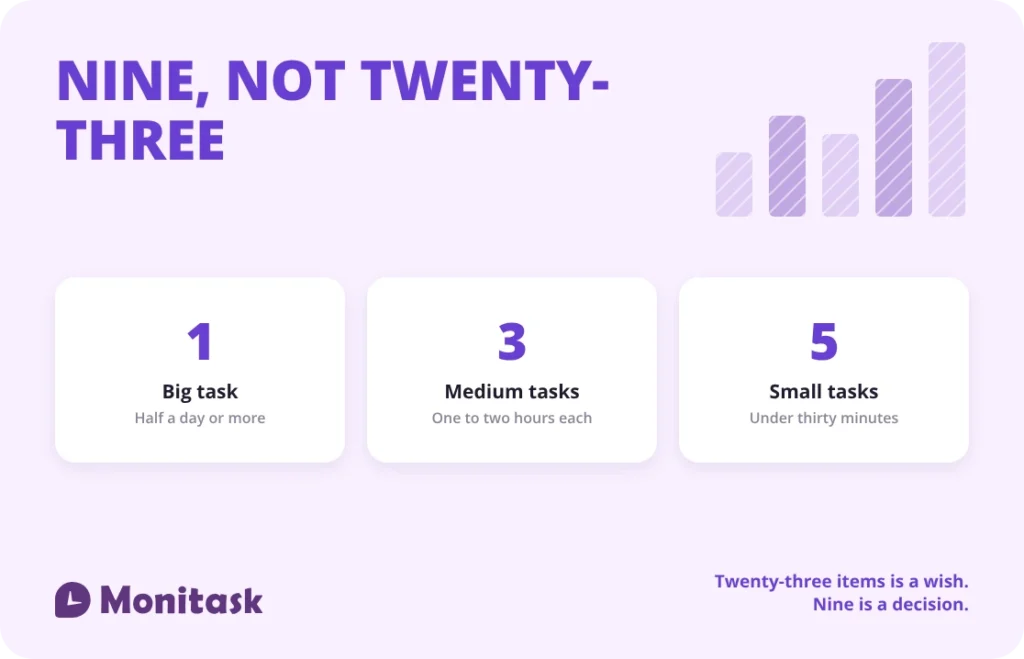
The 1-3-5 rule caps your daily to-do list at nine items: one big task, three medium, five small. The point is not the numbers — it is accepting that a day holds a fixed amount of work, and choosing what goes in it before the day chooses for you. It was popularised by Alex Cavoulacos on The Muse — though nobody, her included, has ever claimed to have invented it — and it works best next to a method that decides when each item happens. One thing no guide to it works out: at the tier sizes the method itself gives, the nine items do not fit in an eight-hour day.
It belongs with the other self-management skills that are easy to describe and hard to hold. The method takes a minute to learn, and the whole difficulty sits in the part nobody writes about: deciding what a big task actually is.
The three tiers
| Tier | What it is | Rough size |
|---|---|---|
| 1 big task | The one achievement that makes the day feel successful | Half a day or more |
| 3 medium tasks | Important but not critical — real progress, less demanding | One to two hours each |
| 5 small tasks | Quick wins that keep things running | Under thirty minutes each |
Nine items, and nothing else on the list. That is the whole method. The difficulty is not understanding it; it is accepting the limit, and then discovering that the sizes above do not quite fit in a working day. Both of those are dealt with below.
Boost your business productivity
Track performance and streamline teamwork
Where did the 1-3-5 rule come from?
The method was set out by Alex Cavoulacos, co-founder and former president of The Muse, in an article called “Why You Never Finish Your To-Do Lists at Work”. It tells you to “assume that you can only accomplish one big thing, three medium things, and five small things”.
The Muse publishes no original date on that page, but Fast Company linked it on 5 April 2013, which puts it on or before then.
It is set out in more detail in the book. The New Rules of Work, written with Kathryn Minshew and published by Crown Business in 2017, covers it at length; The Muse’s own page for the book calls it “The Famous 1-3-5 To-Do List”.
One correction worth making, because every other guide gets it wrong. Most pages about this method say Cavoulacos created it. Neither she nor The Muse says so anywhere. Her article presents it as advice; The Muse’s later standalone explainer is bylined by its editors and credits her with sharing the method rather than inventing it. What can be shown is that she is the reason anyone outside The Muse has heard of it, which is a different claim and the one this page makes.
The line you will see repeated about Betty Liu, then executive vice chairman of the New York Stock Exchange, using the method daily traces to a single Business Insider article from 2019. Her own published biographies do not repeat it, and nor does anything from the exchange, so it is worth reading as one report rather than an endorsement — and the title is a former one.
Why does limiting the list work?
Most to-do lists fail for one documented reason: the planning fallacy. People underestimate how long their own tasks will take, even when they know perfectly well that similar tasks have run long before. Buehler, Griffin and Ross demonstrated it in 1994, using a term Kahneman and Tversky had coined in 1979. The list grows past what is possible, and the gap between the list and the day produces the feeling that nothing is ever finished.
Capping the list at nine items does three things.
It removes the deciding. You start the day knowing what you are doing rather than scanning twenty-three items and picking by mood. Every one of those scans is a small decision, and decision fatigue is cumulative: the choices get worse as the day goes on, which is exactly when the list gets consulted most.
It stops the big task swallowing the day. Without a structure, the largest item either absorbs everything or gets avoided entirely. Three medium tasks alongside it force progress on more than one front.
It makes the trade-off visible. Adding a tenth item means removing one. That is uncomfortable, and the discomfort is the useful part — it is the trade-off you were making anyway, just made explicit.
How do you size a task as big, medium or small?
The question the method depends on, and the one most guides skip. Here is a workable rule.
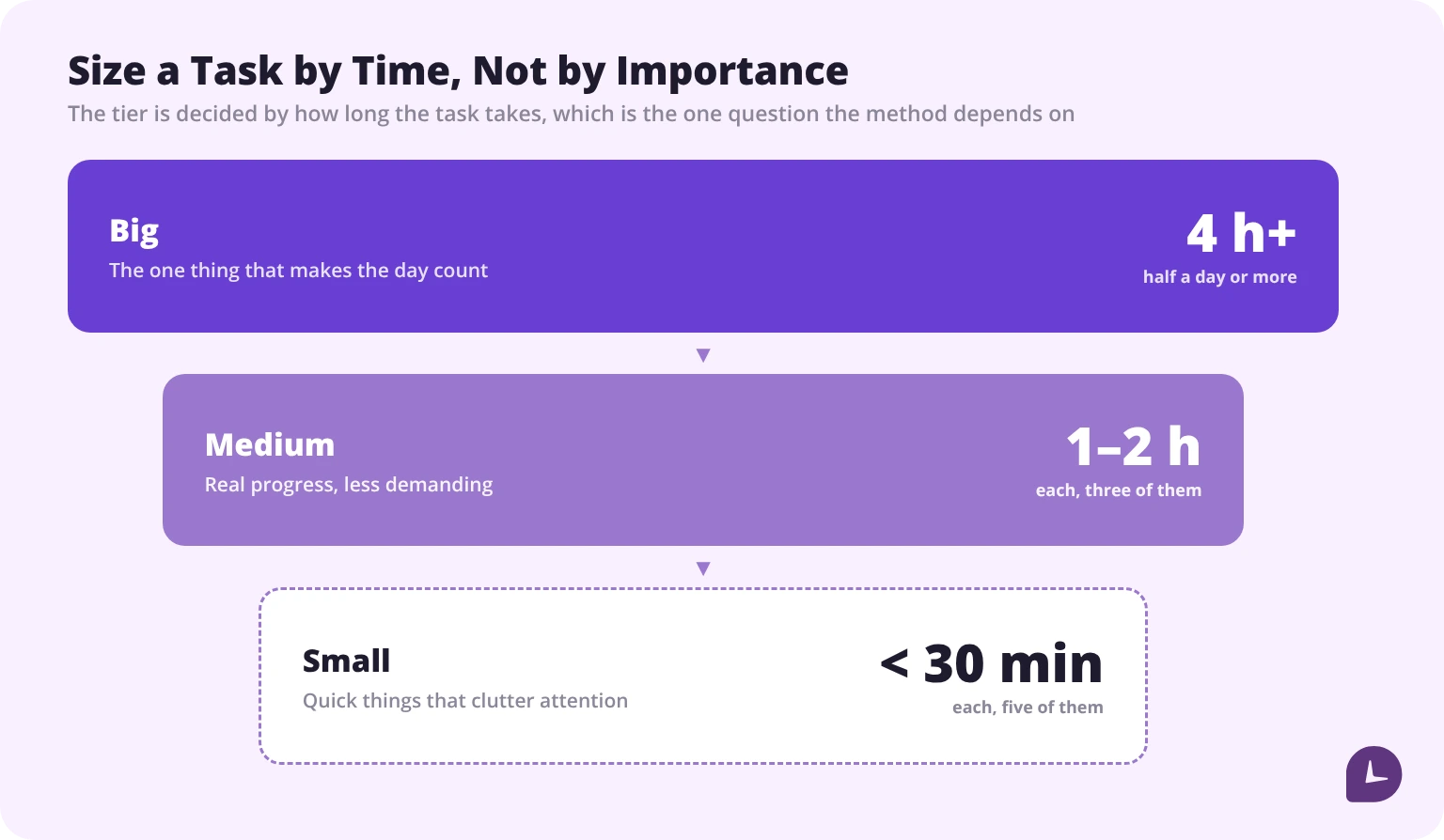
Use time, not importance.
| Tier | Test |
|---|---|
| Big | Needs half a day or more of focused work, and you would be satisfied if it were the only thing you finished |
| Medium | One to two hours. Needs concentration but not a clear run at it |
| Small | Under thirty minutes. Can be done between other things |
Three checks that catch most sizing errors:
- If you cannot describe the finished state in one sentence, it is not a task — it is a project. Break it down and take one piece as the big task.
- If a “small” task has been on the list for a week, it is not small. Something about it is harder than it looks — usually that it depends on someone else.
- If two things are both “big”, one of them is going on tomorrow’s list. There is only one slot, and the constraint is the point.
A note on estimates. Most people’s are optimistic by a consistent factor, which is the planning fallacy showing up in your own calendar rather than in a study. If your days routinely end with the big task half done, your “big” is a day-and-a-half. Adjust the definition rather than trying to work faster.
Do the nine items fit in an eight-hour day?
Not at the sizes above, and this is the part no guide to the method works out.
Multiply the tiers by their own definitions. A big task is half a day or more, so at least 4 hours. Three medium tasks at one to two hours each is 3 to 6 hours. Five small tasks at up to thirty minutes each is up to 2.5 hours. The nine items therefore need between 7 and 12.5 hours of work, with a midpoint of 9.75 hours.
An eight-hour day sits near the bottom of that range. Take the floor — a 4-hour big task and three medium tasks at one hour each — and you have used 7 hours before the small ones start. That leaves 1 hour for five of them: 12 minutes each, with nothing left for meetings, email or anything that arrives.
And the method’s own build step asks for an hour left unblocked. Do that and the arithmetic closes completely: 8 hours minus the open hour is exactly the 7-hour floor, and the five small tasks have no room at all.
This is not an argument against the method. It is the sizing rule the method is missing. The tiers have to be defined against the hours you actually have, not against a nominal working day. A set that does fit, on a day with one short meeting block and an hour kept clear, looks like this: a 3-hour big task, three medium tasks at 45 minutes, five small tasks at 12 minutes. That is 6.25 hours of work, 45 minutes of meetings and 1 hour left open.
The ratio survives. The sizes are what move.
If your sense of what a big task costs is a guess, a week of actual timings will settle it faster than any estimating technique.
See where the hours actually go
How do you build the list?
- Keep a master list of everything, separate from the daily nine. It is not a to-do list; it is a holding area. If it is also where your projects live, how to write a work plan is the next step up from it.
- Pick tomorrow’s nine the evening before.
- Choose the big task first, and choose it by impact rather than by urgency.
- Fill the three medium slots with things that move other work forward.
- Fill the five small slots with genuinely small things — the ones that clutter your attention rather than your calendar.
- Leave the list alone during the day. The list is a decision already made.
What the evening step actually buys you, and what it does not. Planning guides like to say that evening decisions are more realistic than morning ones. No study shows that, and the nearest evidence runs the other way: Buehler, Griffin and Ross found that predictions get more optimistic the further away the task is, and tomorrow morning is further away at nine in the evening than it is at nine the next day.
What the evening step does buy is the removal of the morning negotiation. You arrive at a decision already made, which is worth a great deal on the days when you would otherwise spend the first hour choosing. Pair it with one check, which is the how to be more proactive at work version of the same habit: before you accept the evening list, look at tomorrow’s calendar and subtract the hours that are already gone.
A worked example: a marketing manager’s Tuesday
| Tier | Task |
|---|---|
| Big | Draft the Q4 campaign brief |
| Medium | Review and comment on the agency’s creative concepts |
| Medium | Rework the landing page copy from last week’s feedback |
| Medium | Prep for Thursday’s budget meeting |
| Small | Approve two social posts |
| Small | Reply to the vendor about invoicing |
| Small | Book the photographer |
| Small | Update the campaign tracker |
| Small | Send the team the revised timeline |
What is not on this list: eleven other things that exist and are real. They are on the master list, and they will be on some future day’s nine.
What makes this one work: the big task is a draft, not a campaign. The three medium items are reviews and preparation, which have natural stopping points. None of the five small ones needs anybody else to reply first.
What happens to everything that did not make it?
The question that causes most of the anxiety about this method, and the one the shorter guides leave out.
Nothing gets deleted. Items that do not make the nine go back to the master list. The method does not decide what matters overall — it decides what happens today.
Three rules that make the master list workable:
- Review it weekly, not daily. Looking at forty items every morning defeats the purpose of capping the day at nine.
- Anything that sits there for a month is a decision. Either it is not happening, or it needs to be someone else’s, or it needs to be a big task this week. Leaving it is also a choice, just an unmade one.
- Urgent arrivals displace, they do not add. When something genuinely urgent appears, it takes a slot and the displaced item goes back to the master list. If nothing can be displaced, the new thing is not as urgent as it was presented — which is a useful test to have ready when tight deadlines are being handed out by somebody else.
On the guilt. The objection that comes up most often about this method is that it feels bad to look at what did not make the cut. That feeling was there before, distributed across a list of twenty-three things nobody could finish. The method does not create it; it collects it in one place, which is uncomfortable and also more honest.
What if the big task does not fit in one day?
The most common failure mode, and it is a sizing problem rather than a method problem.
If your big task is really three days of work, you will end each day having not finished it, which is demoralising and also inaccurate — you did make progress.
The fix: make the big task a day-sized piece of the larger thing. Not “write the annual report” but “write the annual report’s methodology section”. The finished state has to be reachable by the end of the day, or the day cannot succeed by definition.
Two tests:
- Can you name what “done” looks like at 6pm today?
- If you did only this, would the day have been worth it?
If either answer is no, cut the task smaller.
Adapting the proportions
The numbers are a starting point, not a rule — but scaling them up is where people come unstuck.
Scaling the counts scales the hours with them. The usual advice is to keep the ratio and go to 2-6-10 if your work is mostly small items. At the tier sizes above, 2-6-10 is 14 to 25 hours of work. If you want more items, the sizes have to come down with the counts: 2-6-10 only means anything if your big task is two hours rather than four.
Adjust for the shape of your work:
| If your day is | Try |
|---|---|
| Mostly meetings | 1-2-3, with the tier sizes halved |
| Deep work with few interruptions | 1-3-5 as written, and a bigger big task |
| Reactive support or service work | 0-3-8 — the big-task slot is not realistic |
| Half the day already booked | 1-2-3 at halved sizes, not 1-3-5 at halved sizes |
Why that last row is not “halve everything”. Halving the sizes of all nine items gives 4.75 hours, which still does not fit the 4 hours a half-booked day leaves you. Halving the counts is not available either: a tier holding one big task has no half. The version that fits is 1-2-3 at halved sizes, which comes to 3.75 hours.
A rule worth keeping whatever the numbers: never more than one big task. That constraint is the method.
How do you combine 1-3-5 with time blocking?
The two methods answer different questions, and almost nobody uses them together.
1-3-5 decides what. Time blocking decides when.
A 1-3-5 list without times is still a list — the big task drifts to the afternoon and gets eaten by meetings. A time-blocked calendar without a 1-3-5 list has structure but no priority, so the blocks fill with whatever arrived most recently.
How to combine them, in five minutes the evening before:
- Pick the nine
- Block the big task first, in your best hours, before anything else can take them
- Block one slot for the three medium tasks — they rarely need separate blocks
- Leave the five small ones unblocked; they fill the gaps between everything else
- Leave at least one hour unblocked for what will arrive
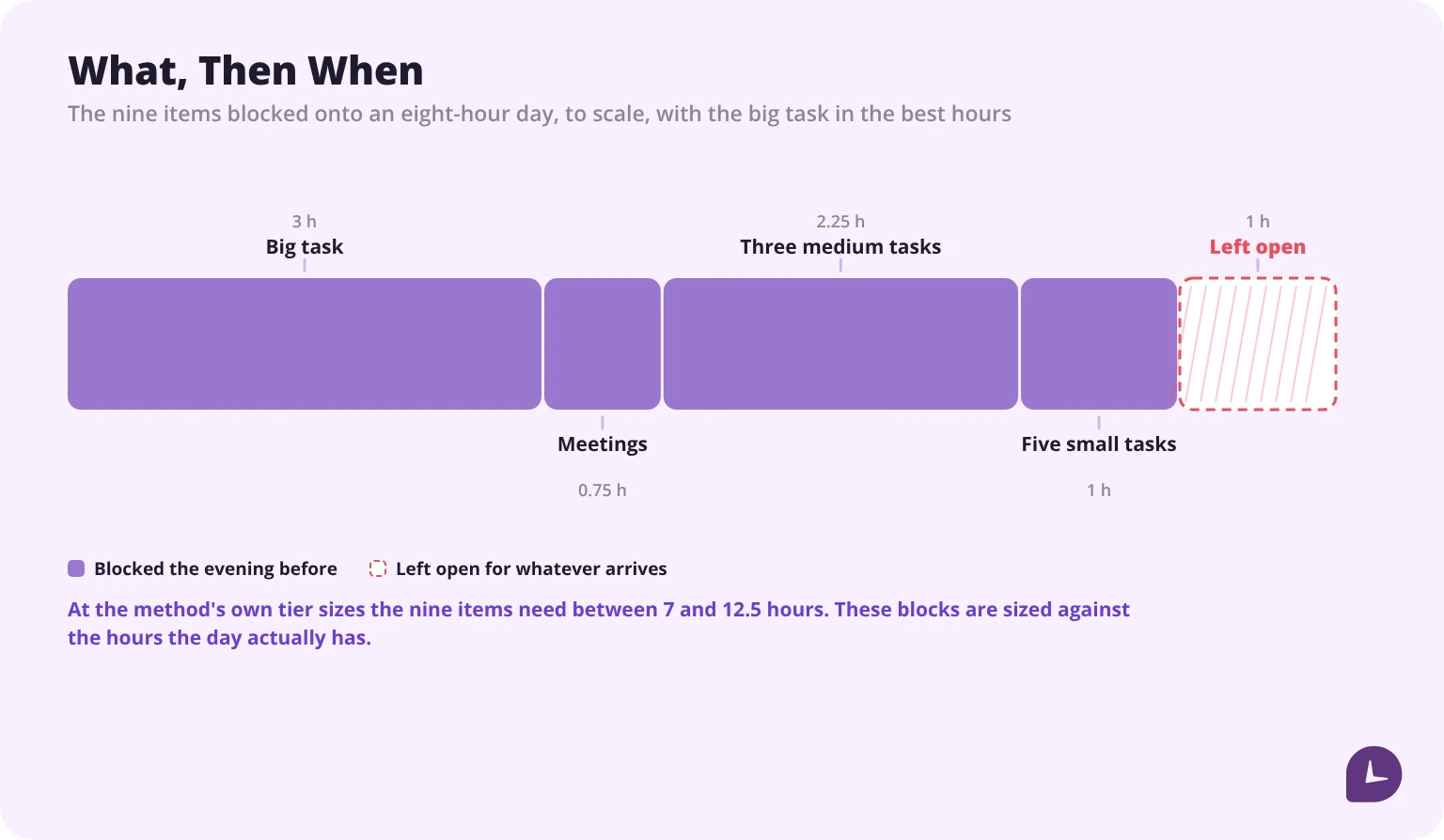
Step four is where the arithmetic above bites: if the first three steps have used the whole day, there are no gaps for the small tasks to fill. Block the big task and the medium ones against the hours you actually have, and the small ones land in what is left. Our guide to time blocking techniques covers the scheduling side in more detail, and the honest answer there is the same as here: the method matters more than the software.
Can a team use the 1-3-5 rule?
Every guide on this method writes for one person. Two ways it works at team level.
As a shared format for daily planning. Each person posts their nine in a channel or standup. The benefit is not oversight — it is that nine items is short enough for colleagues to actually read, which a twenty-item list is not. People spot overlaps and dependencies they would otherwise hit two days later.
As a way of assigning work honestly. If someone’s day already has a big task and three medium ones, adding “just one more quick thing” is visibly displacing something. The format makes the cost of an interruption legible to whoever is causing it.
Two cautions:
- Do not use it to compare people. Nine items of one person’s work is not comparable to nine of another’s, and the moment it becomes a metric people start listing small things.
- Do not require it. A planning method imposed from above stops being planning and becomes reporting.
Where does the method fall short?
Six limitations, of which the first is this page’s own finding and the rest show up the moment the method meets a real week.
The sizes do not add up to a day. Worked out above. It is the likeliest reason a method this simple gets abandoned early: you follow the tier definitions, run out of day, and conclude the problem is you.
It feels rigid when the day goes wrong. The structure that helps on a normal day becomes another thing failing on a bad one. The fix is treating it as a guideline: a day that ends 1-2-3 is a fine day.
It can become a list about a list. Sorting everything into tiers takes time, and for some people the sorting becomes the procrastination. If planning takes more than ten minutes, simplify it.
It does not suit reactive work. If your job is responding to whatever arrives — support, operations, service desk — a big task slot is a fiction. Use 0-3-8, or accept that the method is for your planned work only.
It says nothing about when. Which is why the time-blocking section above exists.
It does not prioritise between days. A task can sit on the master list indefinitely without anyone deciding about it. The weekly review is what covers this, and it is the step most often skipped.
How does 1-3-5 compare with other methods?
| Method | What it decides | Best when |
|---|---|---|
| 1-3-5 | What goes in the day, with a cap | Your list is too long and everything looks equally urgent |
| Eisenhower matrix | What is important versus urgent | You need to decide what to drop or delegate entirely |
| Most important tasks | The two or three things that must happen | You want less structure than 1-3-5 |
| Time blocking | When each thing happens | Your calendar is full and work gets squeezed out |
| Pomodoro | How you work within a block | Focus is the problem, not prioritisation |
They are not alternatives. The workable combination for most people is 1-3-5 to choose, time blocking to schedule, and Pomodoro inside the blocks if focus rather than prioritisation is the problem. If you are not sure which of those is your problem, how to prioritize tasks is the place to start: a method that caps the day only helps once you can rank what goes in it.
Nine items a day only works if you know what the nine cost you. That is a measurement question before it is a planning one.
Keep a record of where your hours actually go
Sources
- Alex Cavoulacos, “Why You Never Finish Your To-Do Lists at Work (And How to Change That)”, The Muse. The article that set out the method; no original publication date is shown on the page.
- Drake Baer, “The 1-3-5 Rule For More Doable To-Do Lists”, Fast Company, 5 April 2013. Links the original article and dates it to on or before that day.
- The Muse Editors, “A Better To-Do List: The 1-3-5 Rule”, The Muse. The later standalone explainer, which credits Cavoulacos with sharing the method rather than inventing it.
- Kathryn Minshew and Alexandra Cavoulacos, The New Rules of Work, Crown Business, 2017. Note the book uses the fuller form of her first name; her Muse writing uses Alex.
- Roger Buehler, Dale Griffin and Michael Ross, “Exploring the ‘Planning Fallacy’: Why People Underestimate Their Task Completion Times”, Journal of Personality and Social Psychology, 67(3), 1994, pages 366 to 381.
- Daniel Kahneman and Amos Tversky, “Intuitive Prediction: Biases and Corrective Procedures”, TIMS Studies in Management Science, 12, 1979, pages 313 to 327. Where the term comes from.
- Neil D. Weinstein, “Unrealistic Optimism About Future Life Events”, Journal of Personality and Social Psychology, 39(5), 1980, pages 806 to 820. A different finding, about personal risk rather than task duration, and the one most often mistaken for the planning fallacy.
- Intercontinental Exchange, “Intercontinental Exchange Names Betty Liu Executive Vice Chairman of the New York Stock Exchange”, 5 June 2018. The source of a title that is now a former one.
FAQ: The 1-3-5 Rule
Who created the 1-3-5 rule?
Nobody has claimed to. It was set out by Alex Cavoulacos, co-founder and former president of The Muse, in an article published on or before April 2013, and it is covered in *The New Rules of Work*, the book she wrote with Kathryn Minshew. Neither she nor The Muse describes her as its inventor, so the accurate statement is that she is the reason it spread.
How do I know if a task is big, medium or small?
By time, not by importance. Big means half a day or more, medium one to two hours, small under thirty minutes. If you cannot describe what “done” looks like in one sentence, it is a project rather than a task, and if a small task has survived a week on the list it is not small — usually because it is waiting on someone else.
Do the nine tasks actually fit in an eight-hour day?
Not at the sizes the method gives. One big task at four hours, three medium at one to two hours each and five small at up to half an hour each comes to between 7 and 12.5 hours, against an eight-hour day. Only the very floor of that range fits, and it leaves 12 minutes for each of the five small tasks. Size the tiers against the hours you actually have.
What do I do with tasks that do not fit in the nine?
They go back to a master list, which you review weekly rather than daily. Nothing gets deleted. The method decides what happens today, not what matters overall. Anything that sits on the master list for a month has effectively been decided against, and it is worth saying so out loud rather than carrying it for another month.
What if my big task takes more than a day?
Then it is a project, not a task. Take a day-sized piece of it: not “write the report” but “write the report’s methodology section”. The finished state has to be reachable by the end of today, or the day cannot succeed by definition and you end every evening with the same item unfinished.
Can I change the numbers?
Yes, as long as the sizes move with the counts. Going to 2-6-10 while keeping a four-hour big task means 14 to 25 hours of work, which is not a day. For a meeting-heavy day, 1-2-3 at halved sizes comes to 3.75 hours and fits a half-booked one. The rule worth keeping is never more than one big task.
When should I make my 1-3-5 list?
The evening before, for a reason that is often overstated. There is no evidence that evening estimates are better than morning ones, and the research on prediction suggests the opposite if anything. What the evening list does is remove the morning negotiation, so you start the day with a decision already made instead of making one.
Does the 1-3-5 rule work with time blocking?
They answer different questions and work well together: 1-3-5 decides what, time blocking decides when. A 1-3-5 list without scheduled time tends to lose the big task to the afternoon. Block the big task first in your best hours, give the three medium tasks one shared slot, and leave an hour unblocked for what arrives.
Can a team use the 1-3-5 rule?
Yes, as a shared daily planning format: nine items is short enough that colleagues actually read it, which is where the overlaps and dependencies get spotted. It should not be used to compare people, because nine items of one person’s work is not nine of another’s, and it should not be imposed, because a required planning method becomes reporting.