Self-Management Skills and How to Develop Them

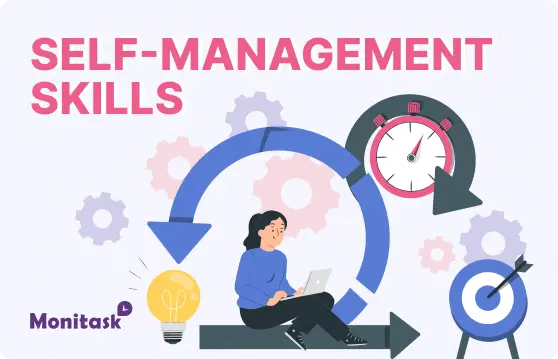
Self-management is the ability to direct your own time, behaviour and attention without someone else supplying the structure. It matters more in remote and flexible roles for an obvious reason: nothing external is holding the day together. Below are ten skills, what each one looks like when it is working, and one concrete thing to do to build it — plus a short self-assessment, because self-management is rarely weak everywhere at once.
Key takeaways
- Self-management splits into five areas: time and tasks, emotions, behaviour, energy, and goals. Most people are strong in two or three and weak in one.
- The weak area is the one worth working on, and it is usually not the one that is easiest to improve.
- Skills are built by changing a specific behaviour, not by resolving to be more disciplined.
- Self-awareness comes first: you cannot manage attention you have never measured.
- At work, self-management is judged by whether you need reminding, not by how busy you look.
Reliable employee tracking software. Clear visibility and insights into how employees work. Even remotely.
Try Now
What Self-Management Actually Means
Self-management is directing your own thoughts, emotions and actions toward what you decided matters, when nobody is making you. It is not the same as discipline, which is one component of it, and it is not the same as productivity, which is one possible result.
The practical definition: a self-managed person decides what needs doing, does it in a reasonable order, keeps going when it stops being interesting, and recovers well enough to do it again tomorrow. Each of those four is a separate ability, and they fail separately.
Boost your business productivity
Track performance and streamline teamwork
The Five Areas
| Area | What it covers | What failure looks like |
|---|---|---|
| Time and task management | Planning, prioritising, sequencing work | Busy all day, nothing important finished |
| Emotional self-control | Responding rather than reacting | One difficult conversation derails the afternoon |
| Behavioural self-regulation | Doing what you decided when you no longer feel like it | Good intentions on Monday, none by Thursday |
| Stress and energy management | Workload, boundaries, recovery | Sustained output for three weeks, then collapse |
| Goals and self-motivation | Direction and the drive to keep at it | Working steadily on things that do not matter |
Where Are You Weakest?
Score yourself one to five in each of the five areas. The exercise takes two minutes and is more useful than reading the whole article, because it tells you which part to read carefully.
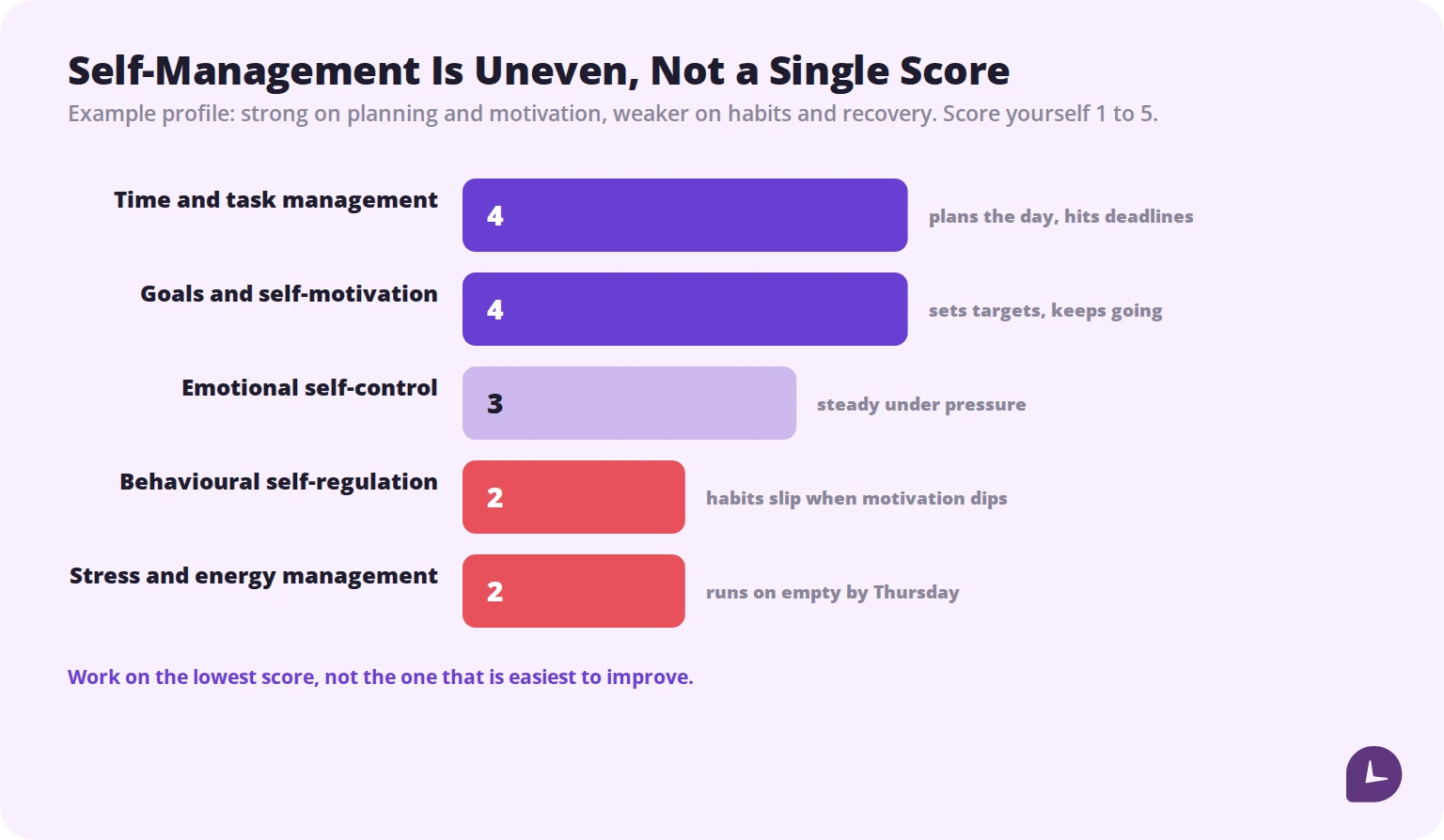
Two things people get wrong here. First, they score the area they think they should be good at rather than the one they are. Second, having found the low score, they work on a different area instead — because improving a strength is more pleasant than confronting a weakness. The low score is the one that limits everything else.
The 10 Self-Management Skills
| # | Skill | What it looks like | One way to build it |
|---|---|---|---|
| 1 | Time management | Knowing what today is for before it starts | Plan tomorrow at the end of today, in writing, three items maximum |
| 2 | Prioritisation | Doing the important thing before the urgent one | Ask of each task: what happens if this waits a week? |
| 3 | Self-discipline | Acting on the decision after the motivation fades | Decide in advance: “when X happens, I will do Y” |
| 4 | Accountability | Owning outcomes, including the bad ones | Report the slipped deadline before you are asked |
| 5 | Emotional regulation | Pausing between the trigger and the response | Name the emotion before responding; the naming creates the gap |
| 6 | Stress management | Noticing the load before it becomes damage | Track energy for two weeks alongside hours; the pattern is usually obvious |
| 7 | Adaptability | Re-planning without relitigating the change | Separate the decision you disagree with from the plan you now need |
| 8 | Goal setting | Objectives specific enough to be finished | Write goals with a date and an observable outcome, not an aspiration |
| 9 | Self-motivation | Keeping going without external pressure | Connect the task to the reason it exists; the reason is the fuel |
| 10 | Self-awareness | Knowing your own patterns accurately | Measure something — hours, interruptions, energy — rather than estimating |
Skill 1 has more depth to it than one row allows; managing your own time covers the mechanics. Skill 4 is the one most often confused with responsibility, and the difference between the two is worth reading if you manage anyone.
The last one underpins the other nine. Almost everyone misjudges where their time goes, usually by hours a week, and a plan built on a wrong estimate fails for reasons that look like weak discipline.
Building the Skills: What Actually Works
Measure before you change anything
Spend a week recording where your hours go, without trying to improve them. Most people find two surprises: a category consuming far more than expected, and a block of “work” that turns out to be context-switching. You cannot fix either while estimating them.
Use implementation intentions, not resolutions
“I will be more focused” fails. “When I sit down after lunch, I will close email and work on the report for 45 minutes” works considerably better, because it specifies the trigger and the action rather than the aspiration. Write them in that form: when X, then Y.
Make the environment do the work
Discipline spent on resisting a distraction is discipline not spent on the task. Remove the distraction instead: phone in another room, notifications off by default, the tempting tab closed rather than open and resisted. This is the cheapest available improvement and the one people skip because it feels like cheating. It is also the precondition for deep work, and screen time management is where most of the leak usually is.
Build one habit at a time
Attempting five changes at once means five things to sustain on the day you have no energy. One change, held until it stops requiring attention, then the next.
Review weekly, not daily
Daily review produces noise; you cannot see a pattern in one day. Fifteen minutes a week, asking what worked, what did not, and what you will change, is enough to notice trends while they are still adjustable.
Managing Stress and Energy
The fourth area is the one people treat as a personality trait rather than a skill, and it is the one where the failure mode is delayed: three good weeks followed by a bad month. Two practical levers do most of the work — setting boundaries so the working day has an end, and a small set of stress management techniques you can apply before the load becomes damage rather than after. Where the load is already past that point, the National Institute of Mental Health has practical guidance on looking after your own mental health.
How Self-Management Shows Up at Work
Self-management is visible to other people before it is visible to you, and it is judged by a narrower signal than most people assume: whether you need reminding.
The behaviours that read as strong self-management are unglamorous. Turning up to meetings having done what you said. Flagging a slipping deadline on Tuesday rather than apologising on Friday. Saying you have capacity for one more thing rather than three. None of these look impressive; their absence looks obvious.
Remote work raises the stakes. In an office, some of the structure is external — people are visible, the day has shape, someone notices when you are stuck. Remotely all of that has to be self-supplied, which is why the same person can look organised in an office and struggle from home without becoming any less capable.
Seeing Your Own Data
Self-awareness is the foundational skill and the one hardest to build from introspection, because memory of how you spent your time is systematically unreliable. Estimates of focus time run high; estimates of interruptions run low.
Time tracking is worth mentioning here specifically because it is usually framed as something done to employees rather than something useful to the person doing the work. Both can be true. Seeing your own week — where the hours went, when the focus blocks actually happened, how fragmented the afternoons were — turns self-management from a matter of resolve into a matter of evidence.
If your employer uses tracking software, you almost certainly have access to your own numbers. Look at them before your manager does. They will tell you which of the five areas is actually your weak one, which is the question this article opened with.
Boost your business productivity. Track performance and streamline teamwork.
Start Your 10-Day Trial
Key Takeaways
Self-management is five separate abilities that fail separately. Find the weakest, change one specific behaviour rather than resolving to be better, and measure rather than estimate — because a plan built on a wrong picture of your week fails in ways that look like a character problem and are not.
Monitask records where hours actually go, with the report visible to the person doing the work and not only to their manager. Try it on a 10-day free trial, no card required.
Reliable employee tracking software. Clear visibility and insights into how employees work. Even remotely.
Try Monitask free for 10 days
FAQ: Self-Management Skills
What are examples of self-management?
Planning tomorrow’s work before today ends. Flagging a slipping deadline early rather than late. Staying composed in a difficult meeting. Keeping a habit going on a day when motivation has gone. Stopping work at a reasonable hour so tomorrow is usable.
Can self-management skills be learned?
Yes, and specific behaviours are learned faster than general resolve. “When I sit down after lunch, I close email and work on the report” is learnable. “I will be more disciplined” is not.
Which self-management skill matters most?
Self-awareness, because the others depend on an accurate picture of your own patterns. Most people misjudge where their time goes by hours a week, and every plan built on that estimate inherits the error.
Why is self-management harder when working remotely?
In an office some structure is supplied externally — visible colleagues, a shaped day, someone noticing when you are stuck. Remotely all of it has to come from you, so the same person can appear organised in one setting and struggle in the other.
How do employers assess self-management?
Mostly by whether you need reminding: do commitments get met without follow-up, do problems surface early, is capacity described honestly. Output and reliability carry more weight than visible busyness.