How to Ask for a Promotion: Scripts, Timing and What to Do If the Answer Is No

Ask in a dedicated meeting you requested in advance, not in a performance review and not in a corridor. Bring a written record of what you have delivered, a clear statement of the role you want, and the case for why it helps the business. The preparation starts months before the conversation, and the most useful part of the meeting is often what you agree to do next if the answer is no.
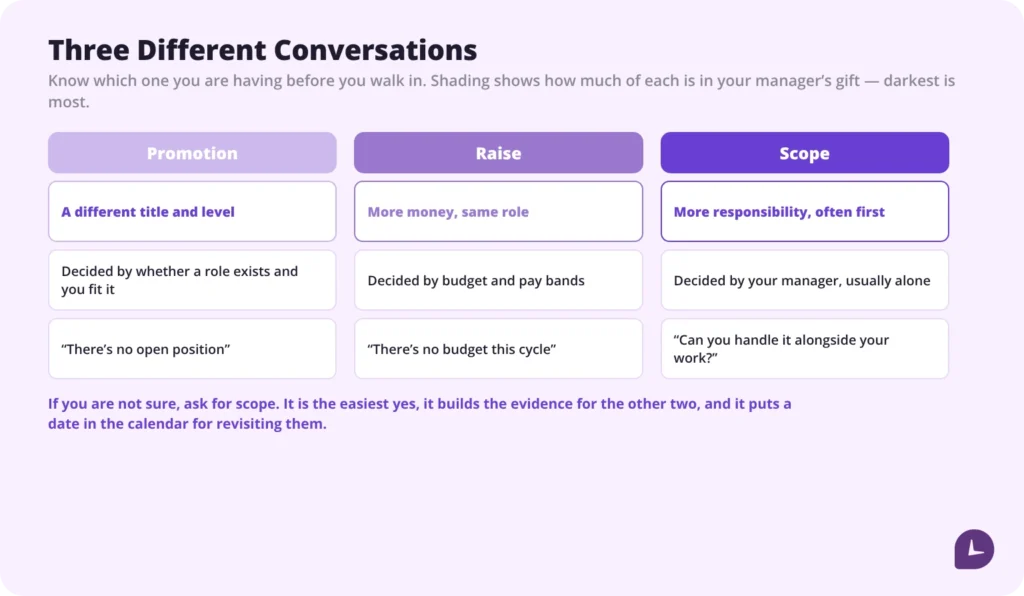
Promotion, raise or scope: which are you asking for?
Three different asks get bundled under one word, and the confusion is a common reason the conversation goes nowhere.
| What you are asking for | What decides it | The usual objection | |
|---|---|---|---|
| Promotion | A different title and level | Whether a role exists and you fit it | “There’s no open position” |
| Raise | More money, same role | Budget and pay bands | “There’s no budget this cycle” |
| Scope | More responsibility, often before a title | Your manager, usually alone | “Can you handle it alongside your work?” |
Decide which one before the meeting. A manager who thinks you are asking for money when you are asking for a path will answer the wrong question, and you will leave with nothing and no idea why.
If you are not sure, ask for scope. It is the easiest yes, it is the one your manager can grant without anyone else, it builds the evidence for the other two, and it puts a date in the calendar for revisiting them.
Boost your business productivity
Track performance and streamline teamwork
When should you ask?
On time in role, the usual advice is at least a year — and it is worth knowing that this is a convention rather than a finding. No payroll or HR data provider publishes a median time in role before promotion, and the figures that circulate in trade press trace back to careers blogs rather than to any dataset.
What the payroll data does show is that promotions are rarer than people assume. ADP Research, modelling a model built on ADP payroll and HR data, 1.2 million US workers at employers of 1,000 or more, 2019 to 2022, found that only 4.5% of workers are promoted within two years of being hired. So a long stretch without movement is the normal case rather than a sign that something has gone wrong. Treat it as a reason to ask what the path looks like, not as evidence that you have been overlooked.
Company context matters more than the calendar. A restructuring, a hiring freeze or a bad quarter is a poor moment. Growth, a new team, a departure that leaves a gap, or a project of yours that has just landed well is a good one.
Find out when decisions are actually made. Most organisations run a cycle, annual or twice-yearly, and levels and budget are settled inside it. Start the conversation before that window, not during the review where the outcome is announced.
If you cannot tell, ask. “When do you think would be the right time to talk about my growth here?” The answer gives you either a date or something more useful about where you stand.
What is the mistake that loses the conversation?
Showing up at your performance review and asking for a promotion.
By the time a review happens, decisions about levels and budget are frequently already made. A request raised there is a request raised after the fact: your manager may agree with every word of it and still be unable to do anything until the next cycle. You will read that as a soft no. It was a scheduling error.
The preparation window is months, not days. Signal the interest early, ask what the criteria are, deliver against them visibly, and let the formal conversation confirm something your manager has already been thinking about.
In practice that means a light conversation three to six months out — “I’d like to work toward this role; what would you want to see from me?” — and then the formal ask once you can point at the answers.
How do you build the case before you need it?
Every guide says bring concrete examples. Almost none mentions that you have to collect them as you go, because in January nobody remembers what they did in March.
Start a file now, whether or not you are asking soon. Once a month, add:
- What you delivered, with dates
- Numbers wherever they exist — time saved, revenue influenced, volume handled, errors reduced
- Problems you solved that were not your job
- Positive feedback, in writing, from anyone
- Things you took over from someone more senior
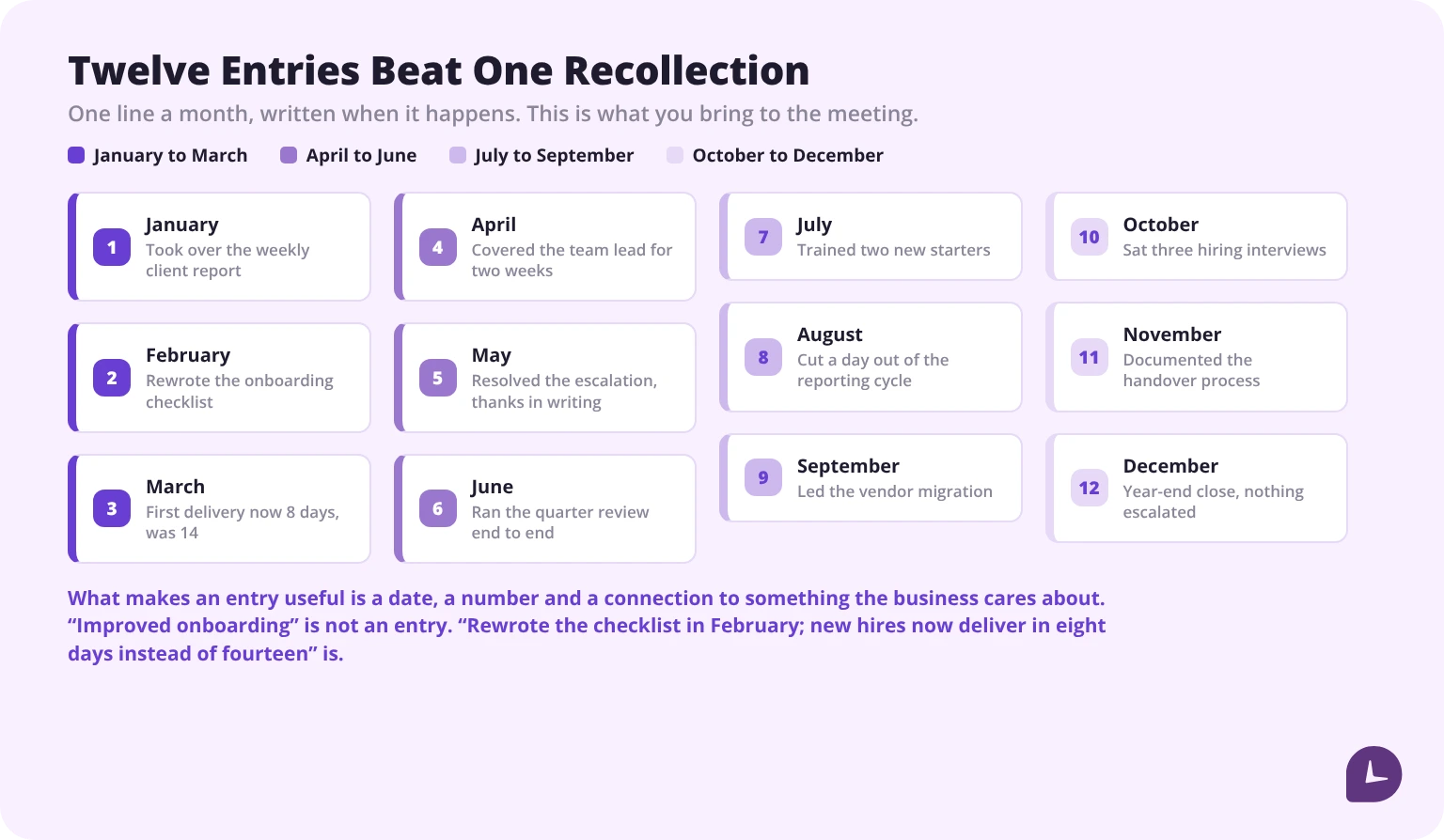
What makes an example persuasive is that it is specific, it has a number, and it connects to something the business cares about. “I improved the onboarding process” is weak. “I rewrote the onboarding checklist in March; new hires now reach first delivery in eight days instead of fourteen” is not.
If you already track your own time by project, that record is half the file — it shows where your effort actually went, which is frequently different from what your job description says. best apps to track work hours covers the tools if you do not have one.
The vocabulary for describing this well is in accountability and responsibility: what you want to show is not that you were busy but that things were yours.
A year of your own time records is the part of the evidence file you cannot reconstruct from memory.
Keep a record of where your hours actually go
How do you research the role and the number?
The role. Read the internal job description if one exists. Look at postings for the same title elsewhere. Talk to someone already doing it, and ask the one question that gets a real answer: what surprised them about the step up. what makes a good team member is a reasonable description of what the next level usually looks like from the inside.
The number is where most guides send you somewhere worse than you need to go. Start with the sources in this order.
First, check whether you have a legal right to the range. This is the part almost nobody uses, and it is the only source where the number comes from the party it would actually bind.
| Where | What you can ask for |
|---|---|
| California | The pay scale for your position, on request |
| Connecticut | The wage range on request, and annually without asking |
| Rhode Island | The wage range, on request during employment |
| Washington | The range, once you are offered an internal transfer or promotion |
| The EU | Your own pay level and the average pay levels, broken down by sex, for colleagues doing the same work or work of equal value |
In California, Connecticut and Rhode Island an existing employee can ask their employer for the pay range of their own current position. Connecticut goes further and requires employers to provide it annually without being asked. Across the EU, Article 7 of the pay transparency directive gives workers the right to request that information in writing; member states were required to have the directive in national law by 7 June 2026, a deadline that has now passed.
At least seven US states require pay ranges in job postings — California, Connecticut, Washington, Illinois, Minnesota, Colorado and Rhode Island among them — which means that even where you cannot request your own range, you can often read the range for your own job in your employer’s own advert for it.
Second, the employer-reported baseline. The US Bureau of Labor Statistics publishes the Occupational Employment and Wage Statistics programme, built from a semi-annual mail survey of non-farm establishments, sampled from state unemployment-insurance lists. The thing that makes it different from everything else is that the figures come from employers rather than from workers, across about 57% of US employment and roughly 830 occupations, with medians and percentiles by state and metro area.
Third, and last, the crowdsourced sites. Glassdoor and Levels.fyi are useful for roles too specific for an occupational category, and both are worth looking at. Two things to hold in mind while you do. Self-reported pay is systematically biased: in a study matching survey answers against administrative payroll records, average reported wages came out 7% low and about two thirds of people understated what they earned. And Levels.fyi states plainly that its published figures are approximations — “within close margin of the real number” — without saying what share of its data is verified. Glassdoor now operates under Indeed, Inc.
What you want out of all this is a range, not a point. Know the number you would accept, the number you will name, and what non-salary elements would make a lower number workable.
Why does the number matter more than your nerve?
There is a well-known piece of advice that women should ask more often. The evidence does not support it, and it is worth saying so because it sends people after the wrong thing.
The largest study to ask workers directly about asking behaviour — 4,582 employees across 840 workplaces, from Australian matched employer-employee data — found that once hours worked are controlled for, men and women ask for raises at statistically indistinguishable rates. What differs is the outcome: women were about one quarter less likely to obtain the raise. Among workers under 41 there was no significant difference in either asking or succeeding. The authors’ summary is four words long: women do ask, but women do not get.
A later study of a hiring platform found something that completes the picture. There was a gap in what people named as their expected salary, and it survived controlling for every characteristic on the résumé. Then the platform changed one thing: it prefilled the expected-salary box with the median figure other candidates were being offered. The gap in what people asked for, in interview requests and in final offers went to zero — almost entirely because women raised what they asked for by about 3.2%.
What closed the gap was showing people the number, not telling anyone to be braver. Which is the argument for spending twenty minutes on the sources above rather than twenty minutes working up the nerve. A third study is worth knowing about too: when women were simply instructed to negotiate more, their earnings went down. Knowing the figure is what helps. Being told to push is not.
How do you ask for the meeting?
Do not raise it in passing, in a one-on-one about something else, or by email out of the blue. Request a dedicated meeting and say what it is about, so your manager arrives having thought about it.
> Subject: Time to discuss my role
>
> Hi Sam,
>
> I’d like to set aside 30 minutes to talk about my progress and where I could grow here. Would some time next week work?
>
> Thanks,
> Alex
Why this wording. It is direct enough that your manager knows what is coming, and open enough that it is not an ultimatum. The advance notice is the courtesy that lets them prepare a real answer rather than a holding one — and a holding answer is the most common outcome of a conversation nobody saw coming.
What do you actually say?
One piece of encouragement before the scripts. In a Pew Research Center survey of 5,775 US workers, 30% said they had asked for more than the pay first offered when they were last hired. Of those who asked, 28% got exactly what they asked for and another 38% got more than was first offered — so 66% came away with more than the opening number.
That is about pay at the point of being hired rather than a promotion request from inside a job, and nobody publishes a reliable success rate for the second. But the direction is clear enough, and the people who did not ask got nothing by definition.
How do you open?
> “Thanks for making time. I wanted to talk about where I’m heading here. I’ve been in this role about two years now, and I’d like to work toward the senior position on the team. I’ve put together a summary of what I’ve delivered, and I’d value your read on what’s realistic.”
Why it works. It states the ask in the first fifteen seconds, frames it as a conversation rather than a demand, and invites their assessment instead of asking them to simply agree.
How do you make the ask?
> “Over the past year I’ve rewritten the onboarding checklist, which took new hires from fourteen days to eight before first delivery, and I’ve run the quarterly review end to end twice. I’ve also been covering the vendor relationship since March, which sits outside my role. I think I’m operating at the senior level, and I’d like to make that formal. What would need to happen for that?”
The closing question matters more than everything before it. “What would need to happen” is answerable; “do you agree?” is not. It converts a yes-or-no into a plan, and a plan is what you leave with even when the answer is not yes.
What should you ask about the process?
Most people forget to ask these, and they determine everything that happens next.
- What are the criteria for that level here?
- Who else is involved in the decision?
- When are promotion decisions made, and by when does a case need to be put forward?
- What would the transition look like — what would I hand over?
- Is there training or support for the parts I have not done?
- Is there anything you would want to see more of before you would back it?
Ask the last one even if today’s answer is yes, because it tells you what to keep doing. If the answer names skills rather than deliverables, self-management skills is usually what is meant.
How do you respond to the four answers you are likely to get?
Three of the four are about the organisation rather than about you, which is worth knowing in the ten seconds after you hear one.
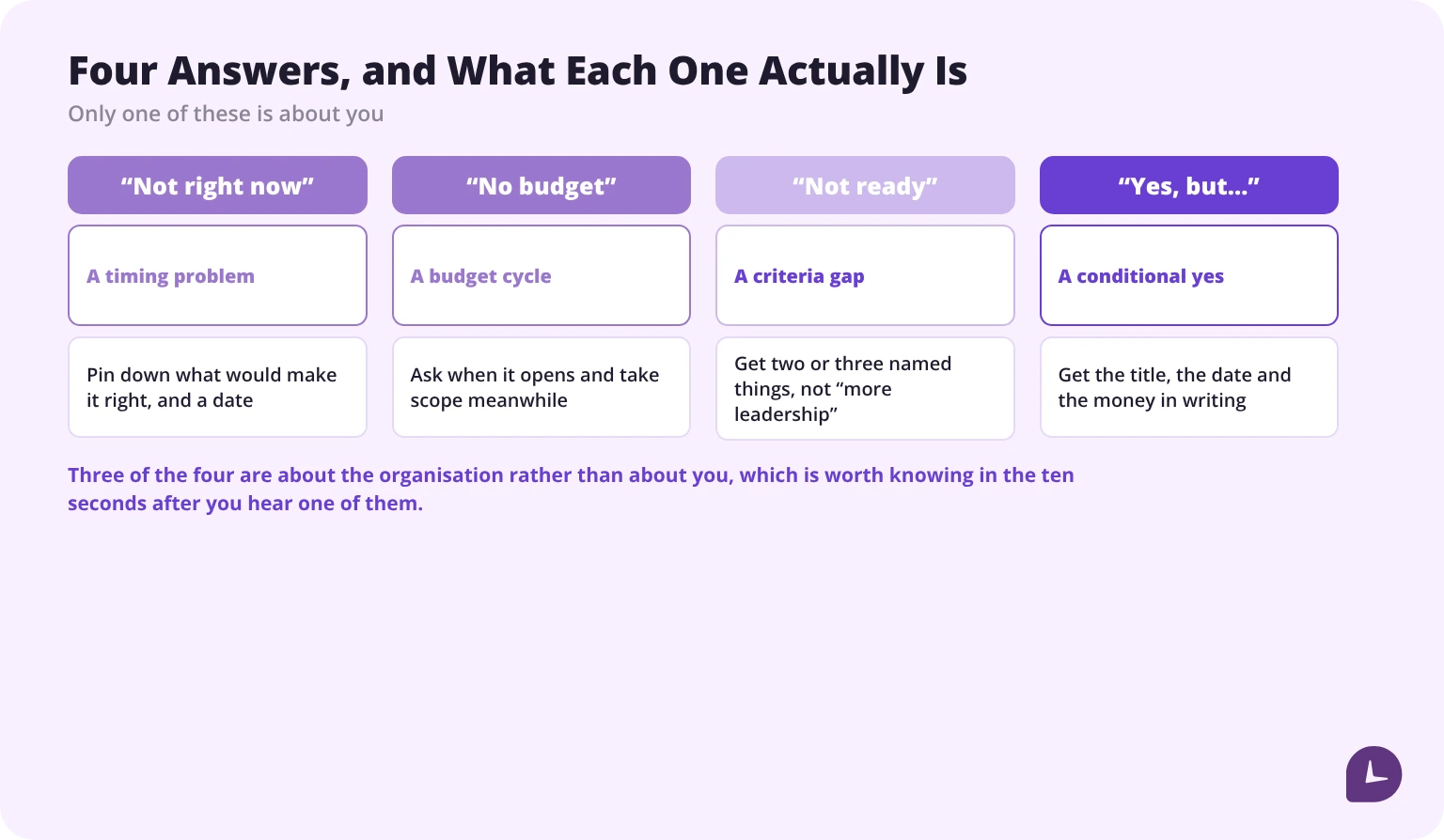
“Not right now”
> “That’s fair. Can we agree what would need to be true, and pick a date to revisit? I’d rather work toward something specific than wait and guess.”
Then get it in writing. A short follow-up email summarising what you agreed turns a soft deferral into a commitment neither of you has to remember.
“There’s no budget”
> “Understood — so that’s a timing thing rather than a fit thing. Two questions: when does the next budget cycle open, and in the meantime is there scope I could take on now, so the case is already made when it does?”
Why this works. Budget objections are rarely about you, and treating one as a scheduling problem rather than a rejection keeps the conversation open and puts you first in the queue when the money exists.
“You’re not ready yet”
> “I’d like to understand that better. What specifically would you want to see? If we can name two or three things, I’ll work on them and we can look at this again in three months.”
The important part is not accepting a vague answer. “More leadership” is not actionable. “Run the next project end to end without escalating” is. If you leave with an adjective instead of a deliverable, you have not been given criteria, you have been given a postponement.
“Yes, but…”
Usually a yes with a delay, a smaller step, or conditions attached.
> “That works. Can we write down what the step is and when it takes effect, so we’re both working from the same thing?”
Get the specifics before you celebrate: the title, the effective date, what changes about the money, and whether anything needs approval above your manager. A yes that depends on someone who was not in the room is a yes with a condition nobody has told you about.
If you want to know what your manager is working from, the site has the same conversation written from their side: what a manager is advised to do when someone asks for more money.
What should you do in the 90 days after a no?
The part no guide covers, and the part that decides whether the next conversation goes any differently.
Week one. Send the summary email: what you discussed, what you agreed, what you will work on, when you will revisit. Neutral in tone. This is a record, not a challenge, and its value is that in three months neither of you has to rely on memory.
Weeks two to twelve. Work on the two or three named things, and make the work visible. Not loudly — a line in a status update, a note in your one-on-one. The point is that when the revisit comes, it confirms something already known. how to be proactive at work is the useful version of this; the unhelpful version is announcing everything you do.
Keep the file going. Every item you add is an item you do not have to remember later.
At the agreed date, raise it yourself. Do not wait to be invited. If the date passes with no acknowledgement, that is itself information, and it belongs in the next section.
When does a no mean “not here”?
Sometimes the honest answer is that the path does not exist here. Three signals, and it is the combination that matters rather than any one of them.
The criteria keep moving. You met what was named, and the answer is a new set of things. Once is a misunderstanding. Twice is a pattern.
The revisit never happens. The date passes, then the next one, and it is always a bad quarter.
Nobody at your level has moved up in years. If the step you want has not been given to anyone recently, the constraint is structural rather than personal, and nothing you do differently will change it.
It is worth separating the organisation from the individual here. Some of this is a company with no room in it; some is one manager. boss versus leader is a reasonable way to work out which you are dealing with, and the answer changes what you do next.
None of this means leave immediately. It means the question changes from “how do I get promoted here” to “where does this role exist” — and that is a different search, one you can run calmly, over months, while still doing your current job well.
What should you not do?
- Do not ambush. No corridor asks, no raising it at the end of an unrelated meeting.
- Do not compare yourself to colleagues. “I do more than they do” moves the conversation onto them and makes you look difficult.
- Do not frame it as what you deserve. Frame it as what the organisation gets.
- Do not threaten to leave unless you are prepared to, and even then it is a last move rather than an opening one. It works once at most, and it changes how you are seen permanently.
- Do not sound like you want your manager’s job. Talk about the level, not their chair.
- Do not accept a vague yes. Without a date and a title it is a pleasant conversation, not a decision.
The case you make in twenty minutes is built from twelve months you already worked.
Try Monitask free for 10 days
Sources
- Artz, Benjamin, Amanda H. Goodall and Andrew J. Oswald (2018), “Do Women Ask?”, Industrial Relations: A Journal of Economy and Society, 57 (4), 611–636.
- Roussille, Nina (2024), “The Role of the Ask Gap in Gender Pay Inequality”, Quarterly Journal of Economics.
- Exley, Christine L., Muriel Niederle and Lise Vesterlund (2020), “Knowing When to Ask: The Cost of Leaning In”, Journal of Political Economy, 128 (3), 816–854.
- Galinsky, Adam D. and Thomas Mussweiler (2001), “First Offers as Anchors: The Role of Perspective-Taking and Negotiator Focus”, Journal of Personality and Social Psychology, 81 (4), 657–669.
- Caliendo, Marco, Katrin Huber, Ingo E. Isphording and Jakob Wegmann (2026), “On the Extent, Correlates, and Consequences of Reporting Bias in Survey Wages”, IZA Discussion Paper 18794.
- ADP Research, Today at Work, Q3 2023, for the share of workers promoted within two years of hire
- Pew Research Center, American Trends Panel Wave 121, fielded 6 to 12 February 2023, n = 5,775
- US Bureau of Labor Statistics, Occupational Employment and Wage Statistics, reference period May 2025
- Directive (EU) 2023/970 on pay transparency, Articles 5, 7 and 34
- California Department of Industrial Relations; Connecticut General Assembly HB 6517; Rhode Island General Laws 28-6-22; Washington L&I policy ES.E.2; Illinois Department of Labor; Minnesota Statutes 181.173; Colorado Department of Labor and Employment
FAQ
How long should I be in a role before asking?
The usual advice is at least a year, though that is a convention rather than a finding — no payroll data provider publishes a median time in role before promotion. What the data does show is that promotions are rarer than people assume: ADP Research found only about 4.5% of workers are promoted within two years of being hired. A long stretch without movement is common rather than a sign you have been passed over.
When is the best time to ask for a promotion?
Before your organisation makes its promotion decisions, not during the review where they are announced. By review time, levels and budget are often already settled, so a manager who agrees with you completely may still be unable to act until the next cycle. Find out when the cycle runs and start the conversation months ahead of it.
What should I say when I ask for a promotion?
State the role you want in the first fifteen seconds, give two or three specific pieces of evidence that you are already operating at that level, connect them to something the business cares about, and ask what would need to happen. There are scripts for the opening, the ask itself and the four answers you are most likely to get above.
How do I prepare for the conversation?
Keep a monthly record of what you deliver, with dates and numbers, starting well before you intend to ask. Research the target role and its pay range. And decide which of the three things you are actually asking for — a promotion, a raise, or more scope — because they are decided by different people on different timescales.
How do I know what salary to ask for?
Start with whether you have a right to the figure. In California, Connecticut and Rhode Island an employee can ask their employer for the pay range of their own current role, Connecticut employers must provide it annually, and in the EU workers can request their own pay level and the averages for equal-value work in writing. Then the US Bureau of Labor Statistics occupational wage data, which is reported by employers. Use Glassdoor and Levels.fyi last: self-reported pay runs systematically low, and Levels.fyi says its published figures are approximations.
What do I do if my boss says no?
Ask what specifically would need to change, agree a date to revisit, and send a short email summarising both. Then work on the named items, make that work visible without making a performance of it, and raise it yourself at the agreed date rather than waiting to be invited. If you left with an adjective rather than a deliverable, go back and ask for the deliverable.
What if they say there is no budget?
Treat it as timing rather than rejection, because it usually is. Ask when the next budget cycle opens, and whether you can take on scope now so the case is already made when it does. That puts you at the front of the queue rather than at the back of a conversation that has to start again.
Should I mention a competing offer?
Only if it is real and you are prepared to take it. It changes the nature of the relationship permanently and it works once at most. If you would not actually leave, it is a bluff that costs you more than the raise is worth.
Do women ask for promotions less often than men?
Not once hours worked are accounted for, and the advice built on the opposite assumption is worth retiring. The largest study to ask workers directly — 4,582 employees across 840 workplaces — found that once hours worked are controlled for, men and women ask at statistically indistinguishable rates, while women are about one quarter less likely to obtain the raise. Among workers under 41 there was no significant difference in either. Separately, when a hiring platform simply prefilled the expected-salary box with the market median, the gap closed almost entirely — so what helps is knowing the number, not being told to push harder.