Reduction in Force: The Hours Tests That Trigger WARN

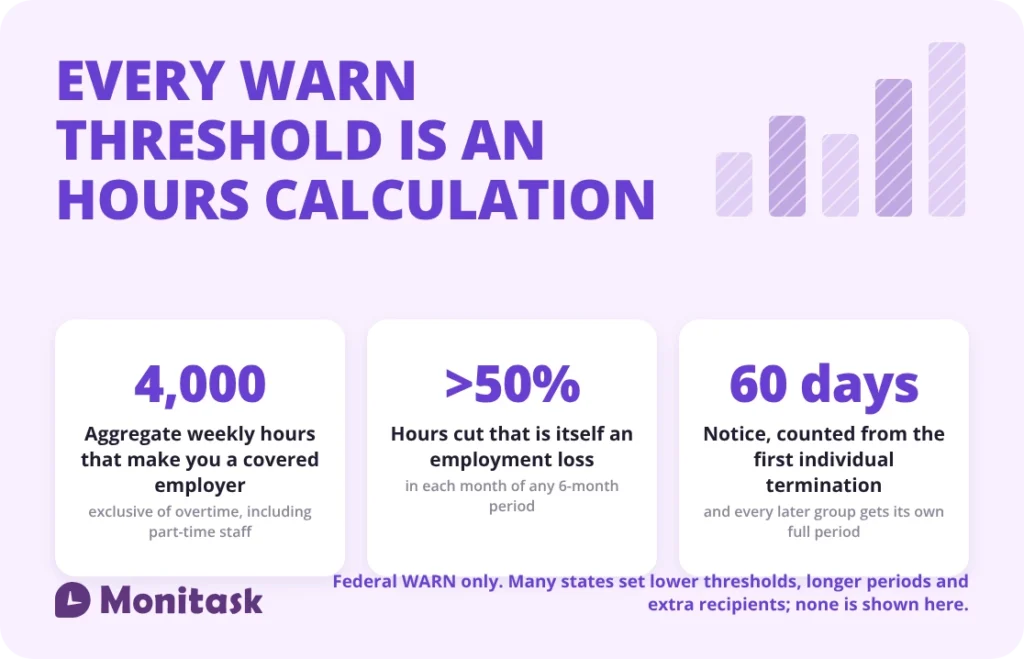
Almost every threshold in the federal notice law is an hours calculation, not a headcount. Whether you are covered at all depends on a weekly hours total. Who counts toward the triggering numbers depends on a 90-day hours average. And the humane alternative to layoffs — cutting hours and keeping people — is itself an employment loss above a specific hours line.
This is not legal advice. The provisions below are the federal Worker Adjustment and Retraining Notification Act and its regulations (29 U.S.C. §§ 2101–2104 and 20 C.F.R. Part 639), quoted directly and read at source on 10 November 2026. Many states have their own notice laws with lower thresholds, longer periods and different recipients, and none of them is described here. A reduction in force carries exposure well beyond notice timing. Take your specific plan to employment counsel before you act on any arithmetic on this page.
One more thing worth knowing before you read any page on this subject, including this one. The Act and the regulation are not worded identically, and in two places the difference changes what the test means. Every quotation below says which text it comes from, and the two divergences have a section of their own.
What is a reduction in force, and when does it become a WARN event?
A reduction in force is any involuntary reduction of headcount or hours. It becomes a federal notice event only when three separate tests are all satisfied: you are a covered employer, the affected people suffer an employment loss, and the count of those losses crosses a threshold at a single site within a 30-day window.
Each of those three tests is defined numerically, and each numeric definition reaches back into hours records. Planning usually misses this, because it starts from a list of names and a target saving and asks the notice question afterwards — by which point the 60-day clock has already been lost or not.
| Test | Where it is defined | What it is computed from |
|---|---|---|
| Are you a covered employer? | 20 CFR 639.3(a)(1) | Headcount or total weekly hours |
| Who is excluded from the counts? | 20 CFR 639.3(h) | A 90-day hours average |
| Did these people suffer an employment loss? | 20 CFR 639.3(f)(1) | Termination, length of layoff, or percentage hours reduction |
| Is it a plant closing or mass layoff? | 20 CFR 639.3(b) and (c) | Counts of the above, at one site, in 30 days |
When all three are met, the statute at 29 U.S.C. 2102(a) applies: an employer An employer shall not order a plant closing or mass layoff until the end of a 60-day period after the employer serves written notice of such an order
Notice goes to three recipients, and missing one is a common failure:
each representative of the affected employees as of the time of the notice, or, where there is none then, each affected employee
the State, or the entity designated by the State to carry out rapid response activities
- the chief elected official of the unit of local government in which the closing or layoff is to occur, with a highest-taxes tie-breaker where there is more than one
A wording note, because it trips people searching for the right office: the regulation still refers to the “State dislocated worker unit”, while the operative statutory phrase is the rapid-response one above. They are the same recipient.
Boost your business productivity
Track performance and streamline teamwork
How many employees do you actually have, for WARN purposes?
Not the number on your payroll. One of two numbers, and the second one is an hours total.
The regulation at 20 CFR 639.3(a)(1): The term ‘employer’ means any business enterprise that employs— (i) 100 or more employees, excluding part-time employees; or (ii) 100 or more employees, including part-time employees, who in the aggregate work at least 4,000 hours per week, exclusive of hours of overtime.
Test (ii) is the one that catches organisations that thought they were under the line. Part-time workers are left out of the headcount in test (i) and brought back in through test (ii) — but only as hours, not as heads. So you can fail test (i) comfortably and still be covered.
One more category belongs in both counts and is routinely left out of neither: Workers on temporary layoff or on leave who have a reasonable expectation of recall are counted as employees.
The regulation defines that expectation as arising when he/she understands, through notification or through industry practice, that his/her employment with the employer has been temporarily interrupted and that he/she will be recalled to the same or to a similar job
— so people you have already laid off, and intend to bring back, are in your headcount while you plan the next reduction.
Here is the arithmetic on a company that does not know which side of the line it is on. The figures are invented; the operations are one each. Payroll of 140 people at one site:
| Group | Count | How classified |
|---|---|---|
| Averaging fewer than 20 hours per week over the last 90 days | 55 | Part-time under 639.3(h) |
| Employed fewer than 6 of the preceding 12 months | 12 | Part-time under 639.3(h) |
| In both groups (counted once) | 4 | — |
| Part-time total | 63 | 55 + 12 − 4 |
| Not part-time | 77 | 140 − 63 |
Test (i): 77 is fewer than 100. Not covered.
Test (ii): 140 people, so the headcount element is met. Now the hours:
| Group | Count | Average weekly hours, excluding overtime | Hours |
|---|---|---|---|
| Not part-time | 77 | 38 | 2,926 |
| Part-time | 63 | 14 | 882 |
| Total | 3,808 |
3,808 is below 4,000. Not a covered employer.
Now change one input, keeping everything else identical: raise the part-time average from 14 hours to 18.
| Part-time average | Part-time hours | Total weekly hours | Covered? |
|---|---|---|---|
| 14 | 882 | 3,808 | No |
| 17 | 1,071 | 3,997 | No, by 3 hours |
| 18 | 1,134 | 4,060 | Yes |
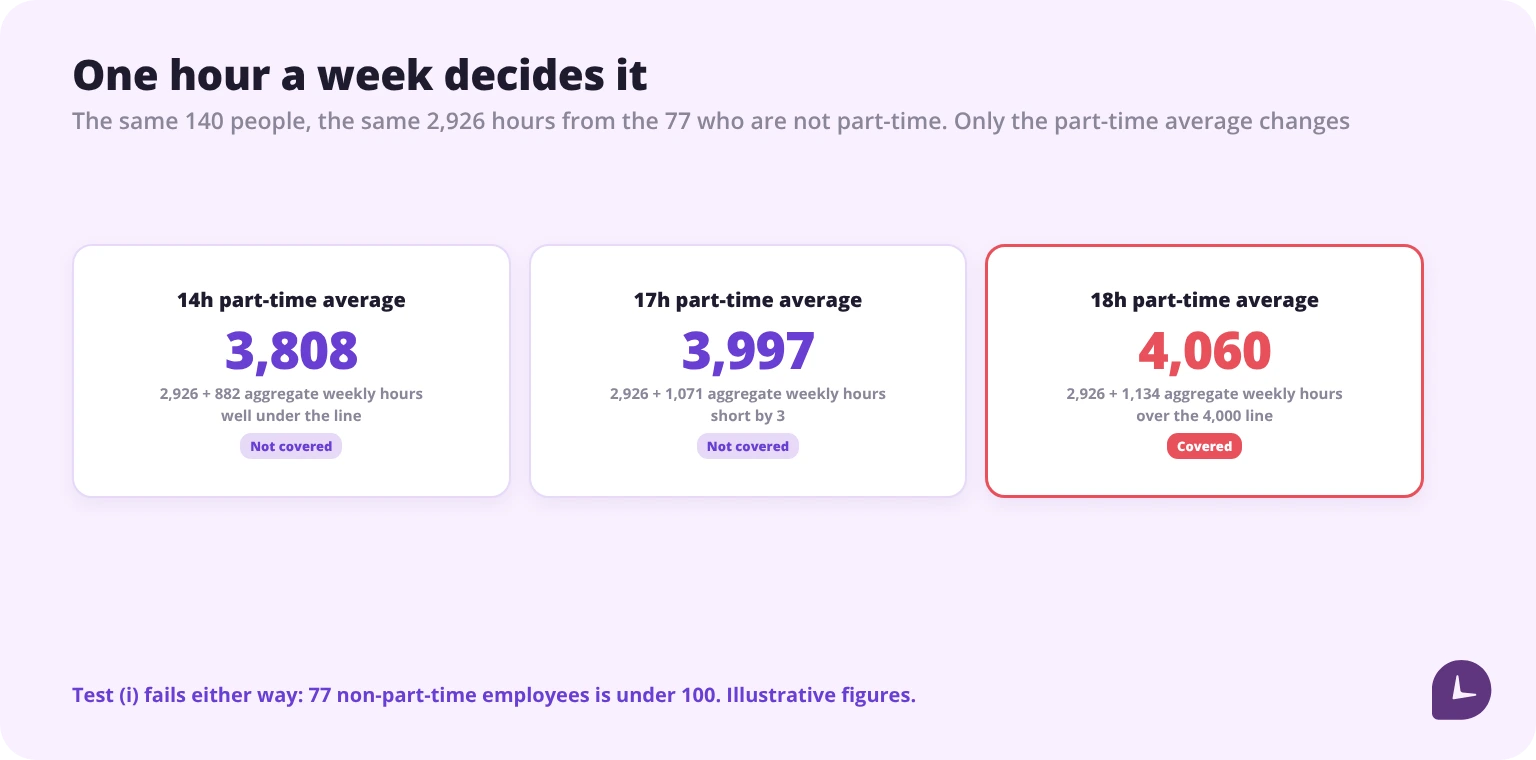
The difference between a reduction in force you can execute next week and one that requires 60 days of notice is 1 additional hour per week per part-time worker — and the only way to know which side you are on is a reliable record of hours actually worked.
On what date do you count?
Not the day you announce, and the answer has a get-out that most summaries of this law leave off.
The regulation at 20 CFR 639.5(a)(2): The point in time at which the number of employees is to be measured for the purpose of determining coverage is the date the first notice is required to be given.
Note which date that is. It is not the date you decide, not the date you announce, and not the date people leave. It is the date 60 days before the first employment loss — so the headcount that determines whether you are covered is fixed at a moment that may already be in the past by the time anyone asks the question.
And the snapshot is rebuttable. If this ‘snapshot’ of the number of employees employed on that date is clearly unrepresentative of the ordinary or average employment level, then a more representative number can be used to determine coverage.
With a limit: Alternative methods cannot be used to evade the purpose of WARN, and should only be used in unusual circumstances.
Two consequences for planning, and they point in opposite directions. If your headcount on the measuring date happened to dip below a threshold, you cannot rely on that dip if it is clearly unrepresentative of your ordinary level. And if it happened to spike, the same provision is available to you — but only in unusual circumstances, and not as a planning technique.
What this means in practice is that the defensible record is not a single number. It is a number, the date it was taken, and enough surrounding history to show whether that date was representative. A payroll figure with no history behind it cannot answer the second question at all.
Who counts as part-time, and why is it an hours calculation?
Because the definition is written in hours, with a specific measurement window — and because it includes people who are not part-time in any ordinary sense.
The regulation at 20 CFR 639.3(h): The term ‘part-time’ employee means an employee who is employed for an average of fewer than 20 hours per week or who has been employed for fewer than 6 of the 12 months preceding the date on which notice is required, including workers who work full-time.
Read the last five words. Including workers who work full-time. Somebody hired four months ago on a standard full-time contract, working 40 hours a week, is a part-time employee for WARN purposes and is therefore excluded from every threshold that excludes part-time employees — from the coverage headcount in test (i), from the 50-employee plant-closing count, and from both sides of the mass-layoff percentage. That is not a drafting accident; it is how a recently expanded workforce is kept out of the counts. It is also the single most common way a headcount computed from job titles comes out wrong.
The statute words it almost identically at 29 U.S.C. 2101(a)(8) — the term ‘part-time employee’ means an employee who is employed for an average of fewer than 20 hours per week or who has been employed for fewer than 6 of the 12 months preceding the date on which notice is required.
— but without the closing clause about full-time workers. The regulation’s version is the one with the explanatory words in it.
The measurement window matters as much as the number: The period to be used for calculating whether a worker has worked ‘an average of fewer than 20 hours per week’ is the shorter of the actual time the worker has been employed or the most recent 90 days.
Four consequences follow.
| Consequence | Why it matters in planning |
|---|---|
| The classification is a moving figure | Someone part-time in March may not be in June |
| A recent busy period can reclassify people | Overtime-free hours above 20 pull people into the headcount |
| You cannot settle it from contracts | The test is hours worked, not hours contracted |
| A full-time new hire is “part-time” | Fewer than 6 of the preceding 12 months, however many hours a week |
The third row is where most planning goes wrong. An organisation lists its “part-timers” from job titles or contracted hours, computes the thresholds from that list, and concludes it is outside the law. The regulation does not ask what the contract says; it asks what the 90-day average of hours worked was.
Note the direction of the error: classifying someone as part-time who is not understates your headcount, which is the error that leads to skipping notice you owed.
What counts as an employment loss?
Three things, and the third is the one nobody plans for.
20 CFR 639.3(f)(1): The term ‘employment loss’ means (i) an employment termination, other than a discharge for cause, voluntary departure, or retirement, (ii) a layoff exceeding 6 months, or (iii) a reduction in hours of work of individual employees of more than 50% during each month of any 6-month period.
| Definition, in the regulation’s words | |
|---|---|
| (i) | an employment termination, other than a discharge for cause, voluntary departure, or retirement |
| (ii) | a layoff exceeding 6 months |
| (iii) | a reduction in hours of work of individual employees of more than 50% during each month of any 6-month period |
Two details inside (ii) that change the arithmetic. The layoff must exceed 6 months — a layoff of exactly six is not an employment loss on the face of the provision. And a shorter layoff that is later extended past six months does not start counting from the extension: the regulation treats it shall be treated as an employment loss from the date of its commencement
So a three-month layoff extended to seven becomes, retroactively, an employment loss dated to the day it began — which can pull it back into a 30-day window you thought was closed, and place the notice obligation in the past.
Items (i) and (ii) are what everyone counts. Item (iii) converts an hours-reduction strategy into a notice obligation, and it is the subject of the next section.
Note also what (i) excludes: discharge for cause, voluntary departure and retirement are not employment losses. That exclusion is sometimes read as an invitation to reclassify departures, which turns a notice problem into a much worse one.
Where do the Act and the regulation differ?
In two places, and both matter.
| Test | The statute | The regulation |
|---|---|---|
| the hours test | a reduction in hours of work of more than 50 percent | a reduction in hours of work of individual employees of more than 50% |
| the mass-layoff share | at least 33 percent of the employees | At least 33 percent of the active employees |
The hours test. The regulation says the reduction is of individual employees. The statute omits the phrase. Those three words are the difference between a test applied person by person and a test that might be read against an aggregate payroll-hours figure. The regulation’s reading is the one to plan against, and it is also the demanding one: it needs per-person monthly figures rather than a department total.
The mass-layoff share. The regulation says active employees. The statute does not. Whatever that word does to the denominator, a page that quotes the regulation’s wording and attributes it to the Act is misquoting, and a plan that uses one denominator while citing the other is building on sand.
This is not a reason for alarm, and it is a reason to check which text any figure you have been given came from. Every quotation on this page is labelled.
Can cutting hours instead of jobs trigger WARN?
Yes, and the line is at more than 50 percent — which puts it between 20 and 19 hours for someone previously working 40.
This is the most consequential and least known part of the law for anyone trying to avoid layoffs. Reducing hours and keeping people employed is usually described as the humane alternative, and above a specific hours line it is an employment loss under 639.3(f)(1)(iii) with the same consequences as a termination.
Take 60 people at one site, previously working 40 hours a week. Invented figures; one subtraction and one division each.
| New weekly hours | Reduction | More than 50%? | Employment loss if sustained each month for 6 months? |
|---|---|---|---|
| 24 | 40.0% | No | No |
| 21 | 47.5% | No | No |
| 20 | 50.0% | No — “more than 50%” is not met at exactly 50% | No |
| 19 | 52.5% | Yes | Yes |
| 16 | 60.0% | Yes | Yes |
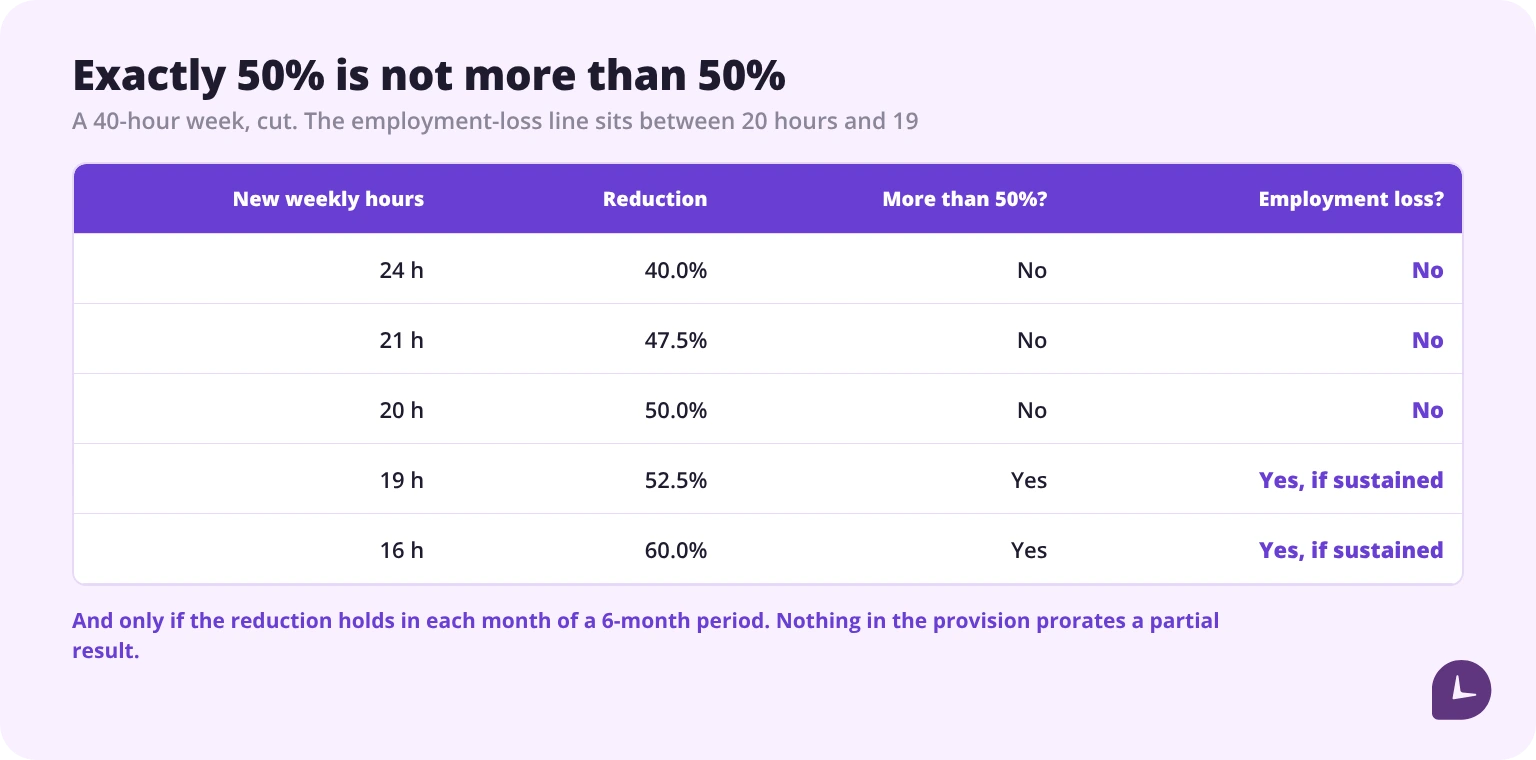
Cutting 60 people from 40 hours to 20 is not an employment loss. Cutting the same 60 people to 19 hours, and keeping them there through each month of a 6-month period, produces 60 employment losses — which, as the next section shows, is itself enough to be a mass layoff at most sites.
1 hour a week separates a cost reduction from a 60-day notice obligation. Two conditions have to hold for the test to be met, and both are worth stating precisely because partial measures fail them:
- The reduction must exceed 50 percent, not reach it.
- It must do so during each month of a 6-month period. A reduction that is deep in two months and shallow in the third does not satisfy the test as written — and nothing in the provision prorates a partial result into a partial loss. It is met or it is not.
Neither condition can be evaluated without month-by-month hours records for each individual: 12 to 24 separate monthly figures per person, depending on how you establish the baseline. The test is written per employee, not per team average, and the regulation says so in words the statute leaves out.
What are the plant closing and mass layoff thresholds?
Both are counts of employment losses at a single site within a 30-day period, and both exclude part-time employees from the count.
Plant closing, 20 CFR 639.3(b): The term ‘plant closing’ means the permanent or temporary shutdown of a ‘single site of employment’, or one or more ‘facilities or operating units’ within a single site of employment, if the shutdown results in an ‘employment loss’ during any 30-day period at the single site of employment for 50 or more employees, excluding any part-time employees.
The regulation adds that An employment action that results in the effective cessation of production or the work performed by a unit, even if a few employees remain, is a shutdown.
so a unit that keeps a skeleton staff has not avoided the definition.
Mass layoff, 20 CFR 639.3(c)(1): a reduction in force that is not part of a plant closing and that causes an employment loss at a single site during any 30-day period for:
| Threshold | |
|---|---|
| (i) | At least 33 percent of the active employees, excluding part-time employees |
| (ii) | At least 50 employees, excluding part-time employees |
Both (i) and (ii) must be met. And the percentage drops away at scale: Where 500 or more employees (excluding part-time employees) are affected, the 33% requirement does not apply, and notice is required if the other criteria are met.
Two features of these tests change how a plan should be built.
“Excluding part-time employees” appears on both sides of the percentage. The 33 percent is 33 percent of active non-part-time employees, counting only non-part-time losses. So the part-time classification that determined your coverage also sets your denominator, and an error in the 90-day hours average propagates through the whole analysis.
Who exactly is in the numerator is a choice the regulation gives you. for purposes of determining whether coverage thresholds are met, either incumbent workers in jobs being eliminated or, if known 60 days in advance, the actual employees who suffer an employment loss may be counted
Incumbents in the roles being eliminated, or the actual people who will lose employment if you know that far ahead — and those two counts are not always the same number.
And every threshold is per single site of employment. A single site of employment can refer to either a single location or a group of contiguous locations.
For people who do not work at a fixed location, the single site of employment to which they are assigned as their home base … will be the single site in which they are covered for WARN purposes
A reduction spread across four offices may be four counts, none of which reaches a threshold — or one count, if the offices are contiguous.
Does splitting the reduction into waves work?
Sometimes, and the regulation tells you exactly how the question is asked. This section describes the rule; whether a particular plan survives it is a question for counsel.
The 30-day look. Look ahead 30 days and behind 30 days to determine whether employment actions both taken and planned will, in the aggregate for any 30-day period, reach the minimum numbers for a plant closing or a mass layoff and thus trigger the notice requirement
Note behind as well as ahead: a reduction you have already made counts against a reduction you are planning.
The 90-day look, for actions that are each too small on their own. Look ahead 90 days and behind 90 days to determine whether employment actions both taken and planned each of which separately is not of sufficient size to trigger WARN coverage will, in the aggregate for any 90-day period, reach the minimum numbers for a plant closing or a mass layoff and thus trigger the notice requirement.
The statute puts the same rule at 29 U.S.C. 2102(d): employment losses for 2 or more groups at a single site of employment, each of which is less than the minimum number of employees specified in section 2101(a)(2) or (3) of this title but which in the aggregate exceed that minimum number, and which occur within any 90-day period shall be considered to be a plant closing or mass layoff unless the employer demonstrates that the employment losses are the result of separate and distinct actions and causes
The way out, and its exact shape. An employer is not, however, required under section 3(d) to give notice if the employer demonstrates that the separate employment losses are the result of separate and distinct actions and causes, and are not an attempt to evade the requirements of WARN.
Three things follow, and together they are why the two-wave plan usually fails.
The burden is on the employer. The regulation says the employer demonstrates. Separateness is not a default you fall into by spacing the dates 91 days apart; it is something you have to be able to show, and showing it needs contemporaneous evidence of two genuinely distinct causes.
The test is causes and actions, not calendars. Two waves of the same restructuring, decided in the same meeting for the same reason, are one action with two dates. The regulation’s own qualifier — and are not an attempt to evade the requirements of WARN — closes the obvious remaining gap.
The clock starts earlier than people expect. When all employees are not terminated on the same date, the date of the first individual termination within the statutory 30-day or 90-day period triggers the 60-day notice requirement.
And every group gets the whole period: The first and each subsequent group of terminees are entitled to a full 60 days’ notice.
So the second wave does not inherit the first wave’s notice. If the two aggregate, the 60 days run from the first individual termination, and the later group is entitled to its own full period.
What happens if you get it wrong?
Back pay per day, with a cap that is sometimes lower than people assume, plus a civil penalty payable to local government.
The statute at 29 U.S.C. 2104(a)(1) makes an employer that fails to give notice liable to each affected employee for back pay for each day of violation at a rate of compensation not less than the higher of— (i) the average regular rate received by such employee during the last 3 years of the employee’s employment; or (ii) the final regular rate received by such employee
The cap: Such liability shall be calculated for the period of the violation, up to a maximum of 60 days, but in no event for more than one-half the number of days the employee was employed by the employer.
Read the second half. It is not simply 60 days. For a worker employed for 80 days, the maximum is 40 days of back pay, not 60 — which means the exposure on a reduction that falls mostly on recent hires is smaller than a flat 60-day calculation suggests, and the exposure on long-tenured staff is the full period.
Separately, an employer that fails to give the required notice to the unit of local government is subject to a civil penalty of not more than $500 for each day of such violation
That is the recipient most often missed, and it carries its own penalty independent of what employees are owed.
None of this is the main risk in a reduction in force, and saying so is the honest framing. Notice exposure is calculable and capped. The selection decisions underneath it are not, which is what the next two sections are about.
How do you build the headcount computation defensibly?
Compute it before the selection, from hours records, and keep the computation.
The sequence that goes wrong: decide who goes, total them up, then ask whether notice is owed. By then the answer is either yes and you are late, or no and you cannot prove it.
| Step | What you do | Why in this order |
|---|---|---|
| 1 | Pull per-person hours worked, by week, for the last 90 days and the last 12 months | Both windows appear in 639.3(h) |
| 2 | Classify each person against both part-time tests | Hours average and months employed, and remember full-time new hires |
| 3 | Compute both coverage tests, including total weekly hours excluding overtime | Test (ii) is the one that surprises people |
| 4 | Establish the denominator: active non-part-time employees per site | Needed for the 33 percent |
| 5 | Model the thresholds against candidate scenarios, including hours-reduction scenarios | Before anyone is named |
| 6 | Freeze the computation with its date and inputs | It is the record of why you did or did not give notice |
| 7 | Take the computation and the plan to counsel | State laws are not covered here and often bite first |
Step 3 has a detail worth repeating: total weekly hours are measured exclusive of overtime. A payroll export taken at face value overstates the figure and can produce a false positive on coverage — the less dangerous error, still expensive.
Step 6 gets skipped and it is the one that matters if the decision is questioned later. The defensible position is not “we were under the threshold”. It is “here is the computation we made on this date, from these hours records, using these definitions” — which, given the snapshot rule above, also has to show that the date was a representative one.
Per-person hours by week and by month, separable from overtime, attributable to a site — every threshold on this page is computed from that one record
See how the hours record is kept
What does a defensible selection process need?
Written criteria, applied in a fixed order, recorded before names are attached — and reviewed by counsel, because selection carries exposure this page does not address.
What follows is process hygiene, not a legal standard. The legal risks in selection — age, disability, protected activity, release agreements and their disclosure requirements — are real, jurisdiction-sensitive and entirely outside the notice provisions quoted above.
| Element | What it means in practice |
|---|---|
| Criteria written before the list | Criteria chosen after a list are criteria reverse-engineered from it |
| A fixed order of application | Same sequence for every person in the pool |
| Defined pool boundaries | Which roles, sites and teams are in scope, and why |
| Criteria that are measurable | If it cannot be evidenced, it will not survive a question |
| One decision record per person | Showing criteria applied, not conclusions reached |
| A second reviewer on the pool, not on individuals | Catches pattern problems a case-by-case review misses |
| Counsel review before anything is communicated | Especially on releases and on state requirements |
On measurable criteria: hours and utilisation data are legitimate inputs and also the inputs most likely to be misread. Recorded hours tell you what someone worked, not what work was available to them. Someone on the thin end of a badly distributed workload shows low utilisation through no act of their own, so selecting on that figure selects for your own distribution error. See workload distribution on why the team average conceals this, and the causes of boreout on how underload is produced rather than chosen.
What records do you need before you decide, not after?
6, and all 6 have to predate the decision.
| Record | Why |
|---|---|
| Per-person weekly hours, 12 months | Both part-time tests and the hours-reduction test |
| Hours separated from overtime | Coverage test (ii) is exclusive of overtime |
| Site assignment per person | Every threshold is per single site of employment |
| Hire date per person | The 6-of-12-months part-time test, which catches full-time new hires |
| The frozen coverage computation, dated | The record of the notice decision, and of whether the date was representative |
| Month-by-month hours for any hours-reduction scenario | 639.3(f)(1)(iii) is tested each month over 6 |
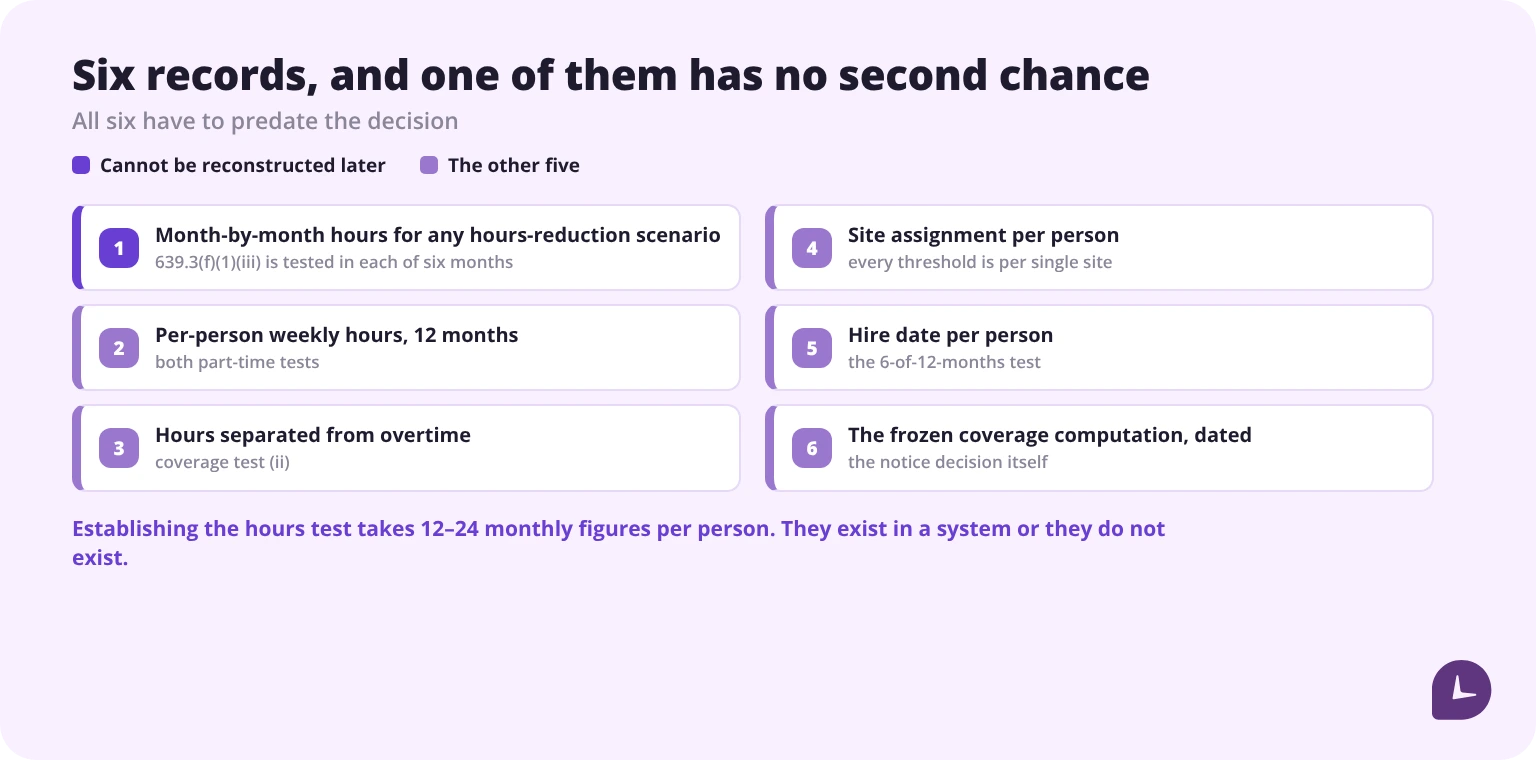
The last row cannot be reconstructed. Establishing whether a reduction exceeded 50 percent in each month of a 6-month period takes 12 to 24 separate monthly figures per person, and they either exist in a system or they do not exist at all.
Where does Monitask fit?
Every computation on this page runs on one input: per-person hours worked, by week and by month, separable from overtime, attributable to a site. Monitask records and exports that, which is what makes the coverage tests and the hours-reduction test computable rather than estimated.
It does not tell you whether notice is owed, and nothing here should be read as a compliance product claim. It supplies the hours record that the definitions are written in terms of. For the product detail, see employee time clock software and online timesheets. For the definition of the term itself, see our glossary entry on reduction in force; for the related terms, layoff and furlough. If you are drafting the policy rather than executing a specific reduction, start from the temporary layoff policy.
The month-by-month per-person hours record is the one input on this page that cannot be assembled after the decision
Start keeping it
Sources
- 20 C.F.R. Part 639 (Worker Adjustment and Retraining Notification regulations). § 639.3(a)(1), coverage:
The term ‘employer’ means any business enterprise that employs— (i) 100 or more employees, excluding part-time employees; or (ii) 100 or more employees, including part-time employees, who in the aggregate work at least 4,000 hours per week, exclusive of hours of overtime.
§ 639.3(a)(1) also:Workers on temporary layoff or on leave who have a reasonable expectation of recall are counted as employees.
§ 639.3(h), part-time:The term ‘part-time’ employee means an employee who is employed for an average of fewer than 20 hours per week or who has been employed for fewer than 6 of the 12 months preceding the date on which notice is required, including workers who work full-time.
andThe period to be used for calculating whether a worker has worked ‘an average of fewer than 20 hours per week’ is the shorter of the actual time the worker has been employed or the most recent 90 days.
§ 639.3(b), plant closing:The term ‘plant closing’ means the permanent or temporary shutdown of a ‘single site of employment’, or one or more ‘facilities or operating units’ within a single site of employment, if the shutdown results in an ‘employment loss’ during any 30-day period at the single site of employment for 50 or more employees, excluding any part-time employees.
§ 639.3(c), mass layoff:At least 33 percent of the active employees, excluding part-time employees
,At least 50 employees, excluding part-time employees
, andWhere 500 or more employees (excluding part-time employees) are affected, the 33% requirement does not apply, and notice is required if the other criteria are met.
§ 639.3(f)(1), employment loss:The term ‘employment loss’ means (i) an employment termination, other than a discharge for cause, voluntary departure, or retirement, (ii) a layoff exceeding 6 months, or (iii) a reduction in hours of work of individual employees of more than 50% during each month of any 6-month period.
§ 639.5, timing and aggregation:The point in time at which the number of employees is to be measured for the purpose of determining coverage is the date the first notice is required to be given.
If this ‘snapshot’ of the number of employees employed on that date is clearly unrepresentative of the ordinary or average employment level, then a more representative number can be used to determine coverage.
Alternative methods cannot be used to evade the purpose of WARN, and should only be used in unusual circumstances.
Look ahead 30 days and behind 30 days to determine whether employment actions both taken and planned will, in the aggregate for any 30-day period, reach the minimum numbers for a plant closing or a mass layoff and thus trigger the notice requirement
,Look ahead 90 days and behind 90 days to determine whether employment actions both taken and planned each of which separately is not of sufficient size to trigger WARN coverage will, in the aggregate for any 90-day period, reach the minimum numbers for a plant closing or a mass layoff and thus trigger the notice requirement.
An employer is not, however, required under section 3(d) to give notice if the employer demonstrates that the separate employment losses are the result of separate and distinct actions and causes, and are not an attempt to evade the requirements of WARN.
When all employees are not terminated on the same date, the date of the first individual termination within the statutory 30-day or 90-day period triggers the 60-day notice requirement.
andThe first and each subsequent group of terminees are entitled to a full 60 days’ notice.
Retrieved 10 November 2026. https://www.ecfr.gov/current/title-20/chapter-V/part-639 - 29 U.S.C. §§ 2101–2104, the Act itself. 2101(a)(6):
the term ‘employment loss’ means (A) an employment termination, other than a discharge for cause, voluntary departure, or retirement, (B) a layoff exceeding 6 months, or (C) a reduction in hours of work of more than 50 percent during each month of any 6-month period
2101(a)(8):the term ‘part-time employee’ means an employee who is employed for an average of fewer than 20 hours per week or who has been employed for fewer than 6 of the 12 months preceding the date on which notice is required.
2102(a):An employer shall not order a plant closing or mass layoff until the end of a 60-day period after the employer serves written notice of such an order
2102(b):An employer may order the shutdown of a single site of employment before the conclusion of the 60-day period if as of the time that notice would have been required the employer was actively seeking capital or business
,An employer may order a plant closing or mass layoff before the conclusion of the 60-day period if the closing or mass layoff is caused by business circumstances that were not reasonably foreseeable as of the time that notice would have been required.
No notice under this chapter shall be required if the plant closing or mass layoff is due to any form of natural disaster, such as a flood, earthquake, or the drought currently ravaging the farmlands of the United States.
andAn employer relying on this subsection shall give as much notice as is practicable and at that time shall give a brief statement of the basis for reducing the notification period.
2102(d):employment losses for 2 or more groups at a single site of employment, each of which is less than the minimum number of employees specified in section 2101(a)(2) or (3) of this title but which in the aggregate exceed that minimum number, and which occur within any 90-day period shall be considered to be a plant closing or mass layoff unless the employer demonstrates that the employment losses are the result of separate and distinct actions and causes
2104(a):back pay for each day of violation at a rate of compensation not less than the higher of— (i) the average regular rate received by such employee during the last 3 years of the employee’s employment; or (ii) the final regular rate received by such employee
,Such liability shall be calculated for the period of the violation, up to a maximum of 60 days, but in no event for more than one-half the number of days the employee was employed by the employer.
andsubject to a civil penalty of not more than $500 for each day of such violation
Enacted Pub. L. 100–379, § 2, Aug. 4, 1988, 102 Stat. 890. Retrieved 10 November 2026. https://www.law.cornell.edu/uscode/text/29/2101 - A note on method and on what is deliberately absent. No state notice law is described anywhere on this page. These federal sources do not speak to state obligations, and any state threshold or notice period needs its own sourcing. Every quotation above is labelled as coming from the Act or from the regulation, because the two texts are not identical and the differences are set out in their own section on this page. The two worked examples use invented figures, stated as such where they appear; every published number in them is one subtraction, one multiplication or one division from those inputs. No case law was read, so nothing here describes how any of these provisions has been applied. The selection-process section is process hygiene rather than a legal standard: the discrimination, release and disclosure exposures in selecting individuals are real and are not addressed by the notice provisions quoted here. uscode.house.gov returned a site-level error on three attempts, so the statutory text was read at Cornell and settled word by word against the official GPO print on govinfo. The fetch tool caps quotations at about 125 characters, so longer passages were reconstructed from consecutive short fragments.
FAQ
Is exactly a 50 percent cut an employment loss?
No, as the provision is written. Both the statute and the regulation say more than 50 percent. A reduction to exactly half of previous hours does not meet the test on its face. That is a narrow margin to rely on, and it is a question for counsel rather than for a spreadsheet.
How do I know whether my company is covered at all?
Two tests, under 20 CFR 639.3(a)(1). Either 100 or more employees excluding part-time employees, or 100 or more employees including part-time employees who in aggregate work at least 4,000 hours per week exclusive of overtime. Most organisations check only the first and can be covered by the second.
Who counts as a part-time employee?
Someone averaging fewer than 20 hours per week, or employed fewer than 6 of the 12 months before notice is required — and the regulation adds including workers who work full-time
, so a full-time hire of four months’ standing is part-time for WARN purposes. The hours average is taken over the shorter of the person’s actual employment period or the most recent 90 days.
How much notice does the Act require?
Sixty days. Under 29 U.S.C. 2102(a) an employer An employer shall not order a plant closing or mass layoff until the end of a 60-day period after the employer serves written notice of such an order
on the employees’ representative or the affected employees, the state rapid response entity, and the chief elected local official.
Are there exceptions that shorten the notice period?
3, at 29 U.S.C. 2102(b) — but read the first one carefully before relying on it for a reduction in force. The faltering-company ground permits only An employer may order the shutdown of a single site of employment before the conclusion of the 60-day period if as of the time that notice would have been required the employer was actively seeking capital or business
. It is written for the shutdown of a single site, and on its face it is not available for a mass layoff. The other two are not so limited: business circumstances not reasonably foreseeable as of the time that notice would have been required
, and natural disaster. Where an employer relies on any of them, it An employer relying on this subsection shall give as much notice as is practicable and at that time shall give a brief statement of the basis for reducing the notification period.
Do state laws change any of this?
Frequently, and often in the direction of lower thresholds, longer notice or extra recipients. State notice laws vary considerably and none of them is described on this page. Check your own states before relying on the federal arithmetic, and do it early, because a state threshold can be crossed while the federal one is not.
Can I split a reduction into two waves to stay under the threshold?
The regulation anticipates it. It directs you to look ahead and behind 30 days, and ahead and behind 90 days for actions each too small on their own, and it aggregates them unless the employer demonstrates that the losses result from separate and distinct actions and causes and are not an attempt to evade the Act. The burden is yours, the test is about causes rather than dates, and if the waves do aggregate the clock runs from the first individual termination while every later group still gets its own full period.
What is the exposure if notice should have been given and was not?
Back pay for each day of violation at the higher of the employee’s average regular rate over the last three years or their final regular rate, capped at 60 days or half the days the employee was employed, whichever is less — plus a civil penalty of up to $500 a day for failing to notify the unit of local government. The cap’s second half is the part people miss.
Does a layoff of exactly six months count?
No. The provision says a layoff exceeding 6 months. But a shorter layoff later extended beyond six months is treated shall be treated as an employment loss from the date of its commencement
— so the employment loss is dated to the day the layoff began, not to the day you extended it, and that can place a notice obligation in the past.