What Is the Eisenhower Matrix?

The Eisenhower Matrix, also known as the Urgent-Important Matrix, is a time management tool that helps prioritize tasks based on their urgency and importance. It categorizes tasks into four quadrants: Do First, Schedule, Delegate, and Eliminate. This method, attributed to President Dwight D. Eisenhower, aims to improve productivity and decision-making in both professional and personal contexts.
In today’s fast-paced work environment, effective time management is crucial for success. The Eisenhower Matrix, a simple yet powerful tool, has gained significant traction in recent years as organizations seek ways to optimize productivity and decision-making processes.
This comprehensive guide will delve into the intricacies of the Eisenhower Matrix, its applications in HR, and how it can transform the way we approach task prioritization.
Origins and Concept
The Eisenhower Matrix, sometimes referred to as the Urgent-Important Matrix or the Eisenhower Box, is named after Dwight D. Eisenhower, the 34th President of the United States.
Eisenhower, known for his exceptional leadership skills, once said, “I have two kinds of problems: the urgent and the important. The urgent are not important, and the important are never urgent.” This insight formed the basis of what we now know as the Eisenhower Matrix.
The concept was later popularized by Stephen Covey in his book “The 7 Habits of Highly Effective People,” published in 1989. Covey expanded on Eisenhower’s idea, creating a framework that has since become a staple in time management and productivity literature.
The Four Quadrants
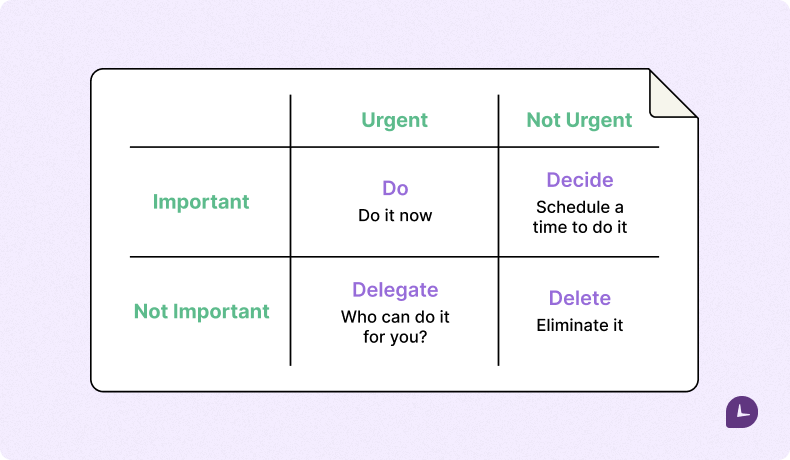
The Eisenhower Matrix divides tasks into four quadrants based on their urgency and importance:
| Quadrant 1: Urgent and Important | Quadrant 2: Important but Not Urgent |
| Do First | Schedule |
| Quadrant 3: Urgent but Not Important | Quadrant 4: Neither Urgent nor Important |
| Delegate | Eliminate |
Let’s break down each quadrant in detail:
Quadrant 1: Urgent and Important (Do First)
Tasks in this quadrant require immediate attention and have significant consequences. These are typically crises, pressing problems, or deadline-driven projects. While it’s crucial to address these tasks promptly, spending too much time in this quadrant can lead to stress and burnout.
Quadrant 2: Important but Not Urgent (Schedule)
This quadrant is where true productivity and growth occur. Tasks here are important for long-term success but don’t have immediate deadlines. Focusing on these activities can help prevent future crises and improve overall efficiency.
Quadrant 3: Urgent but Not Important (Delegate)
These tasks often masquerade as important due to their urgency, but they don’t contribute significantly to long-term goals. Ideally, these tasks should be delegated to others when possible.
Quadrant 4: Neither Urgent nor Important (Eliminate)
Tasks in this quadrant are time-wasters and should be eliminated whenever possible. They don’t contribute to productivity or long-term goals.
Implementing the Eisenhower Matrix in HR
Adopting the Eisenhower Matrix in HR practices can lead to significant improvements in productivity and strategic focus. Here’s how HR professionals can implement this tool:
1. Task Audit
Begin by creating a comprehensive list of your current responsibilities, projects, recurring duties, and pending tasks. Be as thorough as possible and include both day-to-day activities and long-term initiatives. This initial assessment provides a clear overview of how your time is being spent and helps identify tasks that may be consuming resources without contributing significant value. A complete task audit is essential for accurately prioritizing work and applying the Eisenhower Matrix effectively.
2. Categorization
Assign each task to one of the four quadrants. Be honest about the true urgency and importance of each item.
3. Action Plan
Create a clear action plan for each quadrant. Tasks that are both urgent and important should be handled immediately, while important but non-urgent tasks should be scheduled for later. Urgent but less important tasks can often be delegated, and tasks that are neither urgent nor important should be reduced or eliminated.
4. Regular Review
Revisit your matrix regularly, as priorities may shift over time.
Pro Tip: Use digital tools like Trello or Asana to create a visual representation of your Eisenhower Matrix. This can help in dynamically managing tasks across teams.
Benefits of Using the Eisenhower Matrix in HR
Implementing the Eisenhower Matrix can bring numerous benefits to HR departments:
- Improved Time Management: By focusing on important tasks, HR professionals can make better use of their time.
- Enhanced Strategic Focus: The matrix encourages a focus on long-term, important tasks that often get overshadowed by urgent matters.
- Reduced Stress: By prioritizing effectively, the matrix can help reduce the stress associated with constant firefighting.
- Better Delegation: It encourages the development of delegation skills, which is crucial for team growth and efficiency.
- Increased Productivity: By eliminating or minimizing time-wasting activities, overall productivity can significantly improve.
Common Pitfalls and How to Avoid Them
While the Eisenhower Matrix is a powerful tool, there are some common pitfalls to be aware of:
1. Misclassification of Tasks
It’s easy to overestimate the urgency or importance of tasks. Be objective and consider the long-term impact when categorizing.
2. Neglecting Quadrant 2
Many people focus too much on urgent tasks and neglect the important but not urgent ones. Schedule specific time for Quadrant 2 activities to ensure they’re not overlooked.
3. Difficulty in Delegating
Some HR professionals struggle with delegation. Develop trust in your team and provide proper training to make delegation more effective.
4. Rigidity
The matrix should be a flexible tool. Don’t be afraid to re-evaluate and adjust your categories as circumstances change.
“The Eisenhower Matrix is not about rigidly categorizing tasks, but about developing a mindset that prioritizes what truly matters.” – Dr. Laura Stevens, Organizational Psychologist
Integrating the Eisenhower Matrix with Other HR Tools
The Eisenhower Matrix can be even more powerful when integrated with other HR tools and methodologies:
1. SMART Goals
Use SMART (Specific, Measurable, Achievable, Relevant, Time-bound) criteria when defining tasks, especially for Quadrant 2 activities.
2. Agile Methodology
Incorporate the matrix into sprint planning in Agile HR teams to ensure a balance between urgent and important tasks.
3. OKRs (Objectives and Key Results)
Align your Eisenhower Matrix categories with your organization’s OKRs to ensure daily tasks contribute to overarching goals.
4. Time Tracking Software
Use time tracking tools in conjunction with the matrix to gain insights into how time is actually spent across different quadrants.
The Future of Time Management in HR
As we look towards the future, the principles behind the Eisenhower Matrix remain relevant, but their application is evolving. With the rise of AI and machine learning, we’re seeing new tools that can help automate the process of task categorization and prioritization.
For instance, AI-powered HR systems are being developed that can analyze patterns in task execution and suggest optimal prioritization strategies. These systems can learn from past decisions and outcomes to provide increasingly accurate recommendations over time.
Moreover, the integration of predictive analytics with time management tools like the Eisenhower Matrix could allow HR professionals to anticipate future urgent tasks and plan proactively, potentially reducing time spent in Quadrant 1.
Emerging Trend: Some companies are experimenting with “No-Meeting Days” or “Focus Time” blocks, inspired by the Eisenhower Matrix’s emphasis on important, non-urgent tasks. Early adopters report increased productivity and employee satisfaction.
Conclusion: Prioritizing What Matters Most
The Eisenhower Matrix remains one of the most practical and effective frameworks for managing priorities in today’s demanding work environment. By helping HR professionals distinguish between what is urgent and what is truly important, it encourages better decision-making, stronger focus, and more strategic use of time.
For HR teams, the value of this approach extends beyond productivity. It supports long-term planning, improves delegation, reduces unnecessary stress, and helps ensure that critical initiatives receive the attention they deserve. Rather than constantly reacting to immediate demands, HR professionals can allocate more time to activities that drive employee engagement, organizational growth, and business success.
As workplaces continue to evolve, the ability to prioritize effectively will remain an essential skill. Organizations that embrace structured decision-making frameworks like the Eisenhower Matrix will be better equipped to balance daily responsibilities with long-term objectives, creating a more productive and strategic HR function.