Discipline Without Punishment: What Works Instead

Punishment produces compliance, not commitment. The alternative is not permissiveness: it is coaching plus documentation, with consequences that stay real. The question most guides skip is how to keep the legal protection that progressive discipline was built to provide — and the answer turns out to be more interesting than it looks, because that protection is not where most managers think it is.
What is the difference between punishment and discipline?
| Punishment | Discipline | |
|---|---|---|
| Purpose | Impose a consequence for what happened | Change what happens next |
| Direction | Backward, at the incident | Forward, at the behaviour |
| What it teaches | That you were caught | What to do instead |
| Who holds the problem | The manager | The employee |
| Typical outcome | Compliance | Commitment, or a clear decision to leave |
| Effect on the relationship | Damages it | Tests it |
The distinction that matters is not severity. Discipline can include serious consequences: a conversation that ends with “if this continues, we will be having a different conversation” is discipline. What separates it from punishment is that the employee leaves knowing what to do, not only what it cost them.
Writing for SHRM, Randy Pennington put the cost of getting this wrong in five words: employees who feel punished learn to “learn to get by, get out or get even”. None of those three is the outcome anyone was aiming for.
Boost your business productivity
Track performance and streamline teamwork
Why does punishment fail?
Two reasons, and the second one is the one almost nobody names.
What does behavioural science offer instead?
Punishment can suppress a behaviour. What it cannot do on its own is establish a replacement, because it carries no information about what to do instead — which is why behaviour analysts pair it with reinforcement of an alternative rather than using it alone.
This is worth stating carefully, because the behavioural literature is less settled than management writing usually implies. Some researchers in the field argue that punishment combined with reinforcement outperforms reinforcement by itself in certain circumstances, and the question is treated as open rather than closed. What is not in dispute is the practical point: a consequence with no replacement attached leaves the person knowing only what not to do.
Two approaches do carry that information.
Extinction. Every unwanted behaviour is being reinforced by something. Stop delivering the consequence that has been reinforcing it and the behaviour loses its payoff. A shortcut persists because it saves time; if the correct route becomes the faster one, the shortcut stops paying. This is harder than it sounds, which is why it is used less than it should be.
Differential reinforcement of alternative behaviour, usually shortened to DRA. Reinforce a specific alternative that serves the same purpose for the person, and it displaces the one you do not want. The unwanted behaviour is not attacked directly; it is crowded out.
The practical version of both: “how do I stop them doing X” is a weaker question than “what would make doing Y easier and more rewarding than X”. The second has answers you can act on this week.
What is the delay-then-overreact cycle?
This is the mechanism that turns a small problem into a formal one.
Punishing people is unpleasant, so managers let minor things pass. Once, then twice, then several times. By the time the final straw arrives the manager is frustrated, the conversation is emotional, and the response is out of proportion to the incident that triggered it.
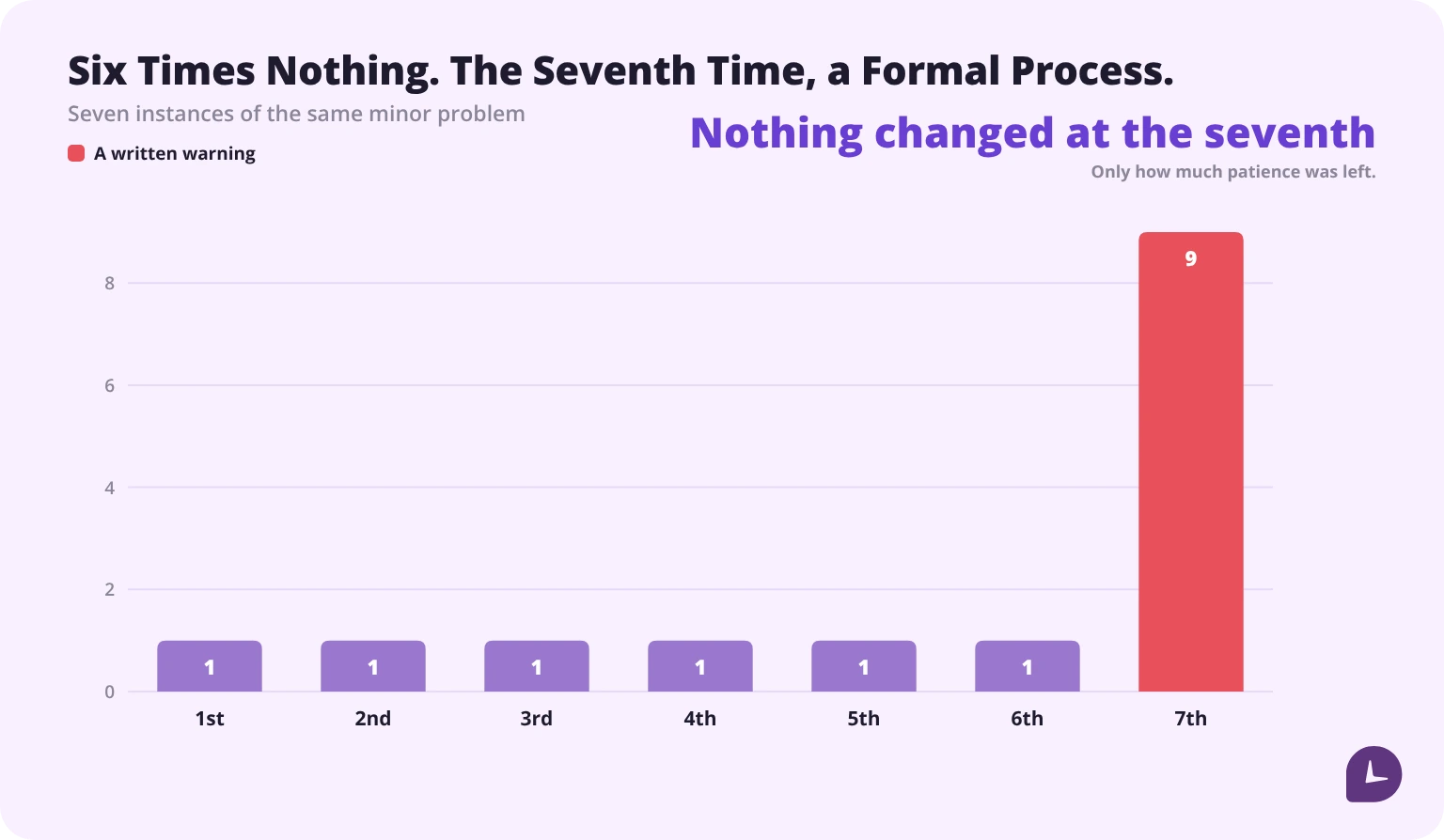
From the employee’s side this is a severe response to something minor that nobody had previously mentioned. Which, from where they are standing, is exactly what it is — and it is why these conversations so often produce bewilderment rather than change.
The fix is not a firmer response at the seventh instance. It is a two-minute conversation at the first. That conversation costs nothing and prevents the formal process entirely. The reason it does not happen is that the first instance never feels worth it, and the habit of deferring it is a management one rather than a policy one. boss versus leader is a fair account of the difference.
What is wrong with progressive discipline?
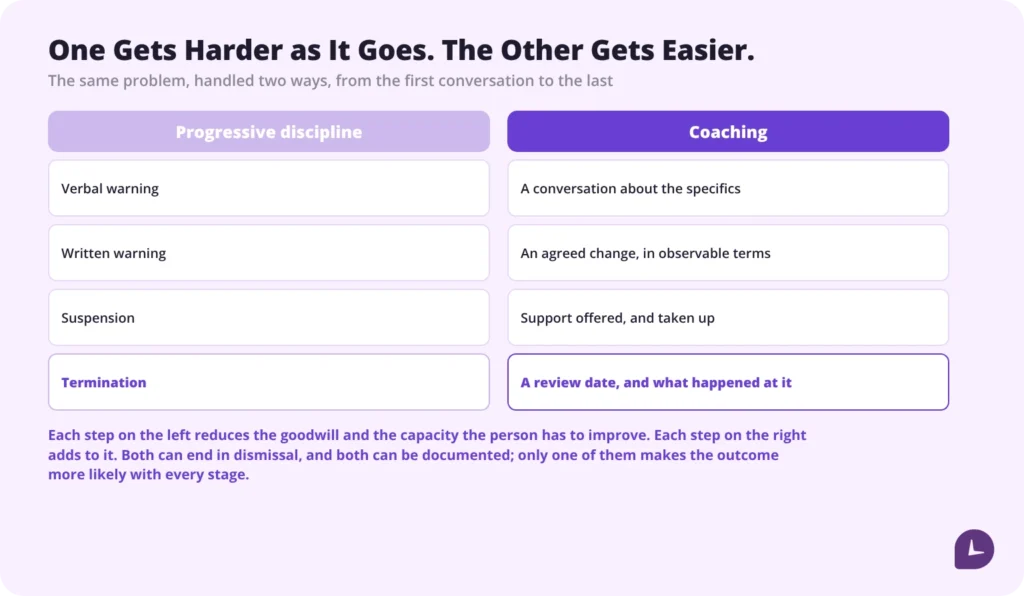
Progressive discipline is the standard model: verbal warning, written warning, suspension, termination. Each step harsher than the last.
The structural problem is that it escalates severity while reducing the person’s capacity to do anything about it. Pennington describes the model as “rooted in the decades-old mindset that treating people progressively worse will cause them to improve”. Someone on a final written warning is not better placed to improve; they are worse placed, with less goodwill and more anxiety.
Three practical problems on top.
It forces managers through steps that do not fit. A prescribed number of stages has to be completed even when it is obvious the person will not change, which wastes months and assumes the manager cannot judge the situation.
It focuses everyone on the process. The conversation becomes about which warning this is, rather than about what needs to change.
And it signals the outcome. By the second written warning both parties usually know where this ends. Everything after that is paperwork, and both of them know that too.
Why do companies keep using it anyway?
Here is the honest reason, and no article on this subject should skip it.
Progressive discipline persists because it is believed to be legally defensible. Employment attorneys recommend it, and employers adopt it because documented, escalating steps are understood to protect against wrongful termination claims and unemployment disputes.
That belief is largely well-founded, and any argument for abandoning the model that does not address it is asking a manager to trade legal risk for better culture — which most will decline, correctly.
So the question is not whether to keep documentation. It is whether documentation requires escalating punishment. It does not, and the next section is about why — including a complication that cuts against the model rather than for it.
How do you keep the legal protection without it?
This section sets out general information rather than legal advice. Employment law varies by state and by contract. Review any change to your disciplinary approach with your own counsel before implementing it.
What protects an employer is not escalation. It is a record showing a fair, consistent process in which the employee was told what was wrong, given a real chance to fix it, and told what would happen if they did not. A coaching approach can be documented as thoroughly as a punitive one, and the record serves the same purpose.
The clearest authority sits on the unemployment side. Vermont’s Department of Labor, setting out how it decides misconduct dismissals, puts the burden of proof on the employer, requires that at least one prior warning for the same misconduct was issued — “a warning for something else does not qualify” — and states that “employers who keep records of warnings given to employees usually prevail”. That is one state, and other states run their own rules, but it is the pattern: what is being tested is notice and record, not the severity of the steps.
A complication the standard advice leaves out. A progressive-discipline policy is not purely protective. In a 2017 California appeal decision, an employer with clear at-will disclaimers in its handbook still found an implied-contract claim revived against it, partly because its consistent practice of always using progressive discipline sat awkwardly with the discretionary language of the policies. The decision is unpublished, so its precedential weight is limited and the position differs by jurisdiction — this is exactly the point to raise with your own counsel. But the direction is worth knowing: a written escalation policy creates an expectation, and the risk attaches both to following it rigidly and to departing from it.
What a defensible coaching record contains:
| Element | Why it matters |
|---|---|
| The date and specifics of the issue | Facts rather than characterisations. “Three deliverables late in March, on the 4th, 11th and 22nd” |
| What was said to the employee | That they were told, and what they were told |
| What was agreed | The specific change, in behavioural terms |
| The support offered | Training, reassignment, adjusted workload. This is what distinguishes a genuine chance from a formality |
| The consequence if nothing changes | Stated at the time, not introduced later |
| The review date | And whether the review actually happened |
| What happened at the review | Improvement, partial improvement, or none |
The point: an employee who was told clearly what was wrong, given support, given a deadline and told what would otherwise happen has had due process. Whether the intervening steps were called warnings or coaching conversations does not change that.
Four rules that keep it defensible.
- Be consistent across people. The strongest claim against any disciplinary approach is that it was applied unequally. Inconsistency is a bigger risk than informality, and it is the one thing every authority in this area agrees on.
- State consequences in advance, in writing. “If this continues it will affect your continued employment here” belongs in the record at the first serious conversation, not at the last.
- Do not skip the support step. The offer of help is what separates a fair process from a documented march to dismissal.
- Follow your own policy. If the handbook prescribes progressive discipline, changing the approach starts with changing the handbook — not with quietly ignoring it. That is the exposure the California case turns on.
If it reaches the formal end, how to end an employment legally covers the procedure.
What does the coaching conversation sound like?
The replacement for a warning is a structured conversation, not the absence of one.
- State the specific issue. Behaviour and facts, with dates. Not character.
- Ask for their account. Genuinely — there is frequently information you do not have.
- Agree what needs to change, in observable terms.
- Ask what would help, and mean it.
- State the consequence if it does not change.
- Set a review date.
How it sounds:
> “I want to talk about the last three deliverables — the 4th, the 11th and the 22nd all came in after the deadline. Before I say anything else: what’s your read on it?”
> “Here’s what I need: deliverables in by the agreed date, and if something is going to slip, a heads-up before the deadline rather than after. What would make that workable?”
> “I want to be straightforward with you: this needs to change, and if it doesn’t, it will affect your position here. I’d much rather we fix it. Let’s look at it again in four weeks — I’ll put it in the calendar.”
What makes this different from a warning is the second step. Asking for their account before deciding the response turns it into a problem-solving conversation, and it frequently changes what the problem turns out to be.
What makes it the same as a warning is that the consequence is stated and real. Coaching without consequences is not coaching; it is hoping. accountability and responsibility is the vocabulary for the part where the problem moves from you to them, which is the step that makes the difference.
What is a paid decision-making day?
The most concrete alternative to a suspension, and it is forty years old.
The approach was set out in Harvard Business Review in July 1985, in an article by David Campbell, R. L. Fleming and Richard Grote describing how Tampa Electric Company abandoned punitive discipline. The trigger was a 1977 confrontation between a working foreman and a lineman, after which the foreman was suspended for 13 days. The company’s labour relations manager later reflected:
> “All I did was penalize an employee and his family; I did not change his behavior in any way. I believe he would have done the same thing again. I forced compliance, but he will still believe the company was wrong.”
That is the case against unpaid suspension in four sentences. It penalises the employee and their household, it changes behaviour rarely, and it leaves the person convinced the company was wrong.
The alternative, as Grote later described it: a single day away from work, on full pay, with one task — decide whether to commit to this job, and come back with an answer. It is not an extra day off, and the two available answers are to solve the problem completely or to leave.
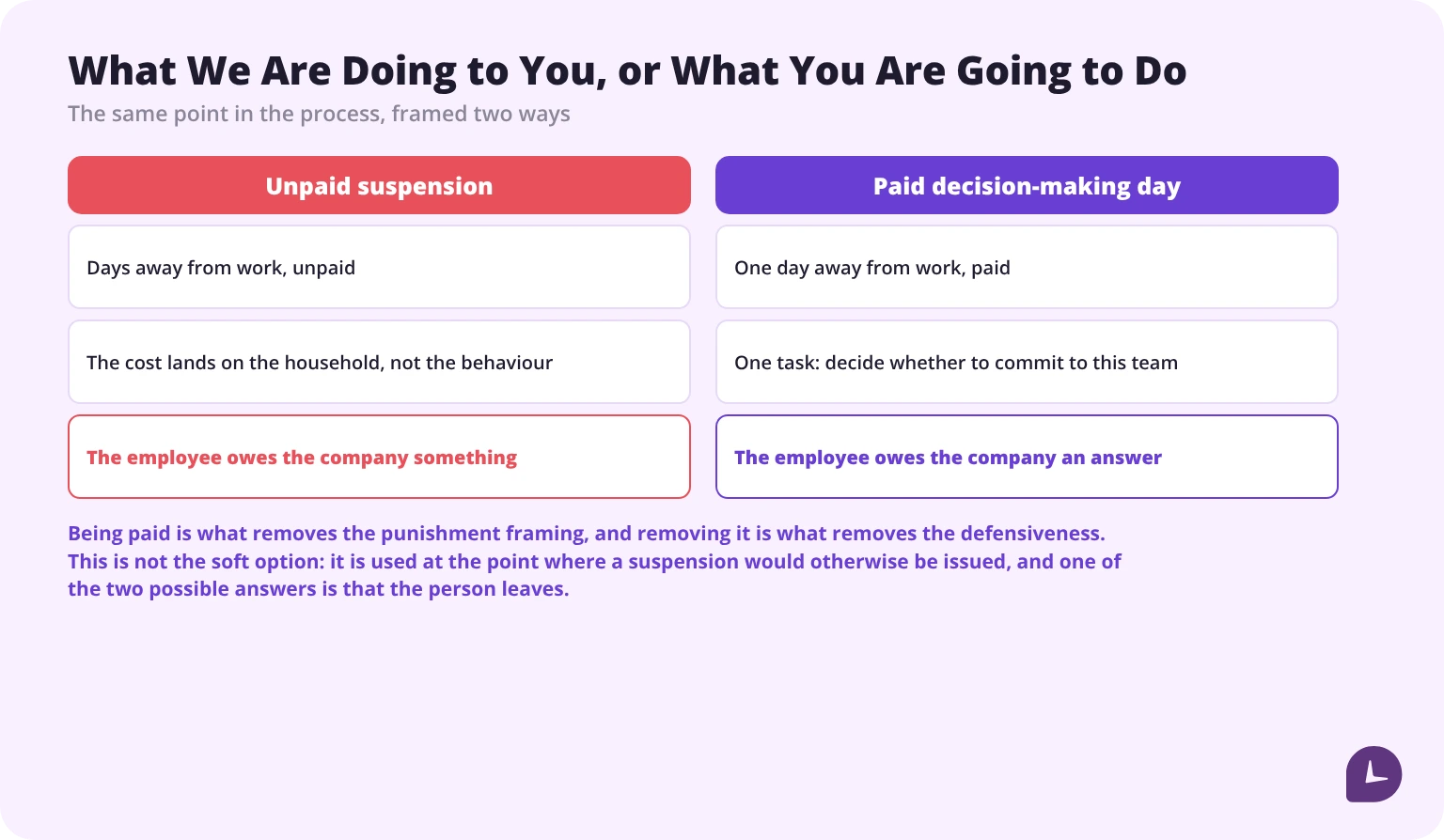
Why it works. It moves the focus from what the organisation is doing to the employee to what the employee is going to do. Being paid removes the punishment framing, which removes the defensiveness that comes with it. It forces an actual decision rather than compliance. And the answer is theirs, which makes it binding in a way an imposed outcome never is.
What happens on return: they state their decision and, if they are staying, what they will do differently. That gets written down. If they decide otherwise, the separation is cleaner for everyone.
This is a serious step rather than a soft one. It is used at the point where a suspension would otherwise be issued.
How do you reinforce what you want instead?
The half of discipline that gets no attention at all.
Notice the behaviour you want, out loud, close to when it happens. Not in a review six months later. Specific and immediate beats significant and delayed.
Be specific about what you noticed. “Good work” reinforces nothing. “You flagged the delay on Tuesday before it became a problem — that’s exactly what I need” reinforces a precise behaviour, and the person can repeat it.
Make the right thing easier than the wrong thing. If people skip a step, ask why the step is skippable. Most workarounds exist because the correct route is slower, and no amount of discipline outcompetes a shortcut that saves twenty minutes a day.
Watch what you are accidentally reinforcing. The person who quietly absorbs everyone else’s overflow and is given more of it is being punished for being reliable. That is a reinforcement problem wearing a discipline problem’s clothes.
What should you document?
Whichever approach you take, the rules are the same.
- Facts, dates and specifics. Not “poor attitude” — what was said or done, and when
- What the employee said, in their words where it matters
- What was agreed, and by when
- What support was offered
- The consequence stated
- The review date, and what happened at it
Keep it contemporaneous. Notes written the same day carry weight that a reconstruction six months later does not, and the difference is visible to anyone reading them later.
Store it consistently. Formal written counselling belongs in the HR file. Notes of coaching conversations should live somewhere durable and retrievable, not in a notebook that leaves when you do.
an employee write-up form covers the format for the formal step, and free company forms and policies has templates for the policy side.
Patterns in when work actually slips are easier to see in a record than in anyone’s memory of the last three months.
See where project time is actually going
When is discipline still the answer?
A coaching approach is not universal, and pretending otherwise makes the whole argument less credible.
Coaching is the wrong tool when:
- The behaviour is a safety issue. Act immediately; the conversation comes after
- It is misconduct rather than performance — theft, violence, harassment, falsification. These follow a formal process, not a development plan
- The person is not responsive to intervention. Two genuine coaching conversations, with support offered and no change, is information
- The behaviour is chronic and known. Someone with a five-year pattern is not meeting the expectation for the first time
- Someone else is being harmed by the delay in acting
what actually justifies termination covers where the misconduct line actually sits, which is worth knowing before you are near it rather than after.
The honest framing: by the time formal discipline is genuinely necessary, something has already failed — usually earlier, smaller and cheaper to fix. That does not mean discipline should not happen. It means it should be rare, and its frequency measures the system rather than the people.
How is this different in a remote team?
No comparable guide covers this, and the differences are real.
Written feels harsher than spoken. A message that would be a mild remark in person reads as formal and permanent. A coaching conversation conducted in writing is received as a warning, whatever was intended.
So do it on video, always. Not chat, not email. The rule is simple and it prevents most of the damage.
You notice later. Without ambient visibility, small performance issues surface only when something is missed — which pushes every conversation toward the delay-then-overreact cycle above.
Check in more deliberately. The remote equivalent of noticing something in passing is asking about it in a one-on-one, and it has to be scheduled, because it will not happen by accident.
Follow up in writing after the call, not instead of it. A short summary of what was agreed is documentation and clarity at once.
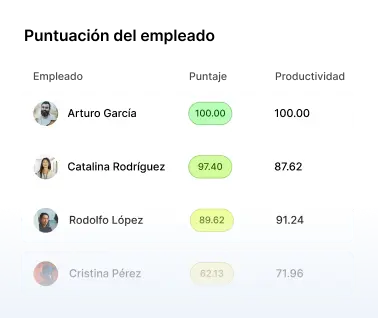
And watch for monitoring being used as punishment. If a team’s activity data is being cited in disciplinary conversations, it has stopped being a management tool. Data belongs in the conversation as context, never as evidence for a verdict — it shows patterns, not causes, and a team that learns otherwise will manage the numbers rather than the work.
When is it the system rather than the person?
Before treating a recurring problem as a people problem, check the four structural causes.
| If | Check |
|---|---|
| Several people make the same mistake | The process, not the people |
| The same shortcut keeps happening | Whether the correct route is realistic |
| Deadlines slip across a team | Workload and estimation, not commitment |
| The same conflict recurs with different people | Unclear ownership or a flawed assignment protocol |
an attendance point system is a worked example of the first row: a rule applied the same way to everybody, which removes both the inconsistency risk and most of the argument.
A useful measure: count the disciplinary conversations in your team this year. If the answer is more than a couple, the question worth asking is what the system is producing, not who is at fault.
The earliest version of most of these conversations is a pattern in the record, weeks before it is a problem in the room.
Try Monitask free for 10 days
Sources
- David N. Campbell, R. L. Fleming and Richard C. Grote, “Discipline Without Punishment — At Last”, Harvard Business Review, July 1985, reprint 85405.
- Richard Grote, abstract for the B. F. Skinner Lecture Series, Association for Behavior Analysis International, for the decision-making day
- Randy Pennington, “Viewpoint: Employee Discipline for the New Workplace”, SHRM, 18 September 2018
- Vermont Department of Labor, “Dismissing an Employee for Misconduct”, 7 June 2010
- Oakes v. Barnes & Noble College Booksellers, California Court of Appeal, 2017 (unpublished)
- University of Nebraska-Lincoln, Nebraska ASD Network, on differential reinforcement
- DiGennaro Reed and Lovett (2008), International Journal of Behavioral Consultation and Therapy, 4 (1), 61–67, on views of the efficacy of punishment
FAQ
What is the difference between punishment and discipline?
Punishment imposes a consequence for what happened. Discipline changes what happens next. Discipline can include serious consequences — the difference is that the employee leaves knowing what to do, not only what it cost them. A conversation ending with “if this continues we will be having a different conversation” is discipline rather than punishment, even though the consequence in it is entirely real.
What is wrong with progressive discipline?
It escalates severity while reducing the person’s goodwill and capacity to improve, forces managers through fixed steps that may not fit the situation, and shifts attention from the behaviour to the process. By the second written warning both parties usually know how it ends.
Why do companies still use progressive discipline?
Because it is believed to be legally defensible, and that belief is largely well-founded: documented warnings matter in unemployment misconduct appeals, where the burden sits with the employer. Any argument for dropping the model that ignores this is asking a manager to trade legal risk for culture.
Can a progressive discipline policy ever work against an employer?
Yes, and this is less widely known. In a 2017 California appeal decision an employer with clear at-will disclaimers still had an implied-contract claim revived against it, partly because its consistent practice of always using progressive discipline sat awkwardly with the discretionary wording of its policies. The decision is unpublished and the position varies by jurisdiction, so this is one to raise with your own counsel.
How do I document a coaching approach so it holds up?
Record the specific issue with dates, what was said, what was agreed, what support was offered, the consequence stated, and the review date with its outcome. Keep it contemporaneous and store it somewhere retrievable. Consistency across people matters more than the label on the process.
What is a paid decision-making day?
A single day away from work on full pay, with one task: decide whether to commit to the job and come back with an answer. It replaces an unpaid suspension and moves the focus from what the company is doing to the employee to what the employee decides. It is used at the point a suspension would otherwise be issued, and one of the two available answers is leaving.
When should I use formal discipline instead of coaching?
For safety issues, for misconduct such as theft, violence, harassment or falsification, for chronic patterns already addressed repeatedly, and where someone else is being harmed by the delay. Misconduct follows a formal process rather than a development plan, and treating it as a coaching matter is its own risk. The honest framing is that by the time formal discipline is genuinely necessary, something earlier and cheaper has already failed.
How do I discipline a remote employee?
On video, never in writing alone, with a short written summary afterwards. Written-only conversations read far harsher than intended and are received as warnings whatever was meant. You will also notice problems later than you would in an office, so the check-in has to be scheduled rather than left to chance.
Can monitoring data be used in a disciplinary conversation?
As context, not as a verdict. Activity data shows patterns rather than causes, and using it as evidence changes what the tool means to everyone on the team. Once people believe the numbers are evidence, they manage the numbers.