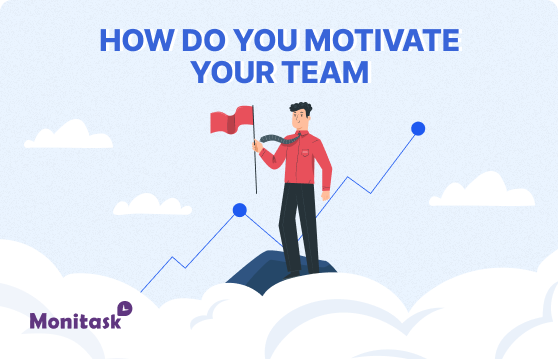
How Do You Motivate Your Team? Proven Strategies for High Performance and Engagement

Motivating a team is one of the most important, and often most challenging, responsibilities of any leader.
A motivated team works more productively, collaborates more effectively, and remains committed even during difficult periods. Yet many managers still ask the same question: how do you motivate your team in a way that lasts?
Today, motivation goes far beyond rewards or strict oversight. Employees expect purpose, growth, trust, and recognition to be part of their daily experience at work.
This article explores proven strategies leaders can use to motivate their teams, strengthen engagement, and drive sustainable business results.

What Does Team Motivation Really Mean
Team motivation reflects the collective energy, commitment, and willingness employees bring to their work. It influences how people approach challenges, solve problems, and contribute beyond basic job requirements.
There are two main types of motivation. Intrinsic motivation comes from internal drivers such as personal growth, purpose, and satisfaction from meaningful work. Extrinsic motivation comes from external rewards like salary increases, bonuses, or promotions. Both play a role, but intrinsic motivation has a stronger impact on long-term performance and engagement.
Motivation also varies based on role, experience, and personality. Entry-level employees may be energized by learning and mentorship, while experienced professionals often value autonomy and the ability to make an impact. One common misconception is that motivation can be applied uniformly. In practice, effective motivation is adaptive and personal.
Why Motivating Your Team Is More Challenging Today
Modern work environments introduce challenges that directly affect motivation. Remote and hybrid work models reduce visibility and informal interaction, making it easier for employees to feel disconnected if leaders are not intentional.
Burnout is another major factor. Heavy workloads, constant digital communication, and unclear boundaries between work and personal life contribute to disengagement. This has led to phenomena like quiet quitting, where employees meet expectations but withdraw emotionally.
Generational differences also play a role. Many younger employees prioritize flexibility, development, and purpose, while others may place higher value on stability and recognition. Leaders must balance these expectations without creating inconsistency or favoritism.
How Do You Motivate Your Team as a Leader
Leadership behavior sets the tone for motivation. Employees are more engaged when they trust their leaders and feel supported rather than monitored.
Leading by example remains one of the most effective tools. When leaders demonstrate accountability, consistency, and commitment, teams respond in kind. Motivation also increases in environments with psychological safety, where employees feel comfortable sharing ideas, asking questions, and acknowledging mistakes.
Alignment is equally important. When people understand how their work contributes to broader goals, daily tasks feel more meaningful. Motivation grows when employees see a clear connection between effort and impact.
Proven Ways to Motivate Your Team at Work
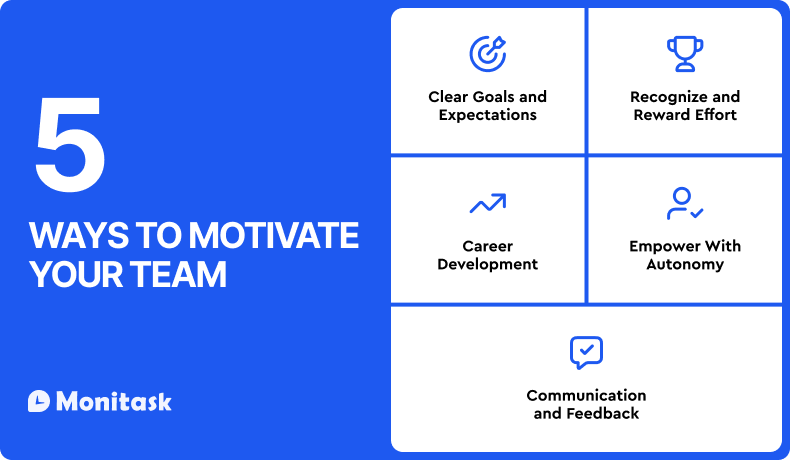
Set Clear Goals and Expectations
Clarity removes friction. Employees perform better when they understand priorities, success criteria, and decision boundaries. Unclear goals create hesitation and frustration.
Effective leaders define realistic, measurable objectives and revisit them regularly. When employees know what they are working toward and why it matters, focus and motivation improve naturally.
Recognize and Reward Employee Effort
Recognition reinforces motivation by acknowledging contribution and progress. Employees want to know their work is noticed and valued.
While financial rewards are important, timely non-monetary recognition often has a deeper effect. Specific praise, thoughtful feedback, or increased responsibility can be highly motivating when tied to real achievements. Consistency and sincerity matter more than scale.
Encourage Growth and Career Development
Motivation increases when employees see a future within the organization. Learning opportunities, skill development, and mentorship signal long-term investment in people.
Clear development paths help employees understand how effort today connects to opportunity tomorrow. Even modest training initiatives can significantly boost engagement, especially for those early in their careers.
Empower Employees With Autonomy
Autonomy strengthens motivation by giving employees ownership over their work. Excessive control erodes trust and discourages initiative.
Leaders should focus on results rather than rigid processes. Allowing employees to make decisions, manage their time, and solve problems independently increases accountability and satisfaction.
Foster Open Communication and Feedback
Motivation thrives in environments where communication flows both ways. Employees need space to share ideas, raise concerns, and receive guidance.
Regular one-on-one conversations, team discussions, and feedback loops help leaders stay connected. Feedback should be ongoing and practical, not limited to formal reviews. When people feel heard, their willingness to contribute grows.
How to Motivate a Team During Difficult Times
Periods of uncertainty require a different leadership approach. Motivation during change or crisis depends heavily on empathy and transparency.
Leaders who communicate honestly about challenges and next steps build credibility. Acknowledging stress, offering flexibility, and recognizing small wins help maintain momentum.
Consistency is critical. When leaders remain fair, visible, and dependable during difficult periods, trust deepens and motivation becomes more resilient.
Mistakes Leaders Make When Trying to Motivate Their Team
One common mistake is overreliance on financial incentives. While bonuses can drive short-term effort, they rarely sustain engagement without meaningful work and strong leadership.
Another is assuming everyone is motivated by the same factors. Ignoring individual drivers leads to disengagement and missed potential.
Lack of follow-through is equally damaging. When commitments are not honored, trust erodes quickly. Motivation cannot exist without credibility.
How to Measure Team Motivation and Engagement
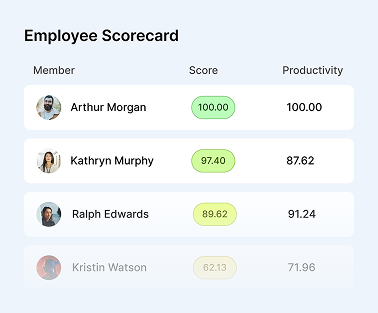
Motivation should be tracked with the same seriousness as performance. Engagement surveys, retention data, productivity trends, and regular feedback provide valuable insight.
Short pulse surveys can reveal early warning signs of disengagement. The key is action. Measuring motivation without responding to results weakens trust rather than strengthening it.
Motivation Strategies for Different Team Types
Different teams respond to different motivators based on experience, environment, and expectations. A single approach rarely works across all groups. Effective leaders adjust their strategy to maintain performance and well-being.
How to Motivate Remote Teams
Remote teams require deliberate connection. Distance can weaken visibility and belonging if not addressed intentionally.
Clear expectations around goals, communication, and outcomes help remote employees stay confident and focused. Regular check-ins replace informal office interactions and create space for alignment without micromanagement.
Recognition should be visible. Public acknowledgment in meetings or internal channels reinforces inclusion. Flexibility and respect for boundaries also signal trust, which directly strengthens motivation.
How to Motivate Entry-Level Employees
Entry-level employees are motivated by learning, feedback, and progress. Confidence and clarity are especially important at this stage.
Structured onboarding and clear role definitions reduce uncertainty. Frequent feedback helps new employees improve and stay engaged.
Mentorship plays a powerful role. Access to experienced colleagues provides guidance and perspective. Recognizing early wins reinforces momentum and long-term commitment.
How to Motivate High-Performing Teams
High performers are driven by challenge, purpose, and impact. Over-supervision or generic rewards often reduce engagement.
Autonomy is essential. Trusting experienced employees with complex work and decision-making demonstrates respect for their expertise.
Involving them in strategic discussions further increases motivation. When people see their insights shaping direction, commitment deepens. Ongoing learning and leadership opportunities help prevent stagnation.
The Long-Term Impact of Motivated Teams on Business Success
Motivated teams consistently outperform disengaged ones. They adapt faster, collaborate more effectively, and remain loyal longer.
Over time, motivation becomes cultural. Organizations that prioritize it attract stronger talent, reduce turnover, and build lasting competitive advantage.
Boost your business productivity
Track performance and streamline teamwork
Conclusion: Motivate Your Team
So, how do you motivate your team? Not through slogans or occasional initiatives, but through consistent leadership choices made every day.
Motivation grows when leaders communicate clearly, treat people fairly, and remain genuinely involved with their teams. It becomes stronger when employees feel recognized for their efforts, supported in their growth, and trusted to do meaningful work. Most importantly, motivation lasts when leadership remains consistent, especially during challenging periods.
Strong teams are not built by chance. They are built through trust, accountability, communication, and sustained support. Organizations that prioritize these principles are far more likely to create engaged teams, stronger performance, and healthier workplace cultures over the long term.
FAQ: Team Motivation
What motivates employees the most at work?
Purpose, recognition, opportunities for growth, and autonomy are among the strongest drivers of sustained motivation.
Can money really motivate a team long-term?
Compensation matters, but it does not replace meaningful work, trust, and development.
How often should leaders motivate their teams?
Motivation is ongoing. It is reinforced daily through behavior, communication, and follow-through.