What Is the 7-Minute Time Clock Rule? A Complete Guide for Employers and Employees


Accurate time tracking is essential for payroll compliance, employee trust, and fair compensation.
One concept that often causes confusion is the 7-minute time clock rule. Although it is widely used in payroll systems, many employers and employees are unsure how it works and whether it is legally required.
So what is the 7-minute time clock rule, and why does it matter?
This guide explains how the rule works, when it is allowed, its legal implications, advantages and risks, and whether it still makes sense in modern and remote workplaces.
What Is the 7-Minute Time Clock Rule
The 7-minute time clock rule is a payroll rounding method that rounds employee clock-in and clock-out times to the nearest quarter hour, or 15 minutes.
If an employee clocks in or out within the first 7 minutes of a 15-minute interval, the time is rounded down. If the time exceeds 7 minutes, it is rounded up to the next quarter hour.
The rule is intended to simplify payroll calculations while remaining compliant with labor laws when applied fairly.
How the 7-Minute Rule Works in Practice
To understand what the 7-minute time clock rule is, it helps to see how it works in real scenarios.
A standard hour is divided into four 15-minute blocks:
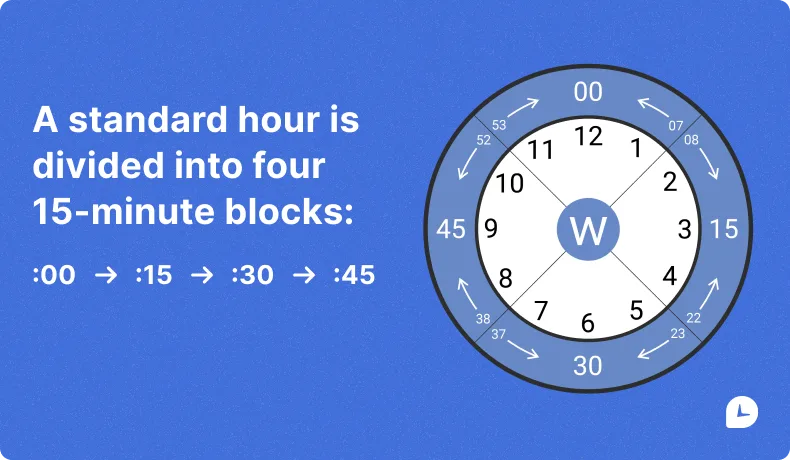
Each block has a midpoint at 7 minutes.
Here is how rounding typically works:
1–7 minutes past the quarter hour → rounded down
8–14 minutes past the quarter hour → rounded up
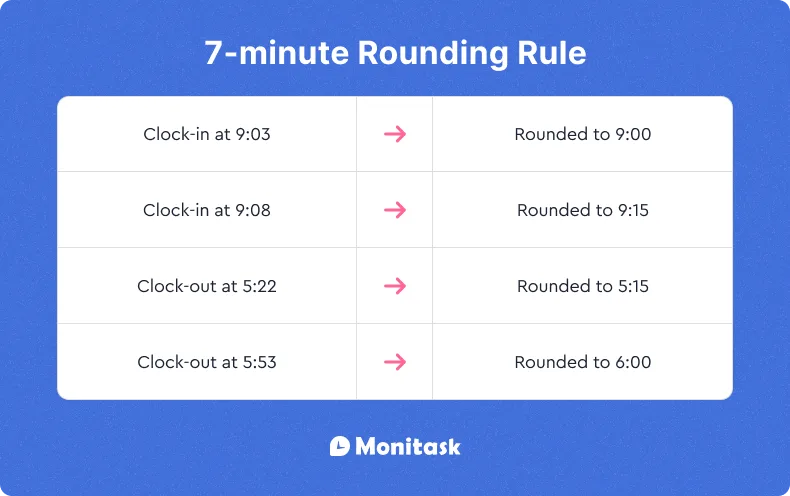
Over time, rounding should balance out so employees are neither systematically overpaid nor underpaid.
Why Does the 7-Minute Time Clock Rule Exist
The 7-minute rule originated as a way to reduce administrative burden. Before digital payroll systems, calculating exact minutes for every employee was slow and prone to errors. Rounding provided a practical compromise between accuracy and efficiency.
Many organizations still use the rule today because it simplifies payroll, smooths minor punch-time variations, and aligns with quarter-hour scheduling or billing models. That convenience, however, does not remove responsibility. Employers must still apply rounding fairly and in compliance with labor laws.
Is the 7-Minute Time Clock Rule Legal
In the United States, the 7-minute time clock rule is permitted under the Fair Labor Standards Act if specific conditions are met. The U.S. Department of Labor allows rounding as long as it rounds to the nearest quarter hour, is neutral on average, and does not consistently favor the employer.
In practice, this means rounding must sometimes benefit employees and sometimes benefit employers. If a system regularly reduces employee pay, it is considered unlawful.
Outside the United States, legality varies. Some countries allow rounding, while others require exact time tracking.
When the 7-Minute Rule Becomes Illegal
The rule becomes illegal when it consistently disadvantages employees. This typically happens when rounding always reduces payable time or is used selectively in the employer’s favor. Pairing rounding with strict attendance penalties can also turn a neutral payroll practice into a compliance risk.
Courts focus on how rounding works in real outcomes, not how policies are written. Even a neutral-looking policy can be unlawful if it consistently benefits the employer.
Boost your business productivity
Track performance and streamline teamwork
The Difference Between Rounding and Time Theft
The 7-minute rule is sometimes misused as a way to control time theft. This is a misunderstanding.
The rule exists to simplify payroll calculations, not to discipline employees for minor lateness or early departures. Attendance and performance issues should be addressed through scheduling and management policies, not payroll rounding.
Using rounding as a disciplinary tool increases legal risk and damages employee trust.
Pros and Cons of Using the 7-Minute Time Clock Rule
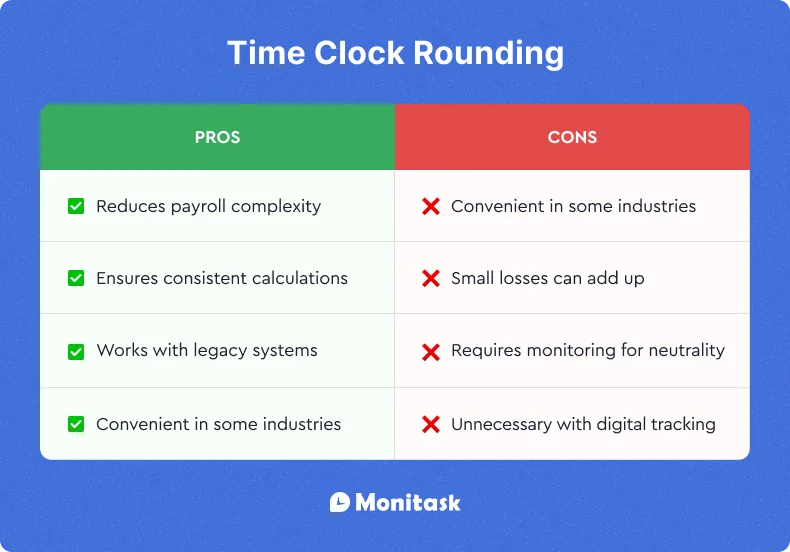
When applied correctly, the 7-minute time clock rule offers practical advantages. It reduces payroll complexity, creates consistent calculations, and works well for organizations that rely on quarter-hour billing models or legacy systems. For certain industries and workflows, rounding can still be operationally convenient.
At the same time, the rule has clear drawbacks. Employees may feel shortchanged if they frequently lose small amounts of time, even when rounding is neutral overall. Small discrepancies repeated over time can increase legal exposure if not carefully monitored. In many modern workplaces, precise digital tracking makes rounding unnecessary.
The 7-Minute Rule in Remote and Hybrid Work
Remote and hybrid work environments have changed how organizations think about time tracking. When employees work flexible schedules, strict rounding can feel outdated and misaligned with outcome-based performance models.
For remote teams, the question is no longer just how the 7-minute time clock rule works, but whether it still fits the way work is actually done. Many remote-first organizations now favor exact tracking or results-focused measurement, although rounding can still be used if it aligns with flexible policies.
Alternatives to the 7-Minute Time Clock Rule
Modern employers have more options than ever. Some track exact minutes worked without rounding, while others focus on daily totals instead of individual punches. In certain roles, productivity is measured by tasks, milestones, or deliverables rather than hours.
Grace periods for minor lateness are another option that avoids altering payable time. These alternatives often reduce friction and improve transparency.
How Modern Time Tracking Software Handles Rounding
Most modern time tracking systems allow employers to configure rounding rules—or disable them entirely.
Advanced platforms can:
✅ Track time down to the second
✅ Apply neutral rounding automatically
✅ Generate compliance reports
✅ Show employees their raw and rounded time
This transparency helps prevent disputes and builds trust.
The key is using technology to support fairness, not exploit rounding rules.
Best Practices for Using the 7-Minute Time Clock Rule
Organizations that use the rule should document it clearly in company policies so employees understand how rounding works and how it affects pay. Payroll data should be reviewed regularly to confirm rounding is neutral in practice.
Rounding should never be combined with punitive attendance enforcement, and organizations should periodically reassess whether it is still necessary as tools and work models evolve.
How Employees Should Understand the 7-Minute Rule
Employees benefit from understanding how rounding affects their pay. Knowing the thresholds helps reduce confusion and unnecessary concern over small time differences.
Employees should also feel comfortable reviewing time records and asking questions if something appears incorrect. Transparency protects both employers and employees.
Common Myths About the 7-Minute Time Clock Rule
One common myth is that rounding always benefits employers. When applied correctly, it should balance out over time. Another misconception is that rounding is required by law, which is not true.
While some view rounding as outdated, it remains legally acceptable in many contexts. Understanding these points helps organizations make informed decisions.
The Future of Time Rounding
As time tracking technology advances, the need for rounding continues to decline. Exact tracking, automation, and analytics make minute-level accuracy easier than ever.
At the same time, many organizations are shifting toward trust-based and outcome-focused management. The future of time tracking emphasizes clarity, fairness, and alignment with how people actually work.
Conclusion: 7-Minute Time Clock Rule
The 7-minute time clock rule is a payroll rounding method that rounds punches to the nearest quarter hour. While legal in many jurisdictions, it must be applied neutrally and transparently.
Today, the rule is a choice rather than a necessity. Employers must balance administrative convenience with employee experience, legal risk, and modern expectations.
Used responsibly, the rule can still work. Used carelessly, it becomes a liability.
The Monitask Team
FAQ: 7-Minute Time Clock Rule in Practice
Is the 7-minute rule required by law?
No. It is allowed in some jurisdictions but not mandatory.
Can the rule reduce employee pay?
Only if applied unfairly, which is not legal.
Is rounding relevant for remote employees?
Often less so. Exact tracking or outcome-based measurement may be more appropriate.
Should companies stop using the rule?
It depends on their workforce, tools, and compliance needs. Many modern organizations choose more precise alternatives.