High-Paying Remote Jobs: What They Pay and What “Remote” Actually Means

Remote roles paying six figures exist across engineering, data, security, product, sales and specialist professional fields. What varies far more than the job title is the level: the same role can pay $80,000 to someone in their first year and over $200,000 to someone with a decade behind them, which is why a single “average salary” for a profession tells you almost nothing.
The second thing that varies, and the one most guides skip, is what “remote” means on the posting. A fully remote job can still require you to live in a particular country, state or time zone. That restriction decides whether you can take the job at all, and often what it pays.
Key takeaways
- Ranges by experience level are the useful number. A profession-wide average hides a spread of two or three times.
- The highest ranges sit in AI and machine learning, security, cloud and senior engineering; the widest spread sits in sales, where commission does the work.
- “Remote” often means remote within a country, a state, or a set of time zones. Check before you apply.
- Some employers set pay by your location, others by the role. This is worth asking in the first conversation, not the last.
- Entry points into six-figure paths exist, but they are paths rather than jobs — they start below the range and take a couple of years.
Remote Roles That Reach Six Figures
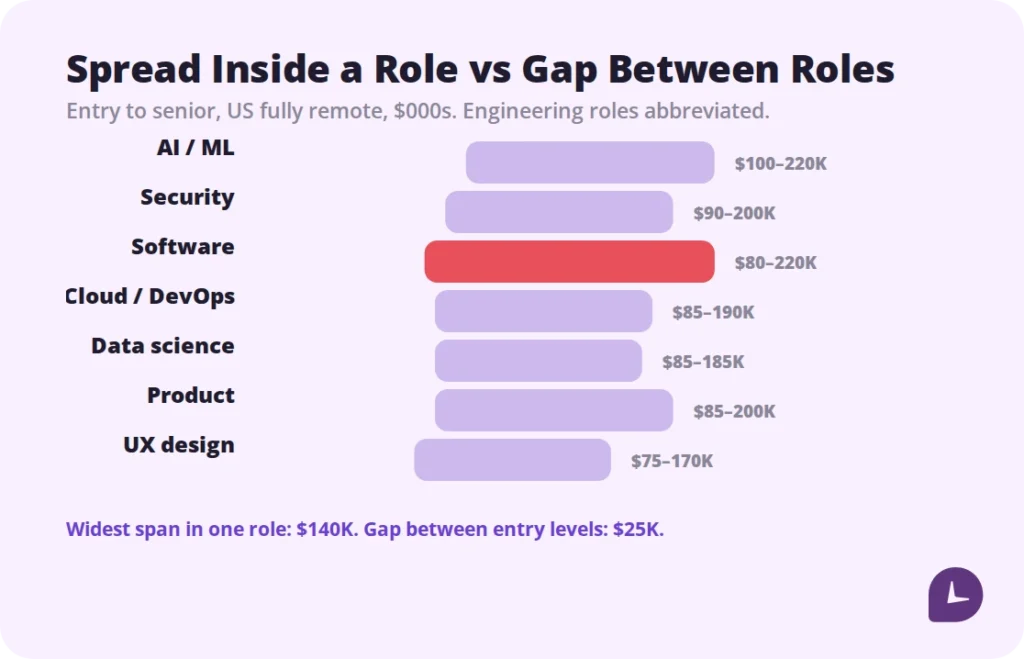
Ranges below are typical US figures for fully remote roles, split by experience rather than averaged. Treat them as the shape of the market rather than a quotation: actual offers depend on the employer, the sector and — often — on where you live. Figures are indicative and were compiled from published salary ranges current at the time of writing.
| Role | Entry | Mid | Senior | What moves you up the range |
|---|---|---|---|---|
| AI / machine learning engineer | $100–130K | $130–170K | $170–220K+ | Production deployment, not just model work |
| Security engineer | $90–120K | $120–160K | $160–200K+ | Cloud security, compliance, incident response |
| Software engineer | $80–110K | $110–150K | $150–220K+ | System design and ownership, not language count |
| Cloud / DevOps engineer | $85–115K | $115–150K | $150–190K+ | Infrastructure as code, cost architecture |
| Data scientist | $85–110K | $110–145K | $145–185K+ | Business impact, not just modelling |
| Product manager | $85–110K | $110–150K | $150–200K+ | Owning a revenue-carrying product line |
| Account executive | $60–85K base | $115–180K OTE | $180–300K+ OTE | Deal size and quota attainment |
| UX / product designer | $75–95K | $95–130K | $130–170K+ | Research plus interaction, not visuals alone |
| Technical writer | $70–90K | $90–115K | $115–140K+ | Regulated or highly technical domains |
Two things to read out of this table. The spread inside a role is wider than the gap between roles, which is why targeting a job title is less useful than targeting a level. And sales is the outlier: the base looks modest and the total depends on quota, so the published figure and the realistic figure diverge more than in any other row.
Boost your business productivity
Track performance and streamline teamwork
What “Remote” Actually Means on a Job Posting
This is the part that decides whether you can take the job. The word “remote” covers at least four different arrangements, and postings rarely spell out which one they mean until you ask.
| What the posting says | What it usually means | What to check before applying |
|---|---|---|
| Remote | Often remote within one country | Which country, and whether they can employ you there |
| Remote (US) | Remote, but you must be a US resident | Whether specific states are excluded — some are, for tax reasons |
| Remote — [time zone] | You must overlap with a team | How many hours of overlap, and whether meetings sit inside them |
| Work from anywhere | Genuinely location-independent | How you are paid and whether you are an employee or a contractor |
| Hybrid remote | On site some days | How many days, and whether that is negotiable |
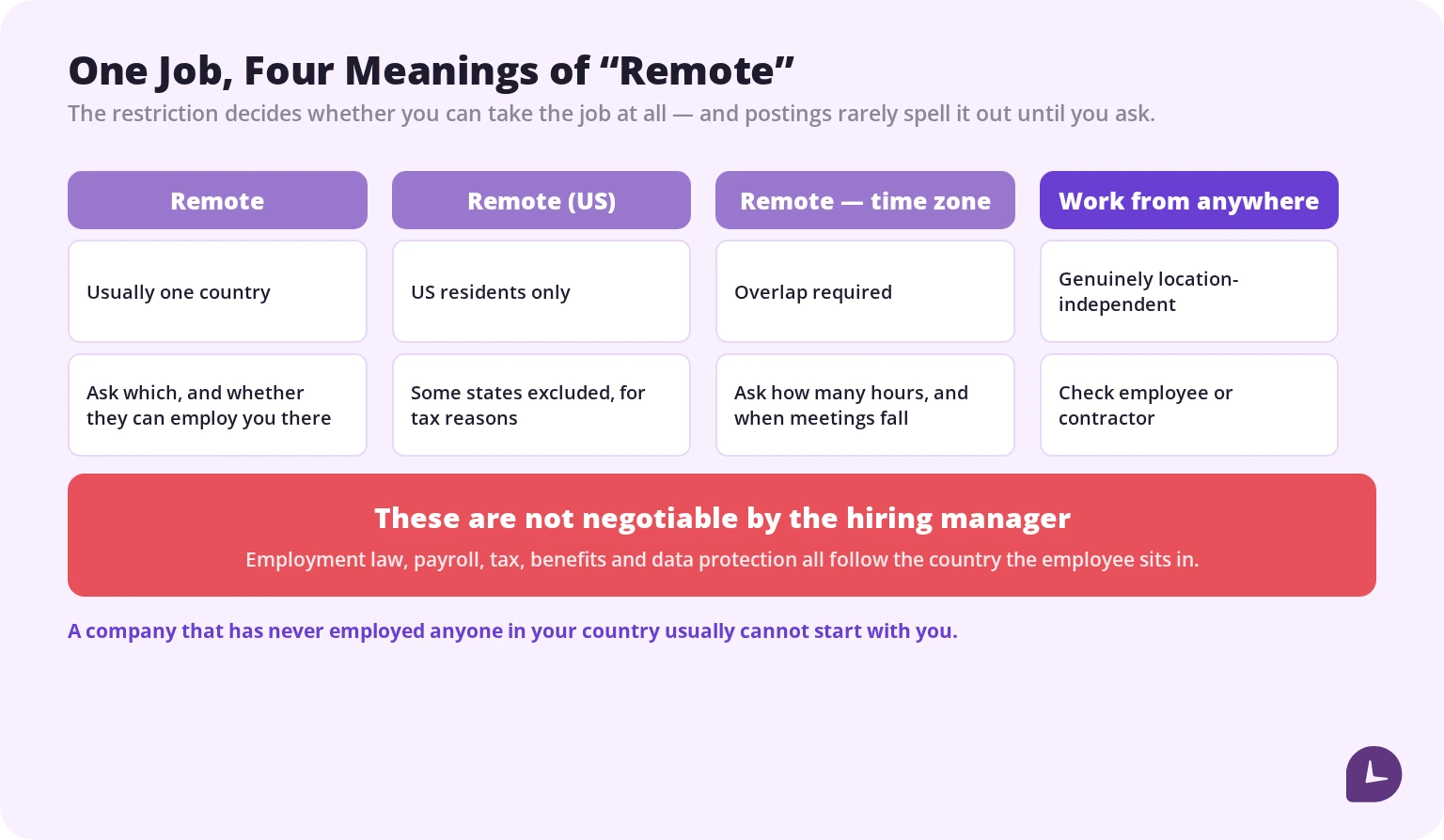
Restrictions exist for reasons that are not negotiable by the hiring manager: employment law, payroll registration, tax, benefits and data protection all follow the country the employee sits in. A company that has never employed anyone in your country usually cannot start with you.
Boost your business productivity. Track performance and streamline teamwork.
Start Your 10-Day Trial
Does Where You Live Change What You Are Paid?
Sometimes, and it is worth establishing early. Some employers set a single range for the role regardless of location. Others adjust to local cost of living, which can move the same offer by a significant margin.
Neither approach is unusual and neither is a red flag on its own. What matters is knowing which one you are dealing with before you have invested four interview rounds. A direct question works: “Is the range for this role location-adjusted, and if so, what band would apply to where I am?”
Ask it in the first conversation. Asking at offer stage means renegotiating a number that has already been approved internally, which is a much harder conversation.
Getting Into These Ranges Without Experience
The honest answer is that these are paths rather than entry points. The entry level of each range above is a real job you can get within a year or two of focused work, but it is the bottom of the range, not the headline number.
- Pick the adjacent entry role rather than the target role. Support engineer into security, analyst into data science, SDR into account executive. These are the routes people actually take.
- Build proof before applying. A portfolio, a public repository, a certification that the field actually recognises. For technical roles, evidence beats credentials.
- Target companies already hiring remotely. A firm with no remote track record that suddenly advertises a remote role is often testing the idea rather than committing to it — remote-first companies are the ones where the arrangement is already proven.
- Watch for the postings that ask for everything. An entry-level listing requiring ten technologies is usually a senior role with a junior budget.
- Count the total, not the base. Equity, bonus, equipment allowance and benefits vary enormously between remote employers, and the base salary is the least informative part of a remote offer.
Freelance or Employed?
The ranges above are for employment. The same skills sold as a freelancer work on a different maths: higher headline rates, no benefits, unpaid gaps between projects, and platform fees on top. Neither route is better; they fail in different ways.
If the freelance route is what interests you, the practical starting sequence — niche, portfolio, rate, first client — is covered in our guide to getting started as a freelancer, and where demand is actually growing covers which skills are being hired most right now.
Making the Income Predictable Once You Have It
Remote work removes the structure that an office provides, and for hourly or contract roles it also removes the witness to what you worked. The people who make remote income stable do two unglamorous things: they record their hours against clients or projects, and they review the record rather than their memory.
A time tracker running in the background produces that record while you work, so invoices and timesheets come from data rather than reconstruction — and you find out what your effective hourly rate actually is. Try it on a 10-day free trial, no card required.
Key Takeaways
Target a level rather than a job title: the range inside a profession is wider than the gap between professions. Establish early whether the role is genuinely location-independent and whether pay is adjusted to where you live — both questions belong in the first conversation. And read the total package rather than the base, because that is where remote offers differ most.
Reliable employee tracking software. Clear visibility and insights into how employees work. Even remotely.
Try Monitask free for 10 days
FAQ: Remote Job Search
Do remote jobs pay less than office jobs?
Not inherently. It depends on whether the employer sets pay by role or by employee location. Companies with a single national range pay the same wherever you sit; companies using location-adjusted bands do not. Ask which approach applies in the first conversation rather than at offer stage.
Can I work a US remote job from another country?
Usually not without the employer already being set up to employ people there. Payroll, tax, benefits and employment law follow the country the employee is in, which is why most “remote” postings are remote within one country. Some companies hire internationally through an employer of record; most do not.
What remote jobs pay over $100,000 without a degree?
Software engineering, security, cloud and DevOps, and sales all have paths that do not require a specific degree, though they do require demonstrable skill. Evidence carries more weight than credentials in these fields: a public portfolio, a recognised certification, or a track record of hitting targets.
How do I know a remote job posting is legitimate?
Verify the role appears on the company’s own careers page, not only on a job board. Be cautious about upfront payments, equipment purchases through an unfamiliar vendor, requests for financial details early in the process, and interviews conducted entirely over informal messaging apps. A real hiring process has identifiable people and a consistent story across sources.
What does "remote — EST time zone" mean?
That you can work from anywhere the company can legally employ you, provided your working hours overlap with that time zone. In practice it usually means a required overlap window for meetings. Ask how many hours of overlap are expected and when meetings actually fall, because “flexible with overlap” and “online 9 to 5 Eastern” are very different jobs.
Is the salary range in a posting negotiable?
Often, within the band. The range published is usually the approved band for the level, so movement within it is realistic and movement above it is rare. The more effective lever for remote roles is the rest of the package — equipment, learning budget, additional leave — which is frequently easier to move than the base.