Time Blocking: A Practical Guide to Planning Your Day

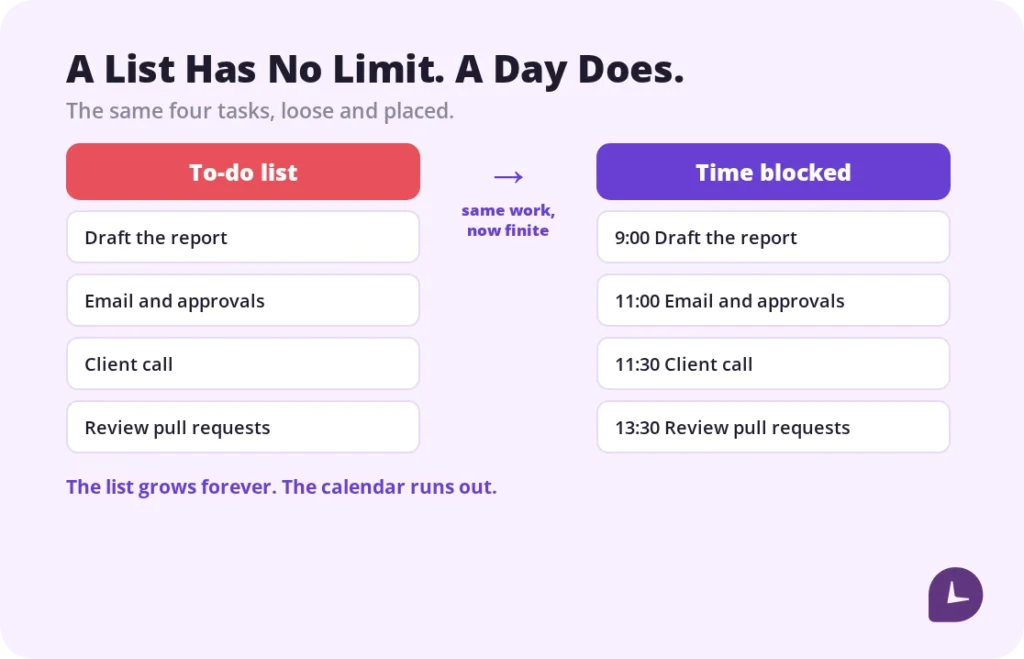
Time blocking means giving each task a specific slot on your calendar instead of working from an open-ended to-do list. You decide in advance when each piece of work happens, so during the day you follow a plan rather than choosing what to do next.
The method is simple to describe and hard to sustain, and it fails for the same reason almost every time: the blocks were the wrong length. This guide covers the six steps, how long blocks should actually be, what a blocked day looks like in different roles, and how to find out within two weeks whether your estimates are any good.
Key takeaways
- A to-do list has no limit; a calendar has exactly as many hours as a day. That constraint is the point.
- Deep work blocks run 90 minutes to three hours. Shallow work runs 20 to 45. A day with no gaps collapses the first time something overruns.
- Give your best hours to your hardest work and cluster meetings instead of scattering them.
- Week one always fails on estimates. Compare planned against actual for two weeks and re-plan with real numbers.
- If your day is driven by other people’s requests, block two protected hours and leave the rest reactive.
What Time Blocking Is
Time blocking assigns a start and end time to every task: “9:00–11:00 draft the report”, “11:00–11:30 email”. The difference from a to-do list is that the list tells you what to do, while a blocked calendar tells you what to do now — and what not to do until later.
Two properties do the work. A block is visible: work that lives only in a task app is invisible to colleagues, while work on the calendar stops meeting invitations before they arrive. And a block is finite: once tasks occupy real slots, it becomes obvious that the to-do list was longer than the day. That discovery is uncomfortable and it is the most useful thing the method does.
Boost your business productivity
Track performance and streamline teamwork
How to Time Block Your Day: Six Steps
Capture everything, sort by type of work, estimate honestly, match the hardest work to your best hours, protect the blocks, and review weekly. The sixth step is the one people skip and the one that makes the method stick.
- Capture and prioritise. One list of everything, ranked. The point is knowing what to drop when the day compresses, so the important work is never what falls off.
- Sort by type. Deep work that needs uninterrupted focus, shallow work that fits in short bursts, and collaborative work that needs other people. These three want very different slots. Grouping the similar ones is task batching, covered below.
- Estimate, then add margin. Almost everyone underestimates. This is why week one feels like failure and why the two-week check below exists.
- Match work to energy. Best hours to hardest work. Use the post-lunch dip for admin. Cluster meetings — three back to back cost you an afternoon, three scattered cost you the day.
- Defend the blocks. Notifications off, status set, blocks marked busy so invitations bounce. Google Calendar’s focus time and Microsoft Viva Insights both do this natively on business accounts.
- Review weekly. Fifteen minutes to see which blocks held and which collapsed. Move the ones that never worked, shorten the ones that always overran.
How Long Should a Time Block Be?
Deep work blocks run 90 minutes to three hours — long enough to reach focus, short enough to sustain. Shallow work runs 20 to 45 minutes. Leave a gap between blocks: a day scheduled edge to edge fails the first time anything runs over.
| Type of block | Length | What goes in it |
|---|---|---|
| Deep work | 90 min – 3 hrs | Writing, design, code, analysis, anything needing flow |
| Shallow work | 20–45 min | Email, approvals, filing, quick calls |
| Meetings | Clustered, back to back | Stand-ups, reviews, one-on-ones |
| Buffer | 15–30 min | Overruns, transitions, whatever the day throws |
| Personal | Whatever it needs | Exercise, lunch, errands — scheduled, not left to gaps |
The buffer row is the one people cut first and regret first. Without it, one overrun cascades through every block after it, and by mid-afternoon the plan is abandoned.
What a Blocked Day Looks Like
The shape depends entirely on the job. Three patterns, all following the same rule: hardest work in the best hours, meetings clustered, light tasks in the low-energy stretch.
| Time | Manager | Developer | Creative |
|---|---|---|---|
| 8:00–9:30 | Planning, inbox triage, metrics | Hardest problem, uninterrupted | Deep creative work |
| 9:30–11:00 | Strategic project work | (continues) | (continues) |
| 11:00–12:30 | Team time: stand-ups, one-on-ones | Code review, pairing | Admin, email, invoices |
| 13:30–15:00 | Operational oversight, unblocking | Second coding block | Collaboration and feedback |
| 15:00–16:30 | External: partners, customers | (continues) | Second creative block |
| 16:30–17:30 | Correspondence, delegation, prep | Testing, deployment checks | Finishing, prep for tomorrow |
Time Blocking, Timeboxing, Batching and Day Theming
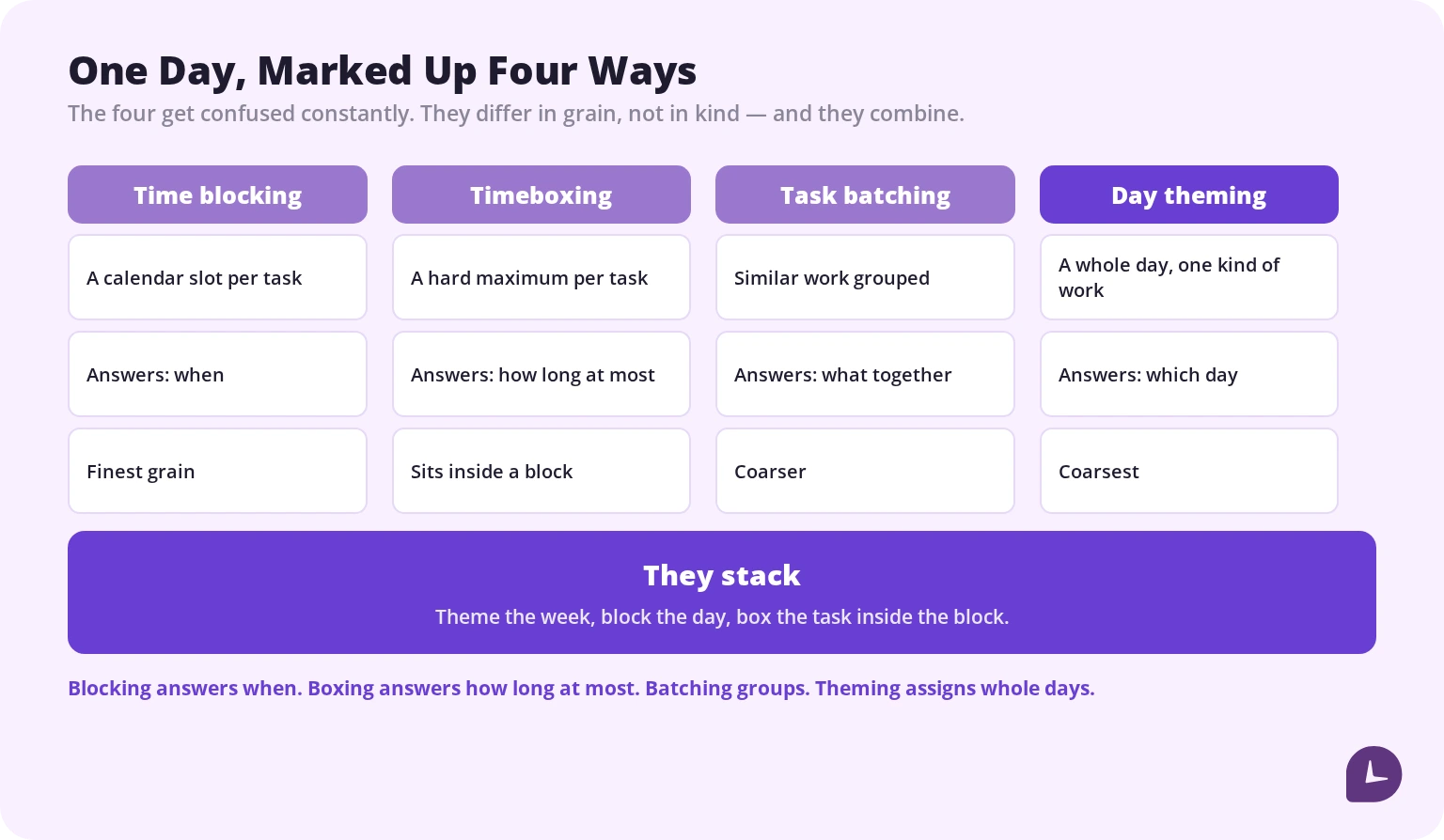
These four get confused constantly. Blocking answers when; boxing answers how long, maximum; batching groups similar work; theming assigns whole days. Most people who are good at this combine them: theme the week, block the day, box the task inside the block.
| Time blocking | Timeboxing | Task batching | Day theming | |
|---|---|---|---|---|
| What it fixes | Scattered, reactive days | Tasks that expand forever | Constant context switching | Fragmented weeks |
| Unit | A calendar slot | A hard time limit | A group of similar tasks | A whole day |
| Structure | High | Medium | Medium | Low |
| Best for | Mixed responsibilities | Perfectionism, open-ended work | Many small, similar tasks | Volatile weeks |
| Main risk | Too rigid, guilt when it slips | Stopping mid-flow | Neglecting non-batchable work | Too coarse for meeting-heavy roles |
Planned vs Actual: The Two-Week Check
Time blocking fails on estimates, not on discipline. Nearly everyone underestimates how long work takes, and a plan built on wrong estimates collapses by Wednesday regardless of how committed you are. The fix is data, and two weeks is enough to get it.
Keep this table for ten working days. One row per block, filled in at the end of the block rather than at the end of the week.
| Task | Planned | Actual | Gap | What it tells you |
|---|---|---|---|---|
| Draft weekly report | 60 min | 95 min | +35 | Deep work blocks are too short by roughly half |
| 45 min | 20 min | −25 | Shallow blocks are too generous; reclaim the time | |
| Client call + notes | 30 min | 55 min | +25 | The follow-up was never blocked at all |
| Review pull requests | 60 min | 60 min | 0 | Estimate is reliable; leave it |
Three patterns usually show up. Deep work takes 1.5 to 2 times the estimate. Shallow work takes less than allocated, because the block was set by habit rather than measurement. And a recurring category of work — follow-ups, hand-offs, prep — never appears on the calendar at all, which is why the day keeps overflowing.
Filling this in from memory does not work; the whole point is measured time rather than remembered time. A time tracker running in the background records what each task actually took while you work, so at the end of a fortnight you are re-planning from numbers instead of impressions. Try it on a 10-day free trial, no card required.
Maximize productivity of your business.
Start Your 10-Day Trial
When Time Blocking Is the Wrong Tool
The method is not universal, and assuming otherwise is why people conclude they are bad at productivity. It struggles when:
- Your day is driven by other people’s availability — support, clinical work, on-call rotations, account management. When work arrives unpredictably, a detailed plan is just something to feel bad about.
- You have caretaking responsibilities that make any fixed schedule provisional.
- Your energy varies sharply in ways you cannot predict a week ahead.
- The work is genuinely open-ended and forcing it into a slot flattens it.
If several of these apply, do not abandon the idea — reduce its resolution. Block the two hours that matter most and leave the rest of the day genuinely open, or move up to day theming, where each day gets a dominant type of work rather than each hour getting a task.
Fixing the Four Common Failures
- Everything takes longer than planned. Universal in week one. Run the two-week check and re-plan from the real numbers rather than quitting.
- Something urgent breaks the day. Treat the plan as a guide, not a contract. Keep one or two unallocated blocks, and make re-planning a two-minute habit instead of a defeat.
- The structure feels suffocating. Do not block the whole day. Protect the two most important hours and add structure only where the open version visibly fails. Overloading every hour is a route to the thing burnout prevention exists to avoid.
- You abandon it after a fortnight. The weekly review is what produces consistency. Fifteen minutes on Friday is the entire maintenance cost.
Key Takeaways
Give every task a slot and the day stops being a series of decisions. Deep work runs 90 minutes to three hours, shallow work 20 to 45, and both need a gap between them. Match the hardest work to your best hours and cluster the meetings. Then spend two weeks comparing what you planned against what actually happened — that comparison, more than any app, is what turns the method from a good idea into something that survives a real week.
Reliable employee tracking software. Clear visibility and insights into how employees work. Even remotely.
Try Monitask free for 10 days
Frequently Asked Questions
What is the difference between time blocking and timeboxing?
Time blocking reserves a slot for a task: “report writing, 9:00–11:00”. Timeboxing sets a hard maximum and stops when it is reached: “90 minutes, then I move on regardless”. Blocking answers when, boxing answers how long at most. They combine well — block the slot on the calendar and box the task inside it.
How do I start time blocking?
Block one week, not one month. Pick the two hours a day when you think most clearly and give them to your most important work, marked busy so meetings bounce off. At the end of the week, look at which blocks survived. Add more structure only where the unstructured version failed.
Why does time blocking keep failing for me?
Almost always because the estimates are wrong rather than because the discipline is. Deep work typically takes one and a half to two times what people allocate, and recurring follow-up work often never gets a block at all. Compare planned against actual for two weeks and the plan usually starts holding on its own.
Does time blocking work if my schedule is unpredictable?
Partly. Full-day blocking does not survive an interrupt-driven job. What does work is protecting one or two periods a day and leaving the rest reactive, or moving up to day theming — assigning each day a dominant type of work rather than each hour a task.
What is the best time blocking app?
Usually the calendar you already use. Google Calendar’s focus time and Microsoft’s Viva Insights focus plan both book and defend blocks natively on business accounts. Dedicated schedulers are worth paying for once you know which specific part of the process hurts — researching productivity apps is itself an effective form of procrastination.
Is time blocking the same as a to-do list?
No, and the difference is the constraint. A list has no natural limit, so it grows indefinitely. A calendar has exactly as many hours as a day, which forces the prioritisation a list lets you postpone. The list tells you what; the calendar tells you when.