Monitask blog

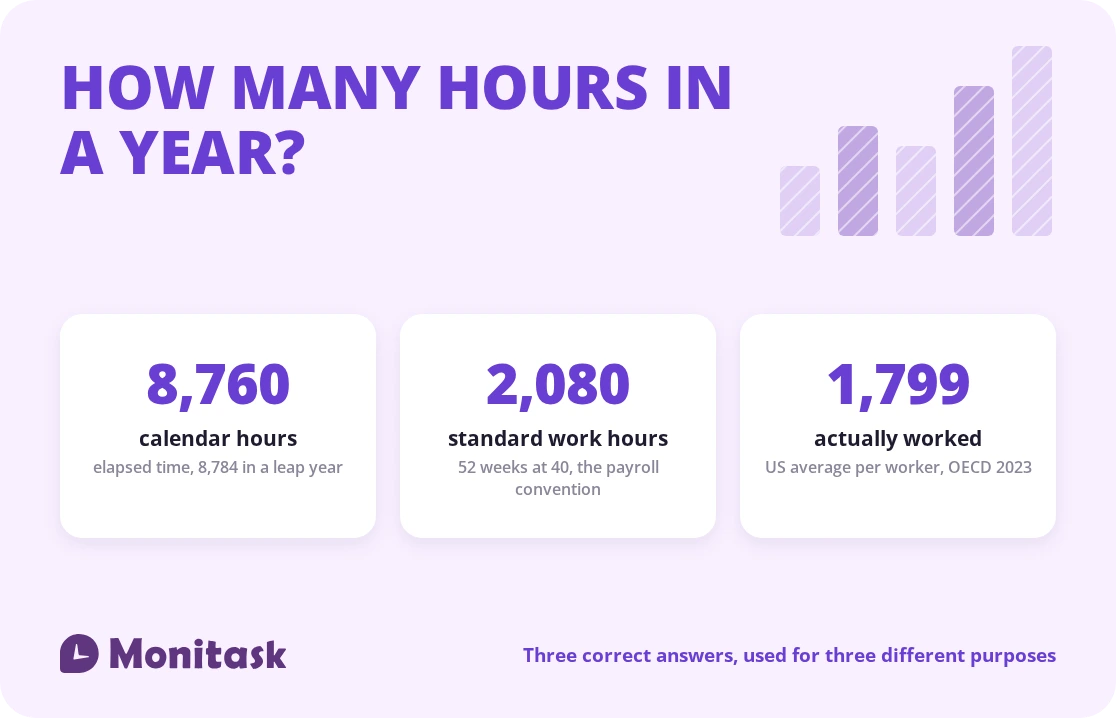
Hours in a year: 8,760 calendar hours, 2,080 standard work hours, and 1,799 actually worked in the US

How Many Hours in a Year? Calendar Hours, Work Hours, and Hours Actually Worked

A year contains 8,760 hours, or 8,784 in a leap year. That is the arithmetic answer and it settles the question only if you were asking about elapsed time. For work, the standard figure is 2,080 hours — 52 weeks at 40 hours. It is the basis for salary-to-hourly conversion, FTE calculations and almost every…

The Top 5 IT Jobs That are Easy to Get Into. Illustration for the Monitask Blog.

The Top 5 IT Jobs That are Easy to Get Into

Getting started in technology does not always require a computer science degree. Many IT jobs without a degree are accessible to candidates who can demonstrate practical skills, relevant certifications, hands-on experience, and a strong understanding of the tools used in the role. Fields such as IT support, systems administration, networking, cybersecurity, and web development often…

10 Ways to Keep Yourself Safe from Layoffs illustration for the Monitask blog

10 Ways to Keep Yourself Safe from Layoffs

Layoffs have become a reality across many industries, affecting companies of all sizes. Economic uncertainty, artificial intelligence, automation, shifting business priorities, and global competition are changing how organizations hire, retain, and manage talent. While no employee can completely eliminate the risk of being laid off, there are practical steps you can take to become more…

12 steps to automate your employee onboarding workflow. Illustration for the Monitask blog.

In‑Depth Guide: 12 Steps to Automate Your Employee Onboarding Workflow

Manual onboarding is a mess waiting to happen. Documents slip through the cracks, tasks get missed, accounts aren’t ready on day one and the result is a disjointed experience that frustrates HR and underwhelms your new hires. It’s not just inefficient; it’s a bad first impression. Automation changes that. With the right tools, you can…


Monitask. Illustration of How Employees Can Tell If They Are Being Monitored?

How Employees Can Tell If They Are Being Monitored

Employee monitoring is becoming a standard practice in many organizations, driven by the growth of remote work and the rise of advanced surveillance tools. These technologies allow employers to track a wide range of activities, from measuring productivity to safeguarding company assets. While the goals may vary, monitoring often sparks concerns about privacy, trust, and…


Monitask. Illustration of How to Handle Multiple Customers at Once

How to Handle Multiple Customers at Once: Practical Strategies

Knowing how to handle multiple customers at the same time is a core skill in today’s customer-facing roles. In retail, hospitality, customer support, sales, and online services, managing overlapping requests is no longer occasional but routine. Customers still expect timely responses, clear communication, and consistent service, even during busy periods. When handled poorly, multitasking leads…

How to Identify Mouse Jigglers Among Your Remote Team?

Employee monitoring software is essential for tracking productivity and ensuring workplace efficiency, especially with remote teams. However, some employees may use tools like mouse jigglers to trick the system into showing them as “active,” even when they are away from their workstations. These devices can undermine your efforts to maintain a productive and secure work…

Monitask. Illustration about What Is the 7-Minute Time Clock Rule?

What Is the 7-Minute Time Clock Rule? A Complete Guide for Employers and Employees

Accurate time tracking is essential for payroll compliance, employee trust, and fair compensation.  One concept that often causes confusion is the 7-minute time clock rule. Although it is widely used in payroll systems, many employers and employees are unsure how it works and whether it is legally required. So what is the 7-minute time clock…

Try Monitask

Track employee productivity and simplify work with them

Start Your 10-Day Trial
In an office visibility happens passively; across a distributed team in multiple time zones it has to be designed

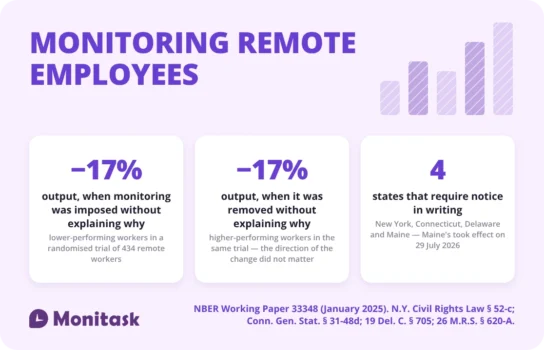
How to Monitor Remote Employees Without Losing the Team

In short: Monitask publishes this article and sells time tracking and monitoring software. Where that is relevant, it is flagged. Why monitoring a remote team is a different problem In an office a great deal of visibility happens without anyone trying. You see who is at their desk, notice a project stalling, spot someone overloaded…

Monitask. Illustration of Best Memorization Techniques: Proven Methods to Improve Memory and Learning

Best Memorization Techniques: 10 Methods and How to Use Them

Most advice about memory stops at naming the methods. This one gives the intervals, the protocols and the examples, because a technique you cannot execute is a technique you do not have. Ten methods below, each with what it is good for and how to actually run it — starting with the two that do…


Monitask. Illustration of Self-Management Skills: Definition, Examples, Strategies, and Development Guide

Self-Management Skills and How to Develop Them

Self-management is the ability to direct your own time, behaviour and attention without someone else supplying the structure. It matters more in remote and flexible roles for an obvious reason: nothing external is holding the day together. Below are ten skills, what each one looks like when it is working, and one concrete thing to…

Monitask. Illustration of Top Management Strategies That Drive Productivity in 2026

Top Management Strategies That Drive Productivity in 2026

In 2026, businesses face a complex mix of remote and hybrid work, multigenerational teams, AI adoption, and growing demands for flexibility, purpose, and autonomy. In this environment, traditional management models built on rigid hierarchies and close supervision no longer deliver strong results. To remain competitive, organizations must adopt strategies that boost productivity, strengthen engagement, and…

Monitask. Illustration of Asking to Work From Home

Asking to Work From Home: How to Make the Conversation Professional and Successful

As flexible work becomes more common, many professionals find themselves thinking about asking to work from home.  While remote work is no longer a radical idea, the way you raise the topic still matters. A thoughtful request can strengthen trust and demonstrate maturity, while a poorly framed one can create doubt about your commitment or…


Monitask. Illustration about How to Measure Employee Satisfaction

How to Measure Employee Satisfaction: Methods, Metrics, and Best Practices

Employee satisfaction has moved from a “nice-to-have” HR metric to a core business priority. In a labor market shaped by remote work, talent shortages, and rising burnout, understanding how employees truly feel about their work is essential for long-term success. Satisfied employees are more productive, more loyal, and more likely to contribute positively to company…


How Do You Motivate Your Team? Illustration for Monitask blog

How Do You Motivate Your Team? Proven Strategies for High Performance and Engagement

Motivating a team is one of the most important, and often most challenging, responsibilities of any leader. A motivated team works more productively, collaborates more effectively, and remains committed even during difficult periods. Yet many managers still ask the same question: how do you motivate your team in a way that lasts? Today, motivation goes…

Monitask. Illustration of 6 Challenges Faced by Organizations Transitioning to Remote Work

6 Challenges Faced by Organizations Transitioning to Remote Work

The transition to remote work has fundamentally changed the way companies operate, communicate, and support their employees. While the shift offers major benefits, flexibility, access to global talent, reduced overhead, it also brings challenges that organizations must address strategically. Without strong systems for communication, collaboration, and performance, remote teams can quickly become disconnected or inefficient….

Effective Employee Management in the Workplace. Illustration for the Monitask blog

Effective Employee Management in the Workplace

Effective employee management is the foundation of a healthy and scalable organization. Whether a team works remotely, in a hybrid arrangement, or in a traditional office, the quality of management shapes performance, motivation, retention, and culture.  Strong leadership requires more than assigning tasks. It relies on clear communication, trust, and people-focused systems that help employees…

61 to 80 of 597

Try Monitask now.
First 10 days free

No credit card required

Secret Link